Communication technology and its culture have mutated into a strange and chaotic hurdle rather than a helpful tool for commercial exchange and human connection. Communication is essential for human wellbeing. In fact, communication with the least obvious purpose is the most valuable. It is the banter, the conversations about nothing, and above all, the time spent together that form our sense of self, our worth, and belonging among those we live with. This is most important for our core group, the partner, immediate family, and 2 or 3 friends that form the heart of our world. It is also important to other spheres of our larger community, but starts in the heart. This communication, both banter and being, is the measure of our presence in these lives and theirs in ours. Consistency of this simple communication in quantity (frequency) and quality (its nature and effect: fun, supportive, reliable, etc) is the source of trust in these relationships. When the communication consistency falters, the trust must somehow be rebuilt through more consistency. One would think that with so much communication technology it would not be a problem. But the opposite is true.
By communication technology I mean all the tools we use, the internet itself, mobile phones, and the platforms on both (social media, whatsapp, telegram, signal, gmail, etc). Because we have allowed a few conglomerates to take over the internet, and the “smart” phone has become a portal to that, our communication is forced into digital highways where all traffic must run together. Intimate chats, friendly banter, sales pitches, professional messages, dealings with your bank and utilities providers, contact from acquaintances, coordination with interest and community groups are all traveling down the same highway neck and neck. Because of its traffic, this highway is going nowhere fast. This is a problem for everyone. Humans need actual commerce, the authentic and fair exchange of value in the form of each person’s contribution to society. That exchange, like our connection to our loved ones, is part of the healthy function of our brain and affects our essential wellbeing. When authentic commercial exchange or personal connection is undermined we sense the instability and we feel stress. Consequently, we carry a daily baseline of anxiety similar to what you typically feel in highway traffic. By hoarding control of communication, the conglomerates that run the platforms, as well as the marketing interests promised access to a captured public, are undermining their own objectives. The need for control crushes the necessary complexity of human connection to one-size-fits-all channels that block, rather than support such connection. The very control and access that the digital highway provides to these interests has become increasingly less inviting to the people the highway was meant to serve. It is a tedious, necessary evil (if not just evil), rather than a helpful thoroughfare.
Intimate conversation, professional messaging, and every transaction now travel the same road at the same time. The result is the condition anyone who commutes already recognizes.
For each platform to get everyone on it to begin with, its initial proposition promised and for the most part delivered a new way of fulfilling our need for essential human connection. It offered an entirely new process and culture for it. These were sites of friendly banter whose main use was serving consistent connection, rather than any transaction. They were virtual forums where we could connect with friends and other spheres of our larger community, sometimes for important coordination, but mostly, and most importantly, for the banter. We used them as extensions of our actual life. The shift to a transactional platform for monetization was gradual (see Enshittification by Cory Doctorow). Rather than the nefarious scheme of a mastermind, the present situation was created by taking one blind, stumbling step after another. The platforms, their inherent uselessness, and the bloated conglomerates that provide real value to very few that have resulted are not designed to last or benefit humanity because they were not designed at all. It is not possible to stumble on a lasting and worthwhile proposition that actually brings real value to all involved. It requires a map because you need to know what you are looking for. The end result is one where everyone loses, including the ones who seem to be temporarily benefitting. Even if the bait and switch of how these platforms and their culture were created was deliberate, it is not relevant. Promising one thing and delivering another is not an effective business strategy. In every way, technology we depend on for communication is undermining trust essential to human culture, community, and wellbeing rather than supporting it.
The gradual shift to channeling all communication to these platforms transformed each from an enjoyable tool for connecting to an obligation. A highway with heavy traffic is not something anyone would choose, because traffic is always exhausting. The banter that brought everyone to them in the first place has faded, as well as the connection they provided. Opening the app of these platforms is akin to taking an on-ramp into rush hour traffic, with the same results. You waste a lot of time and energy to get done whatever you got on there to do, more time and energy than you expected. We expect the connection with others to be seamless. The tools we use should not be the focus, like the table we sit around. So understandably, people are realizing these highways are no longer going towards any authentic human connection. They are not the forum of consistent connection, much less playful and enjoyable banter. So everyone gets on them less and less. Friends and acquaintances are ghosted simply because everyone is exhausted. Something as essential as communication for many aspects of our lives, including our commerce and wellbeing, should not be a drudgery. There should not be noise and friction here just so someone can make a buck.
The worst effect of these “tools” is the culture that has grown around and through them. At the beginning, we used them like they were extensions of our actual lives. A virtual conversation, even if anonymous, was not much different than an actual one. But over time, as we participated more and more with these tools, drawn by the promise of authentic human connection and opportunity for ourselves personally and professionally, the emphasis changed. In rather crucial ways, now actual life is an extension of the virtual one. Or it might be more accurate to say that digital culture, its methods and priorities of exchange, has more weight and effect on real, actual life, than the other way around. This would not be so bad if we were cyborgs. But we are not.
The shift from a pathway for essential human connection to a monetized highway of all communication has had other unhelpful effects. It has made the main method of communication, personal or professional, exhausting and a process that returns less reward than the effort it demands. Even when getting to where you want to go, driving in traffic is driving in traffic. Something that should be effortless, communication and human connection, is unnecessarily demanding. Part of what adds to the demand is the lack of actual communication that happens. Demanding that all communication happen in the same forum, in the same way, reduces the practice and substance of communication to its thinnest, weakest, and least rewarding form. It’s a bizarre virtual world where every conversation has to happen in a chaotic cacophony. There is no quiet place, only off and on. Trying to get a message through to other people like yourself who are distracted (and also possibly exhausted and operating with a baseline of low level anxiety) does not result in helpful human connection, much less effective communication.
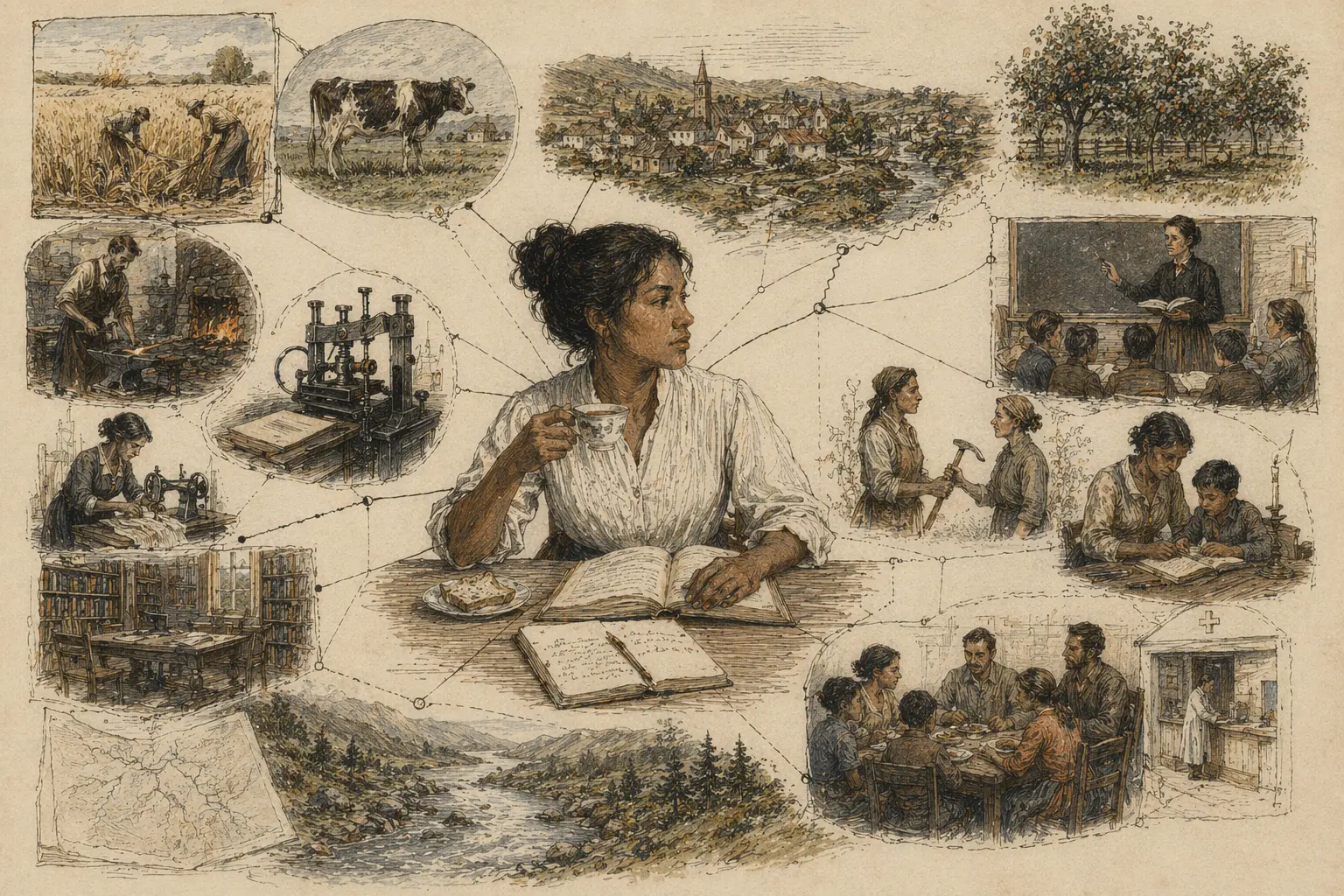
A table set for two, placed in the lanes. Nothing is wrong with the tea, and nothing is wrong with the table. What is wrong is where it has been put, which is the difficulty with expecting depth or peace from a channel built for volume.
As the traffic increased on these virtual highways, the initial promise decreased, but we kept trying to make it work. We adjusted our communication to soundbites and newsfeeds. Who has the time for depth or peace in traffic? But we also tried to bridge the gap by presenting our most attractive selves, or some version that could attract. As the forums that we had begun to rely on for human connection transformed into highways, so did the overall demand for each person’s attention. We naturally adjusted. However, this shift was not just in traffic or reach, it was that the initial promise distinctly shifted and expanded from consistently connecting with your community, wherever they are, virtual or actual, to connecting to many more imaginary others. This expansion played on our need for connection, promising us even more of the good stuff: belonging, opportunity, and affirmation. But this new version of the promise is one that will never deliver because it sells out quality for quantity. The consequence is a particularly superficial online life with superficial connections, if any. The superficiality is enforced by both the thinness of communication, the soundbites, as well as the need to present an attractive version of ourselves. Performance is fine. Life afterall is drag. But real human connection thrives on consistent, real engagement. All of you needs to be present, not just a superficial cutout.
With the emphasis shifting so that this online culture informs offline life, our capacity for human connection has diminished. Our ability to connect adjusted to that online promise and process. We fully adopted the superficiality of what we say and how we present ourselves, damaging our overall human connection on and offline. Soundbites and cardboard cutouts are not helpful for the kind of connection we need in virtual life and absolutely meaningless in real life.
We’ve ended up in a momentary limbo where the only tools ready to hand do not serve us at all, and at the same time we have let our abilities, reliable methods, and offline culture of connecting with each other suffer. Regardless, people return to these platforms and engage less and less, only when they have to, as the reward is meager. It makes no sense to get on a highway that just sticks you in traffic but doesn’t get you where you need to go. So we’ve stopped opening the app to connect with friends in banter as that is not one of the routes the platform serves anymore. As we wake up to the fact that the initial promise and function of what has become this virtual highway and its lifestyle does not serve us anymore (nor do the conglomerates that own them), the more we will move on to practices and processes that do.
In actual reality, in an actual city, in actual traffic, where everyone has to have a car, highways make more sense as wasteful as the whole agreement is. In a virtual reality, they make no sense. The terrain is wide open and the laws of physics do not apply. If our technology served us rather than the other way around, there would be community spaces online. Instead, we have let a few companies buy up all the imaginary landscape and then tell us how it has to be used. The tech they provide limits our choices to their highways and laws of driving. We are stuck in traffic, exhausting ourselves and wasting our time, but worst of all freely giving away our own wellbeing in exchange for little to nothing. Our cognitive abilities are diminished because we are continuing to participate in a virtual system that strip-mines human beings for quick gain. Our imagination and innovation suffer as well, two tools we need for our liberation as well as our wellbeing. We are stuck in an unnecessary, virtual traffic jam, just so others can make money off of us, when we could be riding flying carpets, brooms, or horses, with our friends.
Open sky, no lanes, everyone travelling as they like and still within speaking distance of each other. Nothing about this terrain required a highway.
Jaak Panksepp argued that the experience of feeling is the fundamental affirming state of existence, replacing the Cartesian “I think, therefore I am” with “I feel, therefore I am”. This multifaceted process of feeling arises from a “Core-Self,” a primal agency located in the subcortical midline structures of the brain. This Core-Self provides a center of coherence, allowing the organism to experience itself as a singular, motivated entity.
I would argue they are both right and more, “I think and feel therefore I am.” These infrastructures and processes are coherent, make sense and develop together. They are interdependent and mutually sustaining. Any demarcation between them is academic, which is necessary but demands humility.
I predict and process reality in ever progressive and developmental iteration, interdependent with my society, therefore I am.
This dynamic existence provides a stable, living process that forms the actual self of each and every individual as a unique being. I call it Cognitive Identity, the Iterative Self, to summon higher-order cognition (predictive processing, problem solving, fascinations, competencies, and skills) into the mix of one’s biology (genes and physical existence) through time.
Descartes established that there is an individual self through the very act of doubting there was an individual self, “I think therefore I am.”Jaak Panksepp believes that the Core Self originates from an individual’s ability to feel, “I feel therefore I am.”The Iterative Self: “I predict and process reality in ever progressive and developmental iteration, interdependent with my society, therefore I am.”
A four part series on what human beings actually are, the social ecology we depend on, and what to do about the world we’ve built that works against both.
The Coordination Paradox: Cognitive Failure at Scale
For the first time, global-scale coordination is technically and materially feasible. The major barrier is not raw capacity, but the abdication of our cognitive capacity to solve problems well. The failure to coordinate and instead extract is the result of higher level cognition enslaved to impulse infrastructures of the nervous system. The stable operational hierarchy – higher cognition recruiting impulse infrastructures for sustained, considered action – inverts under stress. Reason goes to the service of threat response instead of the other way around. The philosophies that defend extraction and hoarding practices sound eloquent and well reasoned. But they are the flailing of a mind driven by stress and the fears it produces – of the other, of scarcity, of submission.
That every empire writes its history to validate the right of the conqueror to conquer is a delusion firmly founded in a cycle of anxiety. The uniforms, ceremonies, flags and oaths are necessary to cover the underlying distress with solemnity. After a group wakes from the fever dream of subjugating innocent others for its own benefit, the brain’s neurocognitive systems that seek reciprocity begin to demand that the scales be balanced. The choice is to right the wrongs or rationalize the bloodshed and theft after the fact. The pomp and circumstance of any regime or business built on extraction doesn’t celebrate the truth. It is required to distract from and justify it. Deep within the brain, there is a still small voice of authenticity that knows that despite outward signs, these actions of extraction and failed coordination are an inelegant abdication of our cognitive advantage.
Extraction, in this context, is a deliberately lopsided value exchange. It also is short sighted, dependent on somehow “getting away with it.” Ancient traditions so valued “fairness,” a response so fundamental it registers in the brain before conscious reasoning engages, that they considered it a domain of the gods. Most cosmologies contain figures dedicated to the balancing of scales of one sort or another. The throughline is plain, actions that take more from society than they give are imbalanced. This archetype exists because it has deep, essential meaning to the human brain. That is to say, this would not be so meaningful if the foundations of authentic and fair social coordination weren’t built into our biology. Our biology requires such synchrony, the dynamic alignment between an individual’s internal states and their social environment, not harmony in a soft sense, but functional coordination that makes cognition and meaning possible. It is precisely within society that our cognition and lives make sense. Our sense of meaning and our sense of purpose are derived from our dynamic place within society. Therefore strip-mining it is as ugly and self destructive as strip-mining nature.
The valley that could have fed thousands. What remains when extraction replaces stewardship and the coordination at scale that we’ve proven we can do.
Despite evidence to the contrary, it’s possible that very few actually do “get away with it.” Most likely we are failing to attribute the actual cause and effect dynamics of such actions, especially when sustained and deliberate. The cost to the extractor is not only social – the neurological account is its own argument, and a consequential one. The brain’s fairness response is fundamental and pre-conscious. Theft and thuggery require constant cognitive overhead to maintain, justify, and hide, making it structurally expensive to the practitioner.
While we appear to have the capacity and resources to solve many of our most substantial challenges, we are failing to do so. Just as fight-or-flight is maladaptive to most daily challenges, so is any knee-jerk reaction to deprivation. What is required is exactly what our cognitive advantage facilitates, to problem solve resource management and value exchange for mutual sustainability and growth. For example, many nations are turning to authoritarian leadership in an attempt to resolve lack of opportunity and resources. The authoritarian direction is contrary to the cooperative coordination the present situation actually demands. Authoritarianism reduces trust, pluralism, error correction, and distributed problem solving (all needed for coordination at scale). Therefore it’s the wrong instrument for scarcity/coordination problems. Deprivation occurs largely through misallocation, faulty segmentation, and resource capture (theft). It is insanity that we accept that a very small few benefit so disproportionately from the effort of so many. However, we compound that lunacy when, in realizing that we do not have enough opportunity to respectfully earn reciprocal value for ourselves, we seek solutions that have nothing to do with the problem. We run up a tree when we should be calmly sitting down to work out the problem.
To build systems of extraction is to operate as though the human being is something other than what it demonstrably is: a coherent organism whose higher cognition depends on, and in turn sustains, a functional social ecology. Abandoning proper stewardship of our essential wellbeing individually and socially is costly enough. But extraction goes further. It actively destabilizes how the system works. That is the precise nature of the abdication.
Optimization: The Mechanism of Extraction
The misdefinition of optimization across industries provides one of the clearest insights into an ongoing abdication of higher level cognition in common business practices. What looks like aggressive strategy is actually reason conscripted by fear: a stress-captured brain inventing an incoherent and costly practice and calling it optimization. The practice is to squeeze maximum value from every node in the pipeline – workers, suppliers, customers, communities, infrastructure – while returning minimum value to any of them. The word comes from the Latin word optimus meaning “the very best.” There is nothing very best about this practice in action. A form of extraction, like all others, it affects everyone, even those benefiting only in the short term. A coherent and intelligent business strategy is dedicated to building sustainable value for its stakeholders. That must include the employees, vendors, and customers as well as the investors. But this strategy, designed to squeeze as much value primarily for a select few at the expense of all the others, builds nothing lasting for anyone. Solutions that only serve the short term benefit of a few at the cost of almost all else are evidence of substantial cognitive collapse under distress.
Business, as a practice of social exchange, is a factor of the biological imperative of our cognition, its development and operation. To undermine it, is to undermine yourself and your own near future. The neuroscience of fairness and reciprocity is well documented: the fairness response, the reciprocity circuits, and human sensitivity to inequitable exchange. Authentic value exchange is part of the intelligence of the biological infrastructures of our brain concerned with and dependent on social cohesion. To invent business practices, policies, and systems that position society as a resource to be mined and not an ecosystem to tend, is to embrace a cognitive dark age. There is nothing optimal about extraction. It doesn’t reveal cleverness on the part of these businesspeople, but instead cognitive failure.
Higher-level cognition used to only solve one or two needs/objectives while deliberately ignoring others is at the very least counterproductive. It is weak problem solving and is exactly what happens when impulse infrastructures of the brain commandeer reason to their limited cause. In this case, one of the essential needs being ignored is the stability of the neurocognitive ecosystem of the very actors practicing optimization. Regardless of whether one wishes to abandon their own cognitive capacity, establishing a social dynamic that undermines their own and others’ essential neurocognitive wellbeing for a buck is the equivalent of designing a large building with one toilet. Higher level cognition, training, and experience allow practitioners to handle complexity. The power of the experienced mind, as Elliot Jaques argued, lies in the capacity to hold multiple stakeholder needs across extended time horizons – the longer the arc a leader can genuinely account for, the more sophisticated the stewardship. This is leadership and should be the goal of any entrepreneur and institution.
Optimization, on the other hand, works in the opposite direction. The effects of the practice not only create a culture of diminished neurocognitive wellbeing, normally experienced as a sense of a loss of meaning and purpose, but is resource intensive in the long run. Optimization is a form of extraction practiced in value exchange in business. Extraction, among many other things, is poor resource management. Simply put, it is theft rather than stewardship. “Crime doesn’t pay” not because someone invariably goes to jail, but because undermining authentic value exchange is structurally costly. It does not make sense to the human brain and therefore is expensive to strategically maintain. In practice it burns through resources faster than it builds anything substantial. Optimization and extraction are the opposite movements of business development. For example, a new tech (like blockchain or AI) that’s deployed by a company whose managers are only focused on quarterly earnings is going to burn a lot more resources and take a lot more time to get to a workable iteration than it would if run by managers who can handle the complexity of actual reality and build a product that deliberately contributes to a healthy society. The latter builds on and enhances a social contract that values effective collaboration and authentic value exchange, essential to any endeavor and society. Consider “social media.” At some points it had a few potentially admirable purposes, but through a series of substantial business-model pivots, devolved into a bane of healthy society rather than a valuable contributor to it. This “technology” has made a few people very wealthy at the cost of so much to everyone.
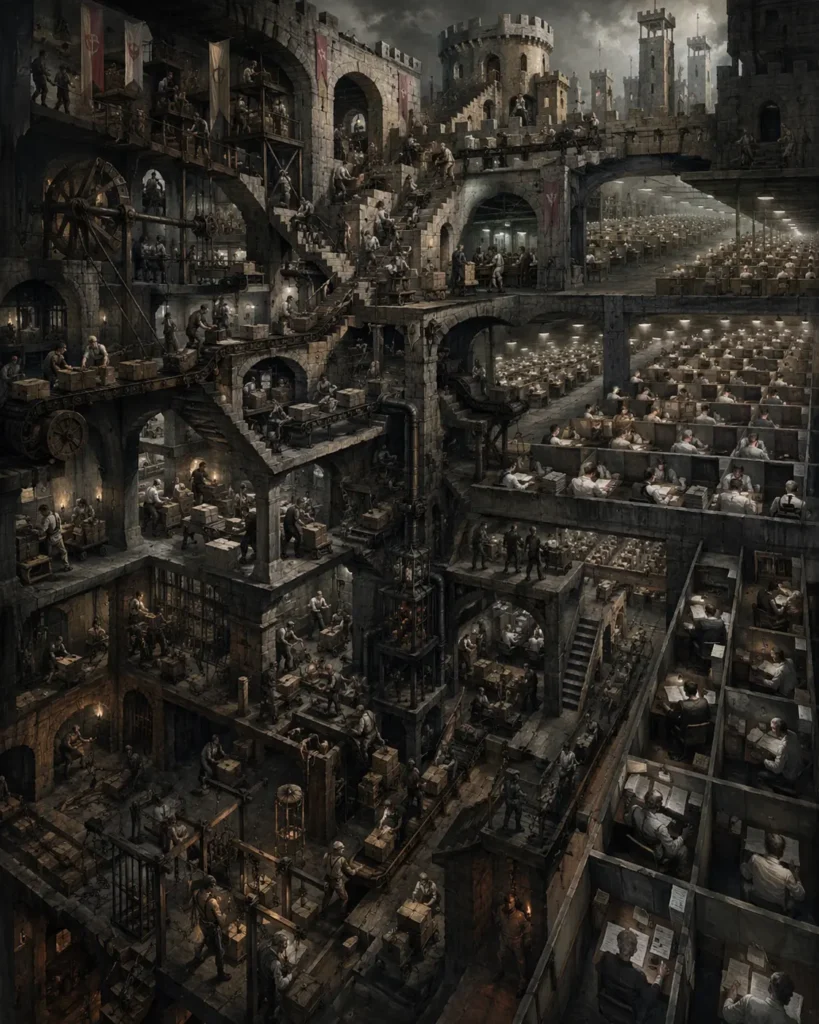
Contemporary enterprises are applying medieval logic to modern situations.
This is the actual condition of many large companies today, Google, Amazon, Meta, etc. They extract for a few and provide increasingly limited value to everyone else. In the case of the “distraction economy,” any business model built on the dopamine reward system, the collateral damage is the neurocognitive wellbeing for all involved. Clearly, this is not sustainable in any way and undermines individual and collective human survival, not to mention growth and development
Amazon has devised and deployed systems of optimization that create what seem like medieval conditions for those caught in its tortuous supply chain, with torturous conditions for workers as a feature, not a byproduct. The decision makers in this organization have invented systems that would be at home in pre-enlightenment Europe. If we thought we had left this kind of abuse in our past, we are sorely deluded. Neo-feudalism* accurately describes the aspirations of some of today’s “captains of industry,” particularly from the tech sector (which tells us a great deal about the nature of our tech today). Regardless of the socially regressive nature of such governance systems, the most alarming effect is the cognitive degradation it facilitates across the board. Simply put, any system of thought or governance that undermines a healthy and dynamic society where each individual has dignity, respect, and opportunity to exchange authentic value, achieves two results regardless of the intentions. It undermines the baseline of neurocognitive wellbeing and the cognitive development of all. In reserving “the best” primarily for those at the top, such a social contract reduces what is “best” across the board for everyone. A society where an individual brain cannot discern that its effort will bring reciprocal reward diminishes its sense of meaning and wellbeing as well as development. In such a dynamic, “best” is typically mediocre. In large corporations dedicated to optimization, the evidence is in what they produce, which includes their solutions, the quality of life of their employees, and their cognitive capacity and contributions, as well as their merchandise. For example, work at most major corporations today is notably devoid of purpose and meaning. One does not go to Amazon to do their best work at any level of the corporation.
The fact that one can clearly draw a throughline from the practice of “optimization” to feudalism is telling enough in regards to social justice and human dignity. But it interestingly reveals that those operating from this scarcity worldview are suffering from a persistent threat calibration in their brain. They have abdicated their higher level cognition, enslaving it to impulse infrastructures that are poorly suited to leading coherent thought.
The Ideological Arc: How Extraction Got a Philosophy
By the mid 20th century, it would have been easy to believe that we had evolved far beyond medieval feudalism and defeated imperial colonialism through enormous cost. During and after World War II, the world saw examples of our cognitive advantage at work, real coordination at scale. Stopping the march of authoritarianism – itself an example of reason conscripted by fear infrastructures – required profound higher-level problem solving across disparate groups and identities. It also required massive sacrifice for the greater good. Little of that sacrifice, collaboration, or even problem solving is valued now. Shortly after benefiting from the rewards of such coordination at scale, certain thinkers allowed scarcity worldviews to again draft their reasoning. They invented grand design theories: myopic, top-down cosmologies of economy that only make sense if you ignore most of reality. It turned out that we had only paused the march towards regressive social systems built on extraction and control. It is not a coincidence that this thinking is best evangelized through fear. It is the real god it serves.
Global coordination at scale is not a fantasy and has never been. The coordination required to defeat forces far more prepared and driven to brutality in WW2 is a prime example of what human cognitive capacity can achieve. What followed demonstrated something equally important: that coordination at scale produces outsized and sustained benefit. The Marshall Plan, the formation of the UN, and the emergence of the European Union – none perfect, but all significant – were attempts at coordination infrastructure that worked well enough to demonstrate the principle. Within the United States, Keynesian economics and the retain-and-invest model of managerial capitalism built the American middle class and produced the most broadly distributed prosperity in the nation’s history. While not perfect, these models were tested and worked.
In 1970, Milton Friedman published his seminal argument for shareholder primacy as an essay in The New York Times Magazine titled “A Friedman Doctrine: The Social Responsibility of Business Is to Increase Its Profits”. The foundations of his thesis had come earlier in his book, Capitalism and Freedom (1962). The problem that he and others in his camp were concerned with was the centrality of power in the hands of experts. The managerial class were the experts that made decisions for everyone, including shareholders. Having lived through fascism, they viewed models utilizing versions of this pattern as totalitarian and anti-liberty, and especially anti-individual freedom. At the same time, by the 1970s the Keynesian economic model seemed to be floundering, conglomerates were behemoths, stagflation was rampant, and change was slow. These are valid points and concerns. The dissonance is in the response. A coherent response is to utilize theories and policies as nothing more than tools. They should never become fixed doctrine or dogma. They may affect change, but quickly calcify and reproduce the same intransigent condition and problems that they were trying to address. Through the lens of our cognitive capacity and advantage, dogmas are at the very least lazy if not an abdication of coherent thought.
Friedman had valid concerns but let stress drown reason. Instead of honoring the complexity of good business, society, and the actual problems he was diagnosing, he reduced the truly worthy work of an actual business leader to cartoonish simplicity. He claimed that the corporate executive is an agent of the owners (shareholders) and their only social responsibility is to maximize profit for them. In context, his argument was a direct response to the errors he was trying to address. This is well and good. But it does not constitute an absolute, or doctrine for enterprise. Real human liberty requires engaging and trusting our higher-order cognition. This means that there will never be a one-size-fits-all solution to any problem. Instead we need a wide range of tools and approaches that facilitate our cognitive flexibility, not grand design theories. Friedman, instigated by stress, overcorrected. The job Friedman describes is not executive, it is administrative, which is what it has become today. Instead of experts, which are required for any worthy work, executives were reduced to faces. In many corporations other employees have far more substantial job descriptions. If these executives have only one job and it’s administrative, why are they paid so much?
Friedman’s argument, followed to its natural but catastrophic end, has become the dogma of optimization. It was not grounds for a doctrine, but a potential solution for a moment that ignored a great deal of context and reality even at the time. It would not pass muster in any other worthy domain. We would reject that the physician is an agent of the hospital board; their sole social responsibility is to maximize the biological duration of the patient. This ignores the quality of life, the relief of suffering, medical ethics, or the patient’s autonomy. In this view, a doctor who keeps a brain-dead patient on a ventilator indefinitely is “more successful” than one who facilitates a peaceful, dignified passing. The same for anyone who would claim that the teacher is an agent of the taxpayer; their sole social responsibility is to maximize the aggregate score on standardized assessments. This reduces children to data entry points. It ignores critical thinking, actual learning, character development, emotional safety, or the spark of curiosity. If a student passes the test but leaves school hating to learn, the “Friedman Teacher” has succeeded. We would never accept that the musician is an agent of the venue owner; their sole social responsibility is to maximize the decibel output for the duration of the contract. Friedman’s thinking applied here reduces art to acoustics. It strips away the emotional resonance, the cultural commentary, the technical mastery, and the soul of the performance. A jackhammer and a Stradivarius are equal in this job description, provided they both make enough noise to fill the room.
Constrained by an oversimplified cause and effect, Friedman myopically focused on the maximization of profit and fatally misunderstood the larger human ecosystem that made profit possible in the first place. A business leader who sticks to this doctrine soon loses any business to lead. Yet it has been the foundational theory taught at business schools for decades. Instead of presenting would-be entrepreneurs with a worthy cognitive challenge, one that provides meaningful work and a sense of purpose, it steers them towards cognitive mediocrity. It’s no wonder that large corporations are the burial grounds of innovation and start-up culture has been reduced to the get-rich-quick scheme of investor rounds for hollow businesses. We have raised an entrepreneurial class that instead of seeing themselves as essential to healthy society, thinks that they can have their cake and eat it too: they can benefit from society while strip-mining it.
Shortly after Friedman published his dogma on the why of cognitive abdication, Lewis Powell wrote the Powell Memo (officially titled “Attack on American Free Enterprise System”). This was the how. The title and text of his memo reveals the fear impulse on which it is grounded. Not only does he repeat the claim that business is under “attack,” but his memo is not a reasoned argument. It’s a manifesto repeatedly calling for aggression. His perceived enemies were a list of people who thought things, such as activists, academics, and theologians, as well as the media, which was considered a reliable institution then. His memo on how to abdicate cognitive advantage became the marching orders for a new generation of those willing to conscript reason and the power of the human mind to the impulse of fear.
The philosophy sounds reasonable, but comes from a mind in distress, incapable of a clear and accurate reading of present reality.
Neither of these two proposed empirical theories were refined by evidence and adjusted by consequences. Instead they preached dogmas, closed systems that succeeded by reducing reality to whatever didn’t challenge the thesis. This is a failure of the basic executive function of cognitive flexibility. Powell’s Memo goes farther. It advocates for a response to an invented conflict that deliberately uses the tools of reason against itself. He writes how to commandeer and shut down debate as well as deploy propaganda, all these tools used deftly by his disciples today. Consequently, from these false gospels of industry we get the legend of the “job creator,” all the more imaginary in the wake of layoffs in the face of new technology. Among other nonsensical beliefs, they rationalize the concentration of wealth as a social good. When the fear impulse is dominating reason, solutions and thinking do not adjust to reality. Instead fear tries to demand that reality adjust to it.
These men, operating with cognition conscripted by fear, stripped “American Free Enterprise” of its real value, power, and place, while desperately trying to achieve the opposite. We need enterprise. It has a legitimate and essential role in stabilizing and developing human cognition through authentic value exchange. Instead, enterprise, in their reductive vision, stands in opposition to what we would consider healthy society. It is its antagonist. They created a fight exactly where there shouldn’t be one. Treating profit as a sole objective of business, or social engagement as a battle, shreds the authentic human exchange we rely on for our baseline neurocognitive wellbeing and developmental opportunity. From here, there is nowhere to go but down. They were among the founding fathers of the abdication of our cognitive advantage right when we had begun to see the potential of what coordination at scale and human dignity looked like.
The Cognitive Diagnosis: Stress Placing Fear at the Helm
While optimization in this definition is clearly a strategic and moral failing, behind the scenes lies a series of cognitive failures of a specific and diagnosable kind. The scarcity worldview defines an eternal anxiety. It proposes a reality where there will never be enough. Instead of seeing the limit of resources as an opportunity to innovate, a brain committed to this perspective panics. It is a survival orientation even when survival is not threatened. The brain’s meaning-making processes run on an elaborate and refined prediction loop. The brain is constantly building its map of reality from experience and then checking that map against incoming data. Specifically it looks for data that it doesn’t expect so that it can keep the map up to date. That is except when the brain’s ecosystem is governed by stress. Stress biases the process, causing data to be misinterpreted and the predictions to go off course. Such a brain has positioned itself in a world of constant threat. It may be standing right next to you, but it is observing a parallel reality, and for certain reasons, cannot rationalize itself out of it. In this case, the threat infrastructures of the brain stay activated, commandeering the same higher level cognition that if allowed to, could properly resolve any actual threat to survival then return to a baseline of stable wellbeing. It is the neurocognitive equivalent between living in a home or a cement bunker.
Maladaptive stress responses cause the mind to never truly be at ease.
This is precisely why it is not helpful to follow a leader whose worldview is grounded in stress rather than one who is pointing to human potential. Such a leader will never be able to manage resources well, as their world is grounded in the fear that there will never be enough. They aren’t seeking to manage resources; they want to hoard them. Then only those closest to them should enjoy the spoils. I am sure certain contemporary “leaders” come to mind. These minds are driven by the persistent belief that there is never enough, therefore hoarding is always rational, cooperation is naïve, and the social world is fundamentally zero-sum. This worldview is a chronic miscalibration, a threat program stuck “on” when reality no longer justifies it. It is also a failure to manage threat responses, like fight-or-flight. In our connected world today this cycle of stress does not protect or facilitate survival, it fundamentally undermines it.
Stress also undermines the brain’s executive functions. As of this writing there are nine: inhibition, self-monitoring, cognitive flexibility, emotional management, task-initiation, working memory, planning/prioritizing, organization, and goal-directed persistence. These are cognitive skills dependent on neurological infrastructures which develop through childhood. They form the basis of what we consider the baseline of healthy operation for an individual and an individual in society. Certain neurodevelopmental conditions are associated with persistent difficulties in the development and operation of some of these executive functions. In these conditions, the neurological development and functioning that support particular executive capacities may differ in ways that make those capacities less reliable under ordinary demands. Everyone experiences moments of stress when these capacities collapse. For people living with some neurodevelopmental conditions, difficulties in these capacities can be more pronounced and persistent.
This diagnosis identifies three overlapping but distinct conditions. The first is a typically developing brain under sustained stress. With the right restoration it can be responsive to a stable environment and in principle recover the cognition that the stress collapsed. The second is a brain whose developmental environment, or whose present one, has produced a systematically distorted model of reality. This brain is operating within a worldview so consistently reinforced that executive functions, like cognitive flexibility, fail. Such a brain can operate with common sense and coherent problem solving in most situations, except where its distorted model of reality is concerned. The third is an actual diagnosable neurodevelopmental condition, such as ADHC. In that case, executive function may be restored with the right strategies and treatment. Unchecked, each condition produces maladaptive stress responses. Friedman focused myopically on the maximization of profit because stress reduced his vision to one factor among a multitude essential to the larger human ecosystem in which stable commerce operates. Stress in its right place is a coherent adaptive capacity suited to immediate, short-term problems. It is not only poorly suited to complex long-term problem solving, it actively blocks it.
It is important to note that groups of people, societies, do not have executive function nor cognition in the same way an individual does. They can and do share knowledge, emotion, and awareness. The distinction is important to avoid false cause and effects. A group is a dynamic and fluid collaboration of individual minds all of which themselves are dynamic and fluid. While not one mind, humans seek coordination as a baseline, it is built into our biology. An example are the elaborate infrastructures that monitor and reward equity in social interaction and exchange. At an early stage humans demonstrate rather advanced social awareness in this respect. By age 9, most children develop an “equal/multicentric” perspective, where they will actually sacrifice their own gain to ensure an equal split between others. However, just like with executive function, stress can throw a wrench into normal operations of the brain. Stress is a condition that humans can easily share. This is where we are collectively.
We are experiencing the results of decades of a functional failure to update: an inability to revise an inaccurate worldview when conditions change; a tendency to treat outdated threat heuristics as if they remain accurate, despite evidence and consequences. Hoarding vast wealth in systems where coordinated provisioning is demonstrably essential to survival is not leadership. It is miscalibrated survival behavior amplified by power. It is not “advanced.” It is archaic. It elevates thuggery – dominance, extraction, consolidation – over actual baseline human behavior and problem solving.
The “solutions” invented by a brain at the mercy of a cycle of anxiety may look sophisticated – complex financial instruments, lobbying infrastructure, ideological think tanks – but as evidenced by their results, are still a maladaptive threat response. These “solutions” are even elaborate, but their short-sightedness reveals that they fail miserably at the real complexity management our situation demands. They may be clever, like a heist is clever, but they are not wise.
Even on their own stated terms – if the genuine concern was the centralization of power in expert hands, or the inefficiency of state management, or individual freedom – a more nuanced and surgical correction was available and demonstrably achievable. The choice to dismantle rather than refine, to burn rather than correct, is itself the diagnostic evidence. Stress-collapsed cognition narrows the solution space to binary options: total control or total dismantling, state capture or extraction free-for-all. The middle ground – calibrated correction, targeted reform, stewardship of what was working while addressing what wasn’t – requires exactly the cognitive flexibility that chronic stress collapses. The Powell Memo isn’t evidence of sophisticated strategic thinking. It’s evidence of a mind that has reduced a complex coordination problem to a war, because war is the only frame available to a brain locked in threat response.
It seems that survival is a daily commitment regardless of your situation. You need consistent nutrition, rest in reliable shelter, and security. However, in a functioning society that’s not survival, that’s maintenance. Maintenance is easy, an administrative action. Survival is more dramatic, it deserves a threat response. Stress has invented problems that we didn’t have, like placing enterprise society at war. It has redefined maintenance as survival. Then it conscripted reason to invent solutions that ignore reason, like the Powell Memo. Then in the wake of the unnecessary destruction, the stress to justify the mess completes the circle. Modern existence, as well as development, depends on coordinated systems that handle complexity well. The anxiety cycle of the scarcity worldview is no longer merely archaic. It is structurally self-destructive.
The Connected World: Why Extraction Is Self-Undermining
“Don’t get caught” is a poor and unsustainable business strategy. It’s the thinking of thugs. The real delusion is not in not getting caught, especially in this case, because they have been caught. The practices like tax evasion, unearned subsidies, poor value exchange, hoarding of wealth, and other heists are all out in the open now. The real delusion is about what is actually being stolen from whom and at what cost.
Today, the scope and immediacy of our global connection means that anyone’s backyard is everyone’s. The truth is that it’s always been that way, it is only harder to ignore now. The real delusion of the cost of abdicating cognitive advantage and failing to participate responsibly in the maintenance and development of healthy society is similar to the practices that caused the climate crisis. In the end, it really doesn’t matter if a factory spewing toxic fumes is next door or across the world; the effects will eventually affect everyone. The cause and effect relationship in these situations is always complex as these practices affect ecosystems. That means they undermine the wellbeing of complex interdependent infrastructures and processes that involve far more than air. It is delusional to ignore the fact that in reality cause and effect relationships are not simple, one step lines, but complex networks. Given that many business leaders have proven that they lack the capacity to understand or manage complexity, it is understandable that they would miss this.
Extraction is a costly and unsustainable strategy that everyone pays for, including if not mostly those doing the extraction.
Despite what anyone may say, the invasion threatening societies today are not of poor refugees, but global conglomerates with no intention other than to extract value for their shareholders. These conglomerates take any legal form necessary to cross borders and extract wealth. The decision makers driving them consistently fail to demonstrate the necessary higher-level cognition required for real stewardship. They seem incapable of realizing that global society is now interdependent so that extracting wealth without an authentic exchange of value to all stakeholders (not just shareholders), undermines not only the wealth they want to extract but any sustainability to them as individuals or as a conglomerate because it undermines society. Due to global realities, undermining society anywhere is now to undermine one’s own society. The invaders have been invading themselves for sometime.
The Political Failure: Doctrine Defended Against Evidence
If Friedman and Powell are among the architects of our present incoherent social contract, Thatcher and Reagan were among the most effective subcontractors. Thatcher’s statement in a 1987 magazine interview that there is “no such thing as society” has been taken out of context, but not far. The full quote is, “And, you know, there is no such thing as society. There are individual men and women, and there are families, and no government can do anything except through people, and people must look to themselves first.” It is marked cognitive failure to praise individual responsibility while dismantling the social substrate that produces capable individuals. It is either propaganda or insanity. She does not demonstrate tough-minded realism but an utterly incoherent understanding of basic human existence and operation. Like Friedman, she lost sight of the context of reality that provided the greater structure in which the problem she was trying to address lived and so failed to understand the interdependencies and consequences. In her memoirs she defended quotes like the one above trying to argue context back in self-defense. It would have demonstrated greater cognitive integrity if she had sought to retain a coherent context of how individuals look to themselves in the first place. Then this particular misunderstanding would never have occurred. Instead, she was right, because of her and others like her, there is no society, at least not the one we need.
Political leaders who fail to comprehend the actual infrastructure of human existence and reality itself continue to compound problems rather than solve them. They have dismantled society and then blame individuals for the fallout.
That these thinkers and leaders continued to advocate for their theories and policies after evidence proved them wrong, reveals the same cycle of anxiety that produced the theory in the first place. The evidence they ignored was in living memory of what broad-based prosperity had looked like when coordination was actually practiced. A theory that cannot update when its consequences become visible is a doctrine. Sound theories that address complex and interdependent realities cannot be made as a knee-jerk reaction to problems. They need to be tested and refined, honed to ensure that the complexity is honored and holds. When rigid dogmas are applied to human governance, they do not facilitate agency or responsibility, as this one claimed to do. In the outward name of individual freedom while enslaved to a dogma, these leaders transformed essential and worthy institutions into extraction machines.
It is incoherent to undermine essential human functioning and then blame humans for not essentially functioning. Dismantling society and then blaming individuals for not looking to themselves is as illogical as dismantling democracy and then claiming it does not work. The trend has been to treat humans as less than they are then blame them for being ungovernable and unsophisticated. The cognitive failing is in the leaders, yet they blame the ones being led. It is the act of schoolyard bullies. The equivalent of tripping someone then blaming them for stumbling, on a national and global scale.
Society is a complex interdependent ecosystem, no element in it has just one function. Government is the formal structure of society’s organization, just like enterprise is the formal structure of society’s proper exchange of value. These institutions are the formal structures through which human cognitive capacity is collectively organized and expressed. Also, because individual cognition develops within social scaffolding, the health of those institutions and the health of individual brains are genuinely interdependent. Failing to see this basic reality reveals that the brains of those designing and defending dismantling institutions are in distress. These thinkers and leaders did not solve any problems, they invented new ones. The same applies for business leaders today. Led by stress and driven by fear they rationalized strip-mining an ecosystem we all rely on, making it unstable and depriving it of the very thing they were looking for. Instead of maximizing profits, they have made maximizing profits more difficult, unsustainable, and unreliable.
Stewardship at Scale
While the extraction world-view has produced many systemic moral failures it is the result of a series of cognitive ones. Invented by minds locked in a cycle of anxiety, it is an incoherent response to a problem of scarcity they imagined then made real and worse. The fact that today’s business and political leaders can’t respond to the evidence that extraction and hoarding are self-destructive reveals substantial cognitive inflexibility. Specifically, it demonstrates an inability to track the complex interplay of forces in which resources exist to manage them for stability. It is like playing jenga with systems everyone depends on. Proposing neo-feudalism as a solution to a developing dark age they are responsible for creating is cognitive failure, not problem-solving. They are not villains, but they also are not examples of the best of us; they are individuals running maladaptive threat responses from positions that amplify the consequences to scale. The diagnosis is not an exoneration; it is an indictment of the systems that select for and reward this mode of cognition. They cannot hold complexity, navigate context in real time, and prove and test workable solutions that create stable and reliable situations for all stakeholders. Unfit for stewardship, they lack the capacity for metacognitive leadership and problem solving.
We are at this moment precisely because the human capacity to develop something far better has been systematically underdeployed and undersupported. This is a developmental failure, not a species failure. The solution is already visible whenever coordination was actually tried and allowed to work. That means it is not utopian, but demonstrable and practical. Instead of abdicating our cognitive advantage to a cycle of anxiety that leads to self-destruction, we have the capacity for coordination and stewardship at scale for the benefit of all.
We’ve proven the ability for coordination at scale. We need leaders in business and politics that facilitate our developmental capacity, rather than block it.
Senate Health, Education, Labor and Pension (HELP) Committee: In late 2024, the committee released a sweeping 160-page report titled “The ‘Injury-Productivity Trade-off’,” documenting Amazon’s internal speed requirements and their link to worker injuries.
Trades Union Congress (TUC): The UK-based TUC maintains the “Challenging Amazon” report, which details practices such as surveillance, gruelling physical conditions, and the refusal to recognize unions.
*A good read on the topic is Yanis Varoufakis’ book Technofeudalism: What Killed Capitalism.
There are two big problems with using LLMs to replace human effort. Both stem from a misunderstanding of the word intelligence. Given the “intelligence” demonstrated by today’s captains of industry (especially those extracting value from society without giving anything back), we can be forgiven for mistaking what it actually is.
It’s understandable our present captains of industry don’t understand how the brain works when they barely use their own.
On Intelligence
Intelligence as a human or animal phenomenon, is a complex, multilayered and ongoing activity that involves, among many other things, interpreting signals through various biological infrastructures and cognitive processes. For the biological beings that do it, the majority of the activity happens so fast, we are hardly aware of it.
What we call AI is a wonderful invention in its own right, but not intelligence. We should stick to calling it an LLM.
The Faulty Foundation, an Archive of Incomplete Drafts
LLMs were built by scraping as much of human utterance as possible, with limited ability to distinguish the refined from the unrefined. Yes it’s worrying that copyrighted material was used, but the real problem is the foundation. The majority of human utterance is not worth reading.
We use expression and utterance as part of our ever ongoing process to navigate reality and make meaning. Even if it’s put out in forums, emails, journals, etc. the vast majority of it is unrefined at best. We think and operate in incomplete sentences, cobbled together on the fly. That’s the way it is supposed to be. Much of this is far from the end result of our intelligence, it’s the warm-up to it, us stretching our cognitive limbs and clearing our throats.
Then there is a large chunk of human expression that is more refined in a loose sense, but isn’t intended to be noteworthy. It isn’t exactly mediocre, but it’s not our best work. Or maybe it is mediocre, like poor movies, tawdry romance novels, etc. These have their place as well. But we would find university level coursework that intentionally trained you how to produce that laughable.
Neither of those two vast sources of data that were used to build LLMs are actually what you want creating the baseline of human expression or effort. Our sublime work is by default rare. There is no shortcut to producing it.
The Learning Curve of the Science of Human Development
The development of LLMs is somewhat parallel to the arc education through the 20th century. For the early part of the era, education involved rote memorization. A student would be lectured by a professor and be expected to recall the information from memory. In the case of literacy and numeracy the methodology involved memorizing multiplication tables and grammatical rules.
As the science of education developed, theories abounded on how a human actually developed mastery in any subject. As a kind of reaction to the drills of rote memorization, a movement that gained popularity in the 70s and 80s was grounded in notions of letting learners figure things out for themselves through exploration. The Whole Language approach was based on the belief that learning to read is a natural process, similar to learning to speak (it is not), and can be acquired through immersion and exposure rather than direct instruction. The theory essentially was that if a learner was exposed to enough input on the topic, they would discover the keys to mastery on their own.
This notion was incredibly naive and assumed a great deal about the subject being learned, the one doing the learning, and the context in which they are learning. Nonetheless it became the primary educational methodology in many countries through the 90s and early 2000s.
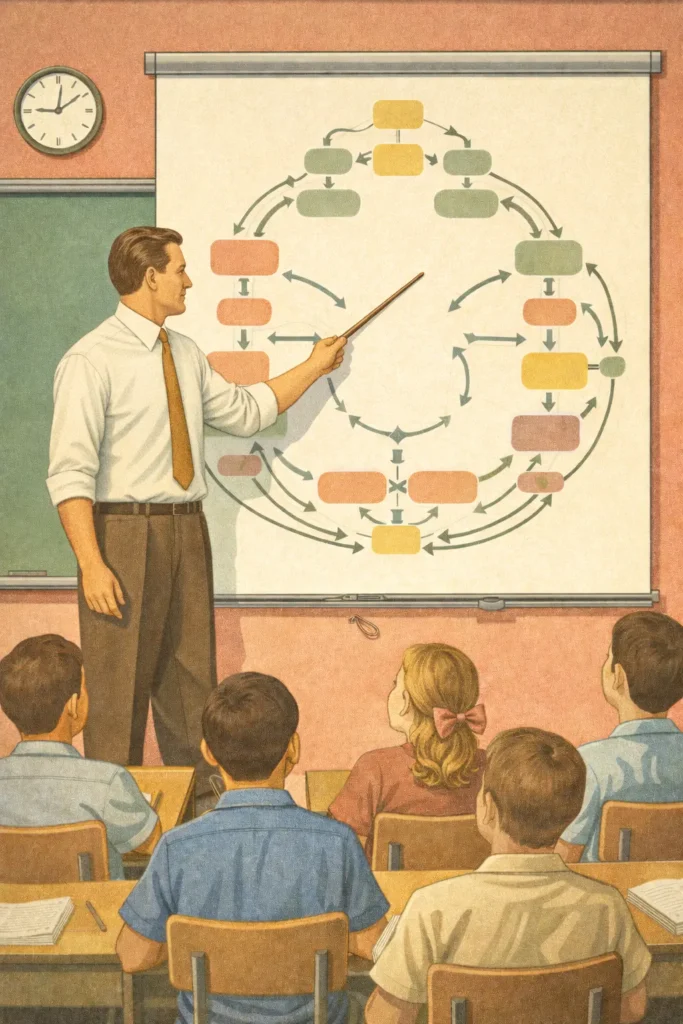
During this time, the biological study of the brain was developing, neuroscience. Now education is far more multifaceted. We understand that mastery of a subject involves all sorts of methodologies, but it basically comes down to common sense. You need to systematically and explicitly teach how to think about a topic in a contextually relevant way to each learner.
You can and should use discovery, memorization, and all the tools the human brain is capable of deploying as they are relevant to the specific learner and the topic. But before all that, you need a roadmap of how the brain will learn and use the information. You develop a progression of awarenesses that it needs in conjunction with procedural skills, a blueprint of what skills build on and support others, and a simple process for checking for the measurable development of all of them.
LLM development is sort of in its own Whole Language era.
The builders have yet to learn that osmosis is not a great teacher, or at least it delivers very unreliable and inconsistent results.
LLM development may be entering the phonics stage of education. This is a more systematic and developmentally sound approach but still lacks the individual context of the learner (we’ve since understood that learning is interdependent with context and have learned to adapt to diverse needs and strengths).
But the real problem is that those training LLMs are using a very different tool than a biological brain.
For much of the 20th century, education was grounded in rote memorization, which didn’t teach how to think, much less engage the higher-level cognition of the brain.
The Biological Brain
Without realizing it our process of making meaning involves filtering input that our nervous system is constantly collecting. Before we are aware of any of it, the nervous system has already run an active, goal-directed filter on incoming signals, suppressing what it expects, flagging what it doesn’t, and passing upward only what is relevant to what we are currently doing or trying to understand. This is not a passive sieve. It is a calibrated, continuously adjusted process, shaped by experience, context, and prediction, and it is already forming our sense of meaning before we’re conscious of it.
The nervous system generates a working model of reality in advance, which is context, and updates that model continuously against what surprises it. In this sense, the world we move through is not discovered but constructed, perception by perception, in real time.
This fantastic process is made possible through a multilayered infrastructure. Our way of making meaning includes internal and external systems, such as distributed cognition, so that we can retain and recreate a wonderfully complex and dynamic context. This is presumed and subsumed into all our thoughts and actions. We sometimes struggle to see it as we are so close to it.
We might not be able to remember where we left our keys, but we know intrinsically their place and importance in our world regardless.
A computer cannot do any of that. In fact, it may never do that (nor need to). We are not computers or machines. Any mechanical or computational metaphor that tries to describe how we think and do is missing the mark. Our intelligence is an internal ecosystem of interdependent infrastructures collaborating nonstop to interpret, form, and create the reality, which is the context, we find ourselves in.
Our intelligence is an internal ecosystem of interdependent infrastructures collaborating nonstop to interpret, form, and create the reality, which is the context, we find ourselves in.
The Dual Problem
So LLMs were built on “intelligence” we don’t want to or need to remember, and definitely don’t want to emulate. Secondly, they cannot retain context like we can. Input is not weighted the same as a human would, shaped by lived experience, relationship, and embodied history. So LLM output will struggle to be truly relevant to us without lots of human interaction.
The second part of the problem is not only a product of the hardware LLMs operate on in comparison to our own, but also a product of how they were trained. If you have been exposed to mostly crap, even when you are told what excellence looks like, you’re still more likely to default to the training pattern (well, not you as you are human and can actually learn and remember context).
The Real Solution
There is a very useful place for LLMs. Tech should enhance and extend our neurocognitive capability, strategically carrying the load that distributed cognition already offloads into the environment. It must seek to support the processes we’ve described here. Tools that do that are a different proposition entirely. Tech worth building understands and respects what we are and how we can develop.
Tools built to replicate or replace human intelligence will always fail because they are using the wrong tool to hit the wrong target. They are inherently self-defeating if not self-loathing. Understanding human intelligence well enough to reverse engineer it would only be a starting point. That bar hasn’t been cleared yet. This endeavor to replicate our mind doesn’t appear to be about bettering us or our lot. It seems intent on replacing us (as the tech is presently being used to do). You don’t replace that which you value, you develop it.
A four part series on what human beings actually are, the social ecology we depend on, and what to do about the world we’ve built that works against both.
Human development is an oddly expensive strategy: a large, plastic brain that takes years to become reliably functional, dependent throughout on sustained provisioning, protection, and structured learning. The question is what makes this viable, and what it requires. Bonobos and chimpanzees have childhoods lasting around fifteen years; male African elephants don’t leave the maternal group until a similar age, spending the following years in bachelor groups before reaching independence — and don’t reach breeding maturity until around forty. The reason in each case is the same: what’s being developed is complex cognition and social language, capacities that take years to master and that only mature inside sustained social environments. The long developmental arc exists because of what it’s building. Sociality is part of the development itself.
The evolution of human childhood and society didn’t happen overnight. It was a risk that must’ve proved stable enough for it to have survived.
As expensive as this process is, in the right conditions and with the right constraints, it affords more advanced capacities for existence. It’s obvious that a long, resource intensive developmental arc interdependent with sociality is a luxurythat’s not for all species. Chief among those capacities is cognition. In the case of humans, the interdependence with society means that higher-levels of cognition provide, facilitate, and depend on societies of more nuanced complexity, creating an iterative, mutually developmental ecosystem. While humans are not alone in having a long road to adulthood facilitated by a society, they are unusual in the complexity of that development, its corresponding society, and the potential afforded by both.
The long childhood requiring protection, instruction, and shared knowledge, becomes an advantage when a community turns danger into knowledge. In a world of predators, the real power is learning together.
While a luxury and potentially fragile, complexity is often a byproduct of existence. Stephen Jay Gould proposed a “Left Wall” that represents the minimum level of complexity for life to exist at all. Most life tends to stay near this wall. Since life involves growth and mutation some organisms have followed a random “walk” away from it into a “right” tail of higher complexity. The same general arc has been observed in other spheres. The “Mineral Evolution” theory proposed by Robert Hazen argues that the Earth began with only about 12 species of minerals. Today there are over 5,000. A large portion of this “geological complexity” was actually triggered by the rise of life (the Great Oxidation Event – to which we were all apparently invited), showing that these realms are deeply interconnected. It is important to not take this effect too far. If complexity were a “law” of nature for all species, we would be having deeper, two way conversations with our pets, and bacteria wouldn’t be the most prolific organism on the planet.
The Law of Increasing Functional Information seems to sum up this process well without imposing a deterministic plan, a teleological direction, or forgetting that complexity is still a “luxury” (not for every species). Essentially, this theory suggests that complexity isn’t “destined,” but is common in any system where different configurations are tested and the ones that “work” (for stability or reproduction) are kept. It’s a helpful refinement of the thought of complexity because it doesn’t define complexity as complexity for its own sake; existence is not a hoarder. But that complexity develops when it works, providing stability and being replicable. This is relevant to humans as it supports the point made in part 1: we evolved as a unified whole, a layered self-contained ecosystem with biological infrastructures that enable fast, impulse systems and higher-level cognition. The system is elegant and time tested, while still in long-term development. Our layered internal ecosystem is not a machine but a complex interdependent set of dynamic elements and states that require respectful stewardship to function well. In turn this internal ecosystem is interdependent with a social ecosystem requiring the same attention, care for sustainability as well as development into its full potential.
This existence evolved without intention or plan, but that doesn’t mean that there is no optimal state, a range of conditions under which the system functions well. It also means that there is no “mistake.” The long, rigorous feedback loop of evolution results in stress-tested, stable systems. Persistently unstable systems don’t persist. Complexity however, tends to introduce fragility. But it is important to use this term in context. Human existence, interdependent with society, may seem “fragile” compared to the existence of bacteria. But it is resilient, adaptive (facilitated by the cognition it enables), and has demonstrated a capacity for continued development. If we were to infer any absolute morality in such an existence, it would be between stewardship vs abuse. Abuse undermines stability as well as optimal functionality. Stewardship – acknowledging the reality of human capacity, potential, actual need, and the actual environment – seeks coherent harmony with all the factors to facilitate as optimal an existence as possible.
Extraction without constraints exhibits a collapse of the cognitive advantage we evolved for baseline wellbeing. The fact that it demonstrates short-term gain for a few into long-term debt for all, is particularly maladaptive and self-destructive.As our biology and sociality demonstrate, constraints are essential to our existence and development. Industry can easily be designed to collaborate well within the ecosystems it operates.
Higher-level cognition, including its capacity to recruit and shape impulses, matures through structured development. It requires sustained feedback, correction, modeling, and shared attention, the steady calibration a solitary environment cannot easily provide. Also, as it matures, it depends on society in which to operate and continue to develop. Cognitive stagnation is not conducive to human wellbeing. Cognition and society are mutually stabilizing while fostering mutual nuanced development. The point is not that individuals cannot think alone, but that the kind of cognition that can track complex reality, updates, and coordinates under constraint is trained and reinforced inside a social environment that can provide repeated, structured learning across time. In a fundamental sense, society in some form is a biological imperative for us.
The Child as Alchemist: Our evolutionary advantage is our capacity for higher-level cognition and learning. Ignoring this capacity, especially in educational and professional spheres, is like having a race car you only take out to buy groceries.
This higher-level cognition, nor its capacity to recruit impulses, does not mature without structured development. It requires sustained feedback, correction, modeling, and shared attention, the steady calibration a solitary environment cannot easily provide. Also, as it matures, it depends on society in which to operate and continue to develop. Cognitive stagnation does not appear to be conducive to human wellbeing. Cognition and society are mutually stabilizing while fostering mutual nuanced development. The point is not that individuals cannot think alone, but that the kind of cognition that can track complex reality, updates, and coordinates under constraint is trained and reinforced inside a social environment that can provide repeated, structured learning across time. In a fundamental sense, society in some form is a biological imperative for us.
This is also why society is not the same thing as a crowd. A herd can be an aggregation, bodies near bodies for protection or convenience. A society, in the sense that matters here, is an ecosystem of complex coordination: people cooperating across time through shared norms, cumulative teaching, and the storage of knowledge outside any one mind. When that exists, cognition becomes more than private cleverness. It becomes collective problem solving, distributed competence, and the ability to manage shared constraints through coordinated action rather than through isolated improvisation. From a biological perspective, society forms the foundational “purpose” of each individual’s existence in a state of fluid interdependence. In an efficient framework, your unique way of making meaning, your skills, interests, and quirks will facilitate your contribution to your group, forming a large part of what makes life “meaningful” to the biology of your mind.
Human existence and development is ecological: layered within, cultivated without. It requires respect, authenticity, and responsibility for proper stewardship
A community is a role-differentiated coordination system with reliable handoffs and shared norms. Role differentiation is necessary but not sufficient: it can exist in arrangements that are coercive or extractive, where the “handoffs” serve power rather than coordination. The distinction is whether roles are organized to support reciprocity, error-correction, and mutual dependence in a way that stabilizes learning and cooperation over time. In a functioning community, roles are not static identities carved into stone. They are adaptive and revisable as people grow, contexts change, responsibilities rotate, and new needs create new forms of contribution. Individuals do not merely “join” society; they develop a distinctive way of making meaning within it, a cognitive identity that shapes what roles they can inhabit well and how they strengthen the whole through their particular constraints, sensitivities, and skills.
Institutions are the durable scaffolds of this ecology. Institutions are not cognition, but they are externalized cognition: collective memory and coordination technology, such as laws, norms, infrastructure, accounting systems, public health systems, and education systems. At their best, they stabilize cooperation, reduce unnecessary conflict, and protect the long developmental runway that advanced cognition requires. When they fail, the correct diagnosis is not that society is irrelevant, but that the scaffolding is misdesigned, captured, or miscalibrated to reality. Part III will argue that the modern world has made coordination at scale materially feasible while also making failure at scale far more consequential, especially when institutions are shaped by chronic defensive postures or extraction incentives that degrade the very social substrate they depend on.
The human being is coherent: a stable, interdependent ecosystem shaped by evolution into reliable function. That coherence is the starting condition. It requires sustained effort to tend it: coordinating the many signals and needs of that ecosystem, across time, in genuine alignment with reality. This is what coherence demands of us as individuals. Society is where that demand scales. The social ecology isn’t the place we go after we’ve sorted ourselves out; it is the developmental environment inside which sorting ourselves out becomes possible at all. To ignore one is to misunderstand what both are.
Humans are a layered internal ecology whose higher cognition develops and functions best inside a social habitat. Society is the precise developmental environment that real life requires. Neither utopian nor sentimental, the implication is practical stewardship: designing our local communities and our institutions to protect the long runway of human development, to make roles adaptive rather than rigid, and to treat diversity as a coordination asset instead of a management problem. We already possess tools – measurement, communication, education, and systems design – that can scale this kind of coherence, but only if we stop treating people as crowds to be controlled and start treating society as an ecosystem to be kept healthy.
Building on what small-scale human groups did well: clear role differentiation, mutual accountability, shared purpose, and tight social feedback; we can design modern local communities that meet our biological needs while handling far greater complexity.With modern conceptual tools and an increased capacity to manage complexity, we can design contemporary local communities that preserve those structural strengths while adapting to present realities.
The aim is not nostalgia or perfection. It is coherence: communities that diversify roles, adjust dynamically to changing conditions, and support stable, long-term wellbeing
Clinical meaning, personal responsibility, and the practice of deliberate skill.
Neurodivergence is not an excuse. It is not an identity. It is not a diagnosis. In fact, it is not even a particularly useful description of a person or of any condition.
The experiences people have gathered under the term are real. Autism Spectrum Condition, Attention-Deficit/Hyperactivity Condition, dyslexia, and other neurodevelopmental conditions are real. Persistent difficulty with attention, sensory input, planning, learning, emotional management, communication, or getting yourself to do what you have already decided to do can have serious effects on daily life.
The problem is the actual meaning of the term versus what it intends to achieve.
The Terms
Neurodiversity describes variation in neurological development, organization, and functioning across human beings. Everyone’s experience of neurodevelopment is unique to them. The specific structure and operation of each person’s neurology is also unique. Additionally, each person is developing and operating in real time under real conditions that influence both. We only see some of the results of that development and structure in observable behavior. The truth is that neurodiversity accurately describes the variation of all human beings.
The later terms neurodivergent and neurodivergence were coined to identify people whose neurological functioning differed from what society treated as typical. They emerged from advocacy and helped many people explain experiences that had previously been dismissed, moralized, or treated simply as a defect. The intention was for social justice, and while the terms have become overused and misused as diagnoses, identities, and the like, that misuse provides us an opportunity to step back and adjust for everyone’s benefit and understanding.
Divergence describes a relation. Something diverges from something else along some particular measure. For example, you and a friend are walking down a path and at a crossroads you take different paths. That moment, the separation, the act of taking different directions can be described as a divergence. Past that moment, the term is a bit of an overkill. To describe one path as divergent is to immediately describe the other as normal, common, expected, etc. It is just like claiming you are an outsider. What you may really be describing is that in some things you act or behave “outside” the expected or common norm. It only makes sense in relation to being inside. If you are always outside, never inside, then you don’t belong in the group description at all. It would be like defining yourself as not Chinese when no one ever thought that you were.
In regard to neurodevelopment and neurological function, the term divergence isn’t as helpful as diversity, as explained above. There is no proper path of neurodevelopment, just as there is no proper human body. The word normal is unhelpful in describing neurodevelopment as it is in any other meaningful aspect of human existence as it suggests something that actually doesn’t exist. There is so much variation that any person can be “normal” in some things and not in others so that normal becomes meaningless. Also, we cannot point to someone’s neurodevelopment in any meaningful way like we can point to their development in learning a language or how tall they grow. Neurodevelopment is a lengthy process lasting well into the 3rd decade or beyond of a person’s life. All the while their neurology is functioning. That functioning influences the development, the two are in a kind of iterative conversation. All this is happening in real time under real conditions. Those conditions also influence development and functioning in various ways. There is so much variation in all of this as no one is exactly the same nor living the exact same experience.
What the term was trying to do was come up with a label that would help bridge understanding and give people who have the conditions described by it the space and freedom to be themselves and build worthy lives. To do this, it was trying to connect the important fact of diversity in human neurodevelopment with a set of clinically defined conditions, at the time mostly ASC, that result from variation in development and are themselves identified largely through what can be observed in behavior and functioning. Then it tried to connect all of that to the whole human being experiencing it and make the result useful as a label. That is a great deal of work for one word. The label was attempting to create a shortcut across several different kinds of information, none of which completely describes the person in the first place.
The real problem is not the term itself, and definitely not the intention. The problem is with the nature of labels. There is no label that will do this work effectively, especially not in daily life. The only label that can provide any meaningful description of who you are is your name.
The Problem with Labels
A whole person cannot usefully be described by a label.
Once neurodivergent becomes a category of person, it stops telling us what differs, how it differs, from what reference, or what any of that means for the particular individual. Two people described by the same umbrella term may have profoundly different development, functioning, needs, difficulties, capacities, and lives.
If you have found the term useful for recognizing something about yourself, that recognition does not suddenly become meaningless. Quite the opposite. It may be the beginning of a much more useful inquiry. The important question is what you were trying to describe.
Labels are useful when they invite welcome and helpful responses. For most reading this these are useful almost exclusively in the clinic, where insurance, medication, and other treatments are used accordingly. A label of a diagnosis is a tool. As a tool it fails miserably when used to describe a person or even one person’s experience of a condition. ASC, ADHC, dyslexia, etc. describe broad kinds of neurodevelopmental conditions. Each individual will experience them very differently, especially because they are observed in real life, under actual conditions and in real time. Even within those terms there may be general degrees of severity across experience and time. The spectrum described is really more like a nebula of existence and experience. This is all to simply demonstrate that the tools of labels need to be used carefully and strategically outside of clinical or research contexts where they were invented.
The term neurodivergence is a particularly unhelpful label. It seems to explain something real. But the more you dig into it, it does three things that are not so helpful at the same time.
First, it divides those who are divergent from those who are not and adds a valuation to each. It creates categories of people which is not only not accurate, it is not helpful to the term’s goal. Labels that create categories of people, come pre-embedded with evaluations on those categories. It is particularly problematic to describe yourself as “divergent,” as it means some form of not-normal. Yet the intention of the word was to normalize neurodevelopmental diversity. Since the label refers to the way you are constructed, that error is not something you can address. It makes sense then to think consciously or not that you are inherently broken and worthy of judgement. When I think of myself as a handful, I tend to make it true by acting and reacting in that unhelpful mindset. In those moments I don’t need to discipline myself. I definitely can’t address the situation with a different label. I need to observe myself from a different perspective, one that doesn’t separate me from others. Using labels like this subtly reinforces the evaluation they were trying to avoid. If the term neurodivergent is meant to remove judgement and evaluation from a person’s sense of self, it is particularly bad at it as the entire point of categories is to do exactly this.
The second problem of the term neurodivergent is that the category removes one group from the concern entirely and fixes it squarely in the beings of the others. Regardless of what it originally intended, it claims that there are those who are normal and do not need special consideration who are distinct from those who do. At best maybe that invites pity. It makes the topic of neurodevelopment and its role in neurological wellbeing “someone else’s problem,” instead of a concern for everyone, which it most definitely is. If you use it to describe yourself, the default imposes that something is wrong with you. The concern is centered within you, not the environment, a process, or other important factor that may also relate to others (see the Opportunity and Social Conditions below). Fixing the situation inside you not only absolves them of “responsibility” but denies everyone else the possibility of seeing how they are affected by conditions when it would be most helpful. A good example is technology that relies on distraction, like social media. For those with certain conditions, it is a nightmare that makes sustaining wellbeing more difficult while offering a temptation hard to avoid. The truth is it is detrimental for everyone period. It is not a degree of detriment. It is just more noticeable for some more than others. But no one is immune.
The third problem of the term neurodivergence is also true of using any label as an identity: it is not up to the task and really doesn’t say much of anything that’s useful for describing an actual person. Inside the clinic, the specific diagnoses of ASC and the others start an investigation and treatment process, typically interventions are tried until the right combination is discovered that stabilizes the patient. The process hopefully continues through regular checkups and as new treatments and knowledge emerges. Outside of the clinic the terms are useful to help others understand your stabilization treatment process. They do not tell them who you are nor give a coherent reason as to why you may do certain things or have certain needs. They definitely don’t explain anything enough to excuse most behavior. When these terms are used as an identity they don’t even help answer the question, “then what?” Using any of them as an identity in this manner makes them a fixed thing to be navigated around. Instead of describing a dynamic process that you are working with, they are like a monolith that represents you. The very act of investigating and exploring necessary to building awareness is stopped as it is like questioning your youness.
Additionally, neurodivergence is a particularly unhelpful term for building shared understanding as it doesn’t mean anything concretely. It tends to be more of a performance of identity than a bridge to awareness (although, my particular experience of ADHC means that I rather enjoy performances). Divergence actually pushes others away, it says I’m different without describing in any way how. The term would be most helpful if it were able to describe the important and rich experience of neurodevelopment and neurological functioning that are realized in real time under real conditions for everyone. Neurodivergent also cannot be used to describe a person as a person does not exist in a state of divergence. They may have a condition that originated in their unique path of neurodevelopment, but that only describes part of how they are specifically neurodiverse, a quality shared by all humans. If the term is meant to build bridges of understanding, then again it is better to be more specific as well as use a kind of term in a way that doesn’t suggest an identity, something core to a person’s existence. It is more logical and helpful to say, “I have ASC,” or ADHC, rather than, “I am ADHC.” Even in the clinic this would be nonsensical. You can say, “I am autistic,” as the adjective form helps set up the next useful question which is “how?” The same applies to the adjective hyperactive. Either way, from there you start building bridges of understanding. The problem with the term neurodivergent (and the wrong use of neurodiverse), is not only that it immediately describes a category of person and is commonly used as a fixed label of identity, “I am neurodivergent,” which evokes the category and evaluation process it was trying to avoid.
Neurodivergence claims perpetual abnormal status for a person rather than describing how everyone is neurodevelopmentally diverse and in the end it describes nothing accurately or helpfully enough to serve as an identity, diagnosis, or even a social justice term.
We do not need more labels. We need to use a few in the right way in the right context. What is really needed is a shift in shared knowledge about neurodevelopment and neurological functioning for all. That is not achieved by a shortcut (label). The labels are getting in the way of that. What will work is an ongoing discussion, at times educational, always a conversation (a real exchange) to build practical and basic shared awareness that then can benefit everyone.
Two ordinary groups become different kinds of people only after the labels are applied. Against intention, the second category separates the people with neurocognitive variation and makes the very important topic that affects everyone somebody else’s problem.
The Facts
Some of what people recognize when they encounter descriptions of ASC, ADHC, dyslexia, and related conditions occurs throughout the human population. Everyone becomes distracted. Everyone can become overloaded. Most people occasionally have difficulty beginning something they intend to do, organizing several demands at once, managing emotional intensity, or shifting their attention when circumstances change.
Under stress, these experiences can become considerably more pronounced.
That is one reason symptom lists are so seductive. A person reads one and thinks, “I do all of these things.” Probably. The clinical question is distinctly different.
Clinical diagnosis is concerned with the pattern: how intense an experience is, how persistently it occurs, how long it has been present, how broadly it affects functioning, and whether the effects are substantial enough to require treatment, accommodation, or other support. A familiar experience is not automatically a clinical condition merely because it appears on a list.
ASC and ADHC are highly heritable neurodevelopmental conditions. They do not suddenly develop in adulthood, even when their effects only become obvious or difficult enough to require diagnosis later in life. A change in environment, responsibilities, stress, or available support may expose patterns that were previously less visible or easier to manage. That is not adult onset. It is a neurodevelopmental condition becoming more consequential under different conditions.
Self-recognition can still be extremely useful. It can prompt investigation. It can give language to something that has been difficult to explain. It may even be what eventually leads someone to seek a professional assessment. It is not the assessment itself.
When a neurodevelopmental condition is seriously interfering with ordinary functioning or baseline wellbeing, the clinical response can operate as triage. Its immediate concern is to identify what is happening accurately enough to mobilize appropriate support and stabilize the person’s situation.
In that context, diagnosis matters enormously. But it also has important limits.
A diagnosis identifies a clinically meaningful pattern. It does not describe the whole person, their complete neurological development, or what that development may make possible across a lifetime.
Responsibility is not control. The sailor cannot command the wind, waves, or weather, but can learn the conditions, use the resources available, and participate intelligently in what happens next.
The Responsibility
A neurodevelopmental condition that substantially affects your daily life creates a practical responsibility to understand and manage it as well as you reasonably can.
Responsibility must be considered outside of judgement or blame, just as a thing to do.
It does not mean you caused the condition or chose its effects. And it most definitely does not mean you can simply reason your way out of them. It does not mean performing “normality” (whatever that is) more successfully. This will never work. It means taking seriously the reality of the condition and its consequences.
If ADHC repeatedly interferes with beginning tasks, keeping track of commitments, directing attention, estimating time, or sustaining effort, knowing that you have ADHC is useful information. The work then is simply learning what those difficulties look like in your actual life and which conditions, strategies, tools, treatments, routines, environmental changes, and forms of support make your functioning more stable.
The same principle applies to ASC or another neurodevelopmental condition, although the actual work may be completely different.
Excuses are not helpful. Explanations are, and when necessary, apologies are. If an apology is in order, explaining why something unfortunate occurred matters less than explaining what you are going to do to help prevent it happening again. Otherwise excuses tend to become weapons, used offensively or defensively, that help no one and build no bridges of understanding.
Responsibility starts with the individual but must be shared by the community. The benefits and risks affect everyone.
A person cannot personally manufacture accessible healthcare, change a workplace policy they do not control, shorten a diagnostic waitlist, create family support that does not exist, or simply decide to have more financial resources. Some people are genuinely blocked from assessment and care by cost, geography, institutional failure, prejudice, or circumstance.
Responsibility correlates to actual agency.
The individual has responsibility for the parts of the situation they can meaningfully tend. Families, workplaces, clinicians, communities, and social institutions have responsibility for the conditions and resources that belong to them.
That exchange matters because none of us functions independently of the environments and people around us.
Important Aside
I love the fact that my brain works the way it does, most times.
When it seems it isn’t working, it’s hell. The fragility of emotional stability is particularity frustrating. It seems that I live with a baseline of anxiety that sometimes is background noise and sometimes threatens to drown me.
Although I’ve developed how to set up environments and lifestyles that leverage my particular brain infrastructures for my wellbeing, it’s not easy. I exhaust myself. Shame seems to be more if a constant than anything else. But it doesn’t have to be this way. That’s why I wrote this article.
The term neurodivergence signals a grave opportunity, both terrible and fantastic in it’s potential. If we build social structures around a respect for neurodivergence (just respect in general would be a great start), we can recruit it to our benefit. It can support communities of mindfully wellbeing, treating the brain as a garden to tend, not a machine to fix.
The Opportunity
Stabilization is a lifelong process and also the grounding of even more opportunities for development.
Once a condition is understood well enough that someone can begin building a sustainable baseline of wellbeing, another question becomes possible: what capacities may be developed from this particular configuration?
That question needs to be explored with great care.
A neurodevelopmental condition is not secretly a superpower. Severe impairment does not become an advantage because we give it more flattering language. Some people require extensive support throughout their lives, and some effects of a condition may remain difficult regardless of how thoughtfully they are managed.
But a trait that creates substantial difficulty under one set of conditions can operate very differently under another. A person may learn to understand it, support it, refine it, and eventually recruit some aspect of it deliberately.
For a deliberately non-scientific example, consider almost any X-Men film.
The mutation that eventually becomes spectacularly useful normally begins by destroying a kitchen, terrifying a school, or otherwise causing the kind of problem nobody would initially describe as a gift. The character needs support, practice, a community that understands what is happening, usually some specialized technology and, apparently, an excellent outfit.
The analogy only goes so far.
The useful takeaway is the supported and structured development, as well as its use. A capacity does not become reliable merely because it exists. Something initially experienced primarily through its costs may become more usable through sustained understanding and practice.
That possibility varies enormously among people and conditions. It should be explored and investigated rather than promised.
The Collective Opportunity
There is another opportunity here, and it is larger.
People living with certain neurodevelopmental conditions often have to make explicit work that other people can leave largely implicit.
Attention may need deliberate structure. Working memory may need to be extended into lists, visible cues, calendars, staging areas, reminders, or physical objects. Tasks may need to be broken into visible sequences. Recovery may have to be scheduled rather than left to chance. Environments may need to be changed so that unnecessary sensory, cognitive, or emotional demands are reduced. Supportive relationships may become part of the practical system rather than something separate from it.
I sometimes refer to this as externalizing the brain.
Nothing about a checklist implies that the person using it is defective. Pilots use them. Surgical teams use them. Kitchens run on mise en place. Humans routinely move cognitive work into environments, tools, procedures, and other people because complex functioning has always been distributed that way.
For someone whose functioning makes the dependency more obvious, these strategies may be necessary for stable daily life.
That necessity makes something visible.
This is why the neurodevelopmental conditions examined in the Neurodiversity Protocol provide such a useful test environment for understanding human functioning more generally. When compensation is substantial, dependencies between attention, cognition, emotion, effort, environment, and community become harder to overlook. Strategies that genuinely improve functioning under that degree of variability may reveal principles useful far beyond the diagnosed population.
The work is more obvious there. It is not exclusive to there.
This is one of the genuinely important opportunities within neurodiversity. Human neurological variation gives us many different configurations through which to observe how human beings function, develop, compensate, specialize, and contribute.
The value is not in sorting those people into a second type of human being.
It is in learning from the variation.
The Opportunities for Society
A neurodevelopmental condition belongs to the person, but its functional effects occur under actual conditions. Those conditions are really the key, even more than the name of any one person’s or even a group of people’s neurodevelopmental conditions. They provide clues to what everyone can find helpful for mental wellbeing.
A person who has difficulty sustaining attention across diffuse, low-relevance demands may function very differently in an environment with clear structure, immediate relevance, meaningful feedback, and visible progress. Someone highly sensitive to sensory input may experience substantially different functional costs in a chaotic environment than in one where noise, ambiguity, and interruption are reduced.
Obviously, environment is an important factor, among many, for helpful neurological functioning. This example demonstrates for anyone how neurological functioning (including our thinking and feeling that spark our behavior) happens through interaction between the person and the conditions in which they are functioning.
Modern life is unusually good at producing difficult conditions. Many people now work inside communication systems built around interruption, compete for attention inside environments deliberately engineered to capture it, navigate inconsistent social expectations, and are asked to maintain levels of individual self-management that communities once distributed among many people.
Those conditions can make existing difficulties much more costly. They can also create similar temporary difficulties in people who do not have the underlying neurodevelopmental condition.
This is a very important distinction. It is the same as reading a list of symptoms. Everyone being distracted does not mean everyone has ADHC. It may mean we have constructed environments in which sustained attention has become harder for almost everyone.
The individual still has work to do as does the society. This is the work that making categories of people obscures.
A coherent response cannot simply demand that every person become better at tolerating whatever conditions happen to be imposed on them. Neither can it assume that changing the environment removes every difficulty experienced by the individual.
Every person should develop awareness of their unique neurological functioning, their processing, in a way that is relevant to them. Then they can establish and adjust routines and tools that are helpful for their overall wellbeing. The same happens collectively, as regardless of diagnosis, neurological functioning is a part of everyone’s life and while each person is different there are important truths relevant to all.
The Bottom Line
Neurodivergence is not the term we need.
But it does point to the thing that needs explaining, neurodiversity and how everyone needs to understand their own.
If you use the word because it helps you recognize that your experience of attention, learning, sensory input, emotion, communication, motivation, or some other part of functioning differs substantially from what people around you seem to expect, keep the core idea. Then get more specific. Find language that helpfully builds your own awareness, supports your development, and is also useful to those around you.
You may be dealing with a neurodevelopmental condition that deserves clinical evaluation. You may already have a diagnosis and need better strategies for living with it. You may discover that an environment is repeatedly making a real difficulty more costly than it needs to be. You may find capacities worth deliberately developing. Most likely, several of these things will be true at once.
The responsibility is to understand what is actually happening and, within the agency and resources available to you, participate in building the conditions for a stable life.
The responsibility is shared by the people and communities whose actions affect those conditions.
The opportunity begins there too.
Human neurodiversity is vastly more interesting than a division between people who are neurodivergent and people who supposedly are not. Particular neurodevelopmental conditions can create serious impairment. They can require clinical treatment, accommodations, sustained management, and substantial support. They can also reveal capacities, strategies, and ways of functioning that would otherwise remain less visible.
The point is not to turn pathology into identity or impairment into mythology.
It is to understand a human being accurately enough to support their wellbeing and discover what development may still make possible.
That is a much more serious responsibility.
It is also a much more interesting opportunity.
The Caveats
Access to Assessment and Support
None of this assumes equal access to diagnosis, treatment, accommodation, or support.
In countries where healthcare is expensive, unevenly distributed, or difficult to reach, professional assessment may involve substantial cost and long waiting periods. Geography, language, family circumstances, employment, and other conditions can also limit what someone can realistically do.
That matters when discussing responsibility.
A person cannot be responsible for using resources they do not have. They can only work with the agency, information, support, and conditions actually available to them.
Self-recognition may sometimes be the beginning of that process rather than a substitute for it.
Pharmacology & Strategies
Medication can be an important part of managing some neurodevelopmental conditions and particular symptoms associated with them. It is one tool among several and should be considered with an appropriately qualified clinician who can evaluate benefits, limitations, side effects, and the individual circumstances involved.
Medication does not replace the longer work of understanding how someone functions.
Routines, environmental changes, sleep, movement, nutrition, tools, relationships, work structures, and other strategies may all participate in creating a sustainable baseline, depending on the person and the condition.
There is no magic pill. There is also no magic routine.
The work is observation over time: learning what actually helps, what does not, what changes under different conditions, and what continues to require support.
Severity and Support
The experiences grouped under diagnosed neurodevelopmental conditions vary enormously in severity.
For some people, a diagnosed condition may be manageable with relatively modest changes and strategies. For others, impairment may be substantial, persistent, and combined with other conditions. Some people require extensive assistance simply to participate in ordinary daily life.
Nothing in the argument about development turns severe impairment into opportunity by rhetorical force.
Those individuals deserve serious care, resources, dignity, and support.
The possibility of development begins from an accurate account of the person who actually exists, including their constraints.
Anything else is just another way of refusing to see them.
ARTESIAN is dedicated to human development and wellbeing. Specifically for those navigating a diagnosis within the neurodivergent umbrella we have developed various tools and processes. You can check them out here: The Neurodiversity Protocol.