Cultivating Our Cognitive Advantage

Part 1 – Coherence: Humankind's Advantage and Developmental Imperative

By Milo de Prieto

·

Human beings are not the only species who evolved intelligence, social bonds, or even sophisticated cooperation. In humans, however, these traits have become far more extensively elaborated, including especially sophisticated language capacity and higher-order problem solving coupled with metacognition. The latter combination facilitates our ability to model reality, reflect on our own thinking, revise beliefs, teach deliberately, coordinate with strangers, and build systems that outlast any individual. 

Humans are a late bloom on an ancient evolutionary tree, facing many of the same basic life tasks as other species, but meeting them through species-specific biological infrastructures. In our case, we also meet them through cognition and culture that substantially shape the meaning of the same elemental demands. Evolution, through a very long and multifaceted process, resulted in a layered organism.  Among our reflective thinking infrastructures and processes sit faster systems that help keep bodies alive and groups intact: impulses for food, rest, sex, bonding, status, and threat detection. These are not remnants of earlier evolutionary stages, but crucial elements of our being. These systems remain highly effective when deployed in acute, time-pressured situations, but they become costly defaults in many modern contexts, especially when they push action without deliberation (e.g., threat responses in non-threatening social settings). Above all, we can see their intrinsic and developmental value wherever humans train performance: sport, intimacy, art. The goal in those activities is not to erase impulse entirely, but to shape it into capacity.

It is not a failure to have impulses. The failure is poor integration: when a threat or appetite system rushes behavior without being shaped by higher-level context and developed calibration, outcomes degrade in predictable ways. This is especially true in contexts that require deliberation and coordination. In humans, these impulse systems are a part of a single organism-level ecology, integrated across timescales, where higher cognition coordinates and trains faster responses rather than replacing them. What is distinctive in the human lineage is not the disappearance of these infrastructures, but the expansion of executive capacity: more ability to shape reflexes, represent longer timelines, compare options, and revise behavior based on consequences and feedback. Our potential is not in erasing these impulses, but in the opposite direction, refining and enhancing them to create even higher quality opportunities for human life.

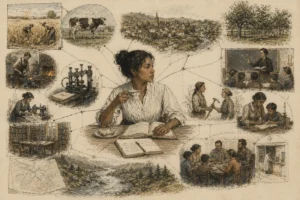
A silhouette of a human woman within an image of a tree and elements of a cohesive ecosystem, around in the discernable background images of a community, people working together.
While each human obviously is one organism, the complexity invites us to also consider the human being as a contained ecosystem. We are invited not to manage ourselves as machines but steward ourselves as we would a garden. We do however exist in a greater ecosystem, society, which is interdependent with our biology.

I refer to this capacity as coherence: the adaptive coordination of many interacting needs and signals, across time, using feedback to stay aligned with reality to act and grow. At the individual level, coherence is what it looks like when a person can notice an impulse, interpret it in context, and choose an action that serves both immediate functioning and longer-term stability. At its best this is not merely to navigate an impulse, but to deftly channel it for growth. It means that the person can hone and train this impulse as a raw capacity for notable developmental achievements. We continue to demonstrate developmental capacity across our biological infrastructures (physical, cognitive, and connective/social) with meaningfully open-ended expansion. At the collective level, the same logic applies: societies are ecosystems that either scaffold this capacity, through norms and mutual respect, education, institutions, and distributed responsibility, or they degrade it by rewarding short-term reflexes that destabilize the whole system. 
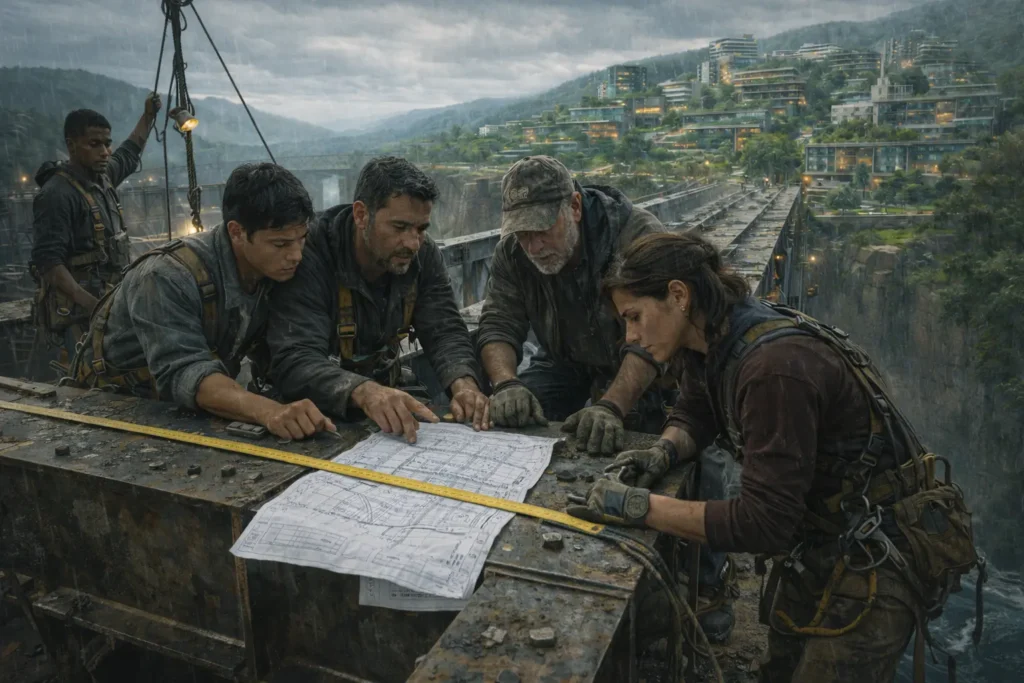
An image of a team of diverse ages and identities collaborating to build a span bridge across a gorge to an ecological district of a city across the way.
We prove conceptual thinking and social coherence stewardship and coordination in many contexts. We have the capacity, we simply have failed to build conceptual thinking (which in my definition includes taking action) and its development explicitly into our social norms and values as a baseline.

Our distinguishing advantage is the capacity to steward all our systems using higher-level cognition developed in social scaffolding. We can and need to scale this cognitive capacity deliberately, but only if we practice a specific kind of higher-level cognition I call conceptual thinking: the capacity to form and revise models of how things relate (constraints, trade-offs, causal links) so we can hold complexity without collapse and act with relevance rather than reaction. This trainable skill not only facilitates learning from an early age, it makes coherence possible.* The resources and clues for this coherent stewardship and development are provided to us in our biology: the need to channel, enjoy, and develop our own impulses and the reward they can provide when harmonized across our living; our capacity to manage and enhance these processes to our benefit and participation in community; and the need for a healthy society, built on mutual respect, collaboration, and shared goals of stability and growth. When we attend to our biology and capacity with authenticity, navigating the complexity of our existence for our wellbeing, we immediately affect those around us for the better as well. Our existences are interdependent and our individual wellbeing correlates to our society’s wellbeing. Our human advantage also means that we are not in this work of development alone.

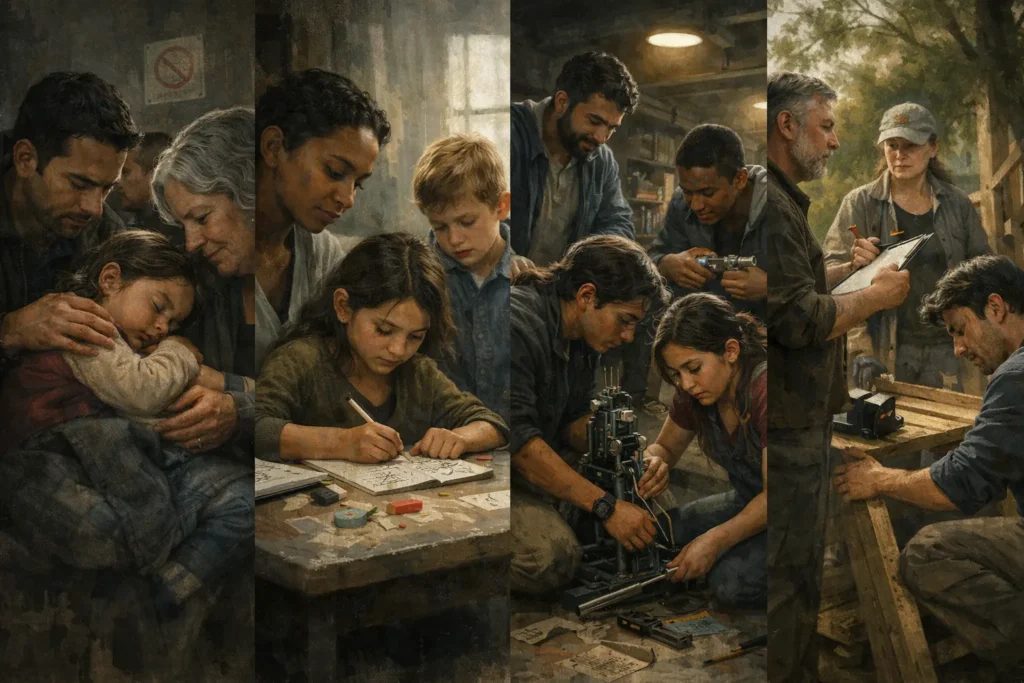
4 panels of the developmental arc of a human from birth to adulthood showing social cooperation and growth.
Humans have unusually long developmental periods requiring deliberate scaffolding by our community. This is an advantage that allows us to develop our cognitive potential individually and collectively.

 *We can and should teach conceptual thinking systematically and explicitly from an early age and dedicate ourselves to its practice throughout adulthood.

ARTESIAN is dedicated to developing conceptual thinking capacity across ages. For example, we believe in starting early as, in addition to the abilities it can provide with experience, it facilitates learning and retention across domains. To that end we’re developing Story Builder, a tool for parents we collaborate with to develop the learning and confidence of their children.

Contact us if you are interested in learning more about other collaboration opportunities including those for adults, professionals, and artists.

A summary of this article is on Substack


Series Addendum: Why these words, why this framing

Why I try to avoid certain terms “control,” “mechanism,” “drives,” “govern,” “regulate”:

Those terms aren’t “wrong.” They’re often technically accurate. The problem is that they suggest a machine metaphor. These words inadvertently suggest a mechanistic approach of the human organism: it is made of “parts” like a machine. In practice, that framing can lead to misinterpretations of the infrastructures and processes they enable. It may lead to attempts to “control” through repression, treating impulses as enemies, rather than integration and training. In this series I’m aiming for a different default picture: the whole person as a contained ecosystem (I do state in this particular essay how societies are human ecosystems as well).  Ecosystems aren’t “controlled” so much as stewarded: you work with feedback, constraints, and trade-offs. The goal is not silencing parts of ourselves, but coordinating them across all the systems so they contribute to stability, development, and real-world functioning. For an example see: Rethinking Maslow.

The deeper point is practical: if we describe ourselves as mechanisms to be controlled, on the social scale we often build policies and institutions that reward short-term reflex. If we describe ourselves as an ecosystem (within the greater ecosystem of society) to be stewarded, we make room for training, feedback, and development, personally and socially.

Why calling a system “survival” may distort our thinking:

When we label certain processes and functions of human biology as “survival,” it can quietly imply a hierarchy of importance or evolutionary “priority,” as if evolution built a basic layer, then moved on to “higher” upgrades. That invites teleology (“built for X”) and determinism (“therefore must dominate”). Assuming that these impulse systems developed first or are hold overs, and possibly even conflict with our cognition, tends to diminish their relevance and potential as well as create a narrative difficult to defend.  A more accurate framing is contextual and ecological: many fast impulse “systems” may be widely observed across species, but in the human organism they operate within a very different developmental environment, especially a long childhood and dense social scaffolding. Also, this naming may suggest that evolution “created” these systems then later went on to create others, inadvertently leaving these “primordial” systems in the mix. However, the process of evolution is a rigorous feedback loop. There is no inherent war inside the human organism between elemental impulse systems and higher-level cognition. They are part of the same internal ecosystem and it stands to reason they were all shaped through millennia of evolution together, rather than “newer” systems as addendums. The question is not whether those systems are “lower” or “older,” but how they all work together well for the organism’s wellbeing.

Our scientific categories are changing (and why I still use “systems”):

A lot of brain-language was built from what could be observed: behavior, injury patterns, coarse physiology, and cultural assumptions of the era. That encouraged categories that may blur structure, process, and function (“threat mechanism,” “executive function,”). As neuroscience and human biology develops, we increasingly model the brain as networks, timescales, and context-dependent coordination, not single-purpose modules with fixed jobs. I prefer the term “infrastructure” and use “system” as a temporary bridge: it respects earlier work without pretending our current labels are final. We are still building our understanding of the structures, their functions, best conditions, and most importantly, potential. We are well on our way to new categorization systems. In any case, if the study of our biology has taught us anything, it is humility.