
MILO DE PRIETO
Neurocognitive strategist, writer, and systems designer focused on turning the brain’s meaning-making into coherent lives, projects, and societies.
My Throughline
I became aware of my divergence early, coming out rather young, navigating ADHD, and moving through a series of shifting worlds. I felt like an observer from another planet, watching humans invent rituals and call them “normal.” Each new place rewrote the script, and identity became a performance I could play with rather than a fixed role I had to inhabit. From that vantage point, the construction of meaning and purpose became the real terrain. Early on, I wanted to understand how the brain turns experience into narrative, how identity flows and stabilizes, and how people build coherent, sustainable lives in worlds that often misread them. This question has animated my research, my work, and my art ever since.
My research centers on how the brain creates meaning and coherence. I study Neural Coherence Ecology, Biolinguistic Creativity, and the developmental structures that shape identity, mastery, and wellbeing. My work focuses on clarifying the internal mechanics of meaning-making — how perception, emotion, memory, and narrative compose a life.
My background, and present professional work, applies this research across education, human development, and creative practice. I have run a school in Indonesia, led literacy and teacher-training initiatives, directed creative work for major brands and artists, and built developmental programs for divergent thinkers. Through ARTESIAN, I design theories, models, and tools — such as NCE, DRIVEN, DRIVEN ART, and the Neurodivergent Protocol — that help individuals understand their cognitive identity and develop sustainable ways of living, learning, and creating.
My art is another expression of this inquiry. I write narratives and build interactive installations that explore perception, identity, and transformation. My creative work functions as a laboratory for the same questions that drive my research: how humans metabolize experience into symbol, and how meaning becomes a coherent form in the world.
These three strands — research, work, and art — are independent but aligned. Together they express the purpose that shapes my life: to understand how meaning is made, and to build the infrastructure that helps people live from that meaning with clarity, coherence, and creative force. The page that follows draws this throughline through the body of work itself.
The Integrated Infrastructure of My Work
My work forms a single ecosystem: a central theory of the nervous system as living ecosystem, three Stewardship Domains through which that ecosystem can be understood and tended, and two companion theoretical inquiries that together with my creative work form the second half of my doctoral research. The sections that follow describe each in turn.
- Neural Coherence Ecology — the central theory. The nervous system rendered as a living ecosystem of four interdependent infrastructures.
- The Stewardship Domains — Functional Coherence, Developmental Coherence, and Social Coherence. Each a theory and model in its own right; each a coherent branch-and-root of NCE.
- Biolinguistic Creativity and The Three Divergences — companion theoretical work that bridges the scientific and artistic dimensions of the research, and forms one half of the doctoral dissertation.
- DIVERGENTE and The Coherence Athenaeum — the artistic and phenomenological expression of the same inquiry NCE pursues scientifically. Together they form the other half of the doctoral dissertation.
The operational systems and applied programs that emerge from this research — DRIVEN, DRIVEN ART, the Neurodivergent Protocol, Story Builder, the Cognitive Assessment Tools, the Purpose Profile, and ARTESIAN’s engagement pathways — are described in full through these links and introduced on the Ecology page.
Neural Coherence Ecology
The Axis Theory and Model of All that Follows
Coherence: It carries two senses from the same Latin root — the quality of holding together logically, and the quality of forming a unified whole. Both senses are active throughout this work, and the distinction between them matters.
The human being is coherent. A stable, interdependent ecosystem shaped by evolution into reliable function. That coherence is the starting condition, what one is born with and has to work with at all times. What this work describes is not how to become coherent but how to tend what already is — to coordinate the signals and needs of that ecosystem, across time, in genuine alignment with reality.
This is the second meaning, coherence as a practice, and it is the sense in which the word runs through Functional Coherence and Developmental Coherence: the ongoing discipline of stewarding a coherent system coherently.
When the word is capitalized — as in Coherence Mastery, or in the coherent-state expressions named in Functional Coherence — it names something further: Coherence as a sublime state of cohesion across internal and external ecosystems, usually realized through a domain of mastery but also available as a state in itself.
The three registers are layered and interactive, rather than ranked. The first is the given. The second is the work. The third is the developmental horizon.
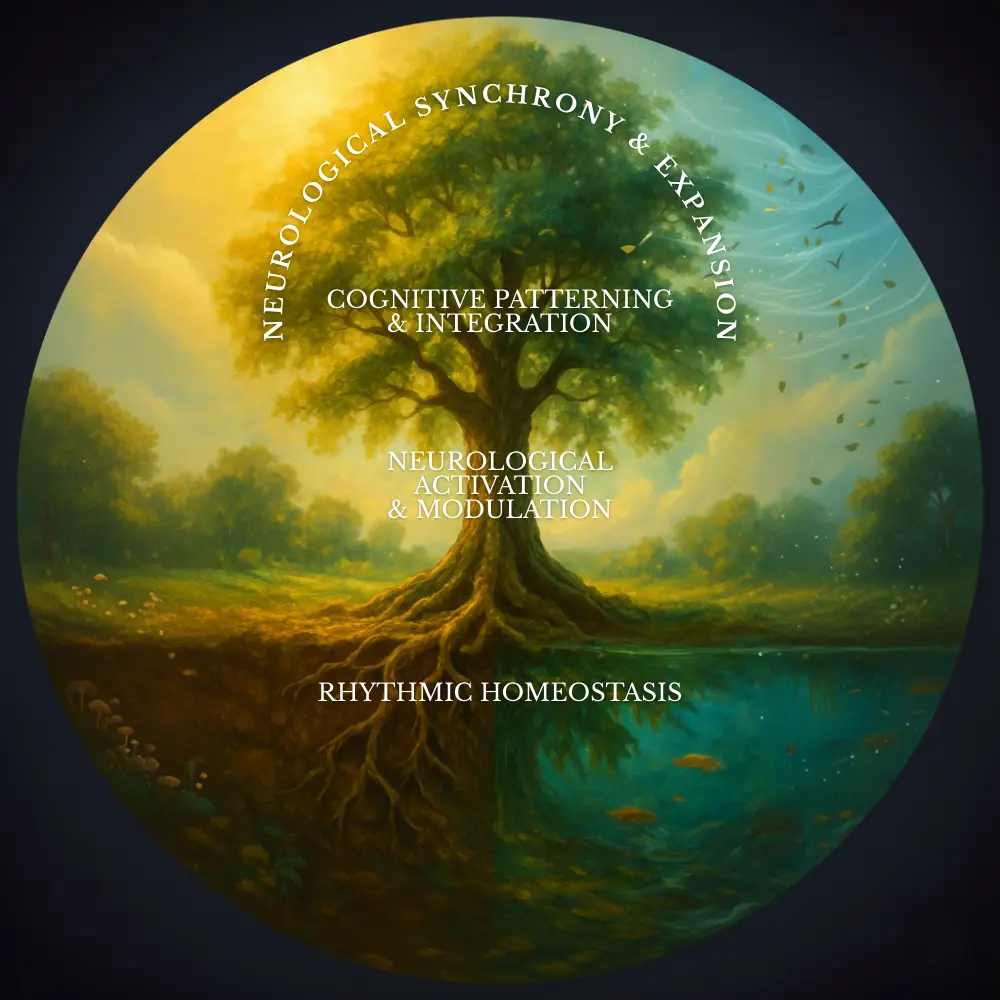
Neural Coherence Ecology treats the nervous system not as a machine to fix, but as a living ecosystem — self-organizing, interdependent, and continuously shaped by environment, relationships, rhythm, and meaning. The point of this frame is agency: if your nervous system is an ecosystem, then quality of life is neither a personality trait nor a moral achievement. It is what tends to emerge when the ecosystem is supported well, stewarded, over time.
Neural Coherence Ecology (NCE) is my systems theory and model of this ecosystem. It describes four interdependent neurological infrastructures — Rhythm, Activation, Cognition, and Synchrony — and how their dynamic alignment produces coherent quality of life. These infrastructures are not a ladder. They co-create one another in feedback: when one destabilizes, the others compensate, often at cognitive or emotional cost. Coherence is the ongoing, living equilibrium of the whole ecosystem, not the perfection of any single part.
Comprehensive Quality of Life is the lived outcome NCE is designed to make stable — the integrated improvement of human wellbeing and environmental health through systems that create mutual benefit rather than extraction. Individual thriving remains inseparable from its effects: coherence in the nervous system supports learning, meaning, and contribution in ways that strengthen community and sustain the wider environment. Comprehensive Quality of Life sets the measurement standard for the entire body of work. Quality of life is evaluated by whether a person’s ecosystem becomes more coherent, and whether that coherence produces benefits that extend outward into relationships, communities, and the environments those communities depend on.
NCE is addressed through three Stewardship Domains, described in the next section. They are not sub-systems of NCE. They are distinct ways of entering the same living ecosystem, each with its own stewardable operations, each in constant exchange with the others because the ecosystem they describe is one.
The Stewardship Domains
The Ecological Models Forming the Branches-Roots of NCE
NCE is addressed through three interdependent domains, each a theory and model in its own right. They describe the ecosystem in three distinct registers: how it operates daily, how it grows over time, and how it functions in relation to others.
Functional Coherence Theory and Model
Functional Coherence describes how the neural ecosystem operates in daily life, and it identifies the specific functions a person can steward to build and sustain coherent functioning over time. It names four stewardable functions — Focus, Cognition, Emotion, and Drive — which in coherent alignment become Focus Navigation, Cognitive Composition, Emotional Harmony, and Drive Alignment. These coherent-state expressions are where the capitalized Coherence appears in the Functional model: each names a function operating in the sublime register where regulation has given way to integrated capacity.
Functional Coherence treats coherent functioning as a developmental achievement rather than a default condition, and it is where much of the applied work lives. It is universal in scope, but its dynamics are most visible in divergent individuals, where functional breakdowns and compensations amplify what would otherwise be harder to observe. It is operationalized directly in the Neurodivergent Protocol, which uses neurodivergence as the high-resolution proving ground for strategies that then generalize across populations.
Developmental Coherence Theory and Model
Where Functional Coherence addresses how the ecosystem operates day-to-day, Developmental Coherence addresses how it grows, changes, and develops capacity over time. It describes how humans build increasingly coherent capacity within and across domains — how learning accumulates into skill, how identity stabilizes through meaning, how divergence can be honed into strength, and how individual development remains inseparable from the social and ecological conditions in which it takes place.
The Three Dimensions of Developmental Coherence
Coherent development is essential to human neurological well-being and comprises three interactive dimensions: maturation, growth, and extension.
- Maturation – The unfolding and stabilization of foundational neurological capacities necessary for baseline human functioning.
- Growth – The elaboration and contextual refinement of those capacities in response to recurring realities, demands, and social conditions.
- Extension – The intentional cultivation of distinct, person-specific capacities into coherent, specialized, and potentially exceptional forms of functioning. Neurocognitively, it enables transformation through both the process of sustained developmental work and lived existence.
These dimensions function as interdependent developmental currents within the human and social ecosystem. Together, they form a living arc that extends through the individual human ecosystem and into the surrounding social ecosystem in an interactive, iterative, and interdependent manner.
Mastery Progression Theory and Model
Mastery Progression is its primary model, describing the structured and mapped development by which mastery emerges. Mastery itself is understood broadly. It can mean functional aptitude — the capacity to perform a task reliably under typical conditions. It can mean certified competence — demonstrable skill validated against an external standard. And it can mean Coherence Mastery, the full integration of a domain into the neural ecosystem, where engagement is sustained and generative without internal conflict, and where flow emerges as an expression of coherence rather than as its aim. Which form of mastery a person pursues depends on their purpose, the domain, and the context.
The Purpose Throughline is the iterative flow by which meaning becomes identity and identity becomes sustained action. This Throughline identifies how the brain constructs continuity across experience, how identity stabilizes over time, and how purposeful action emerges from that internal structure.
Purpose in this theory is a neurologically-grounded navigational approach that emerges from the interaction of the brain’s predictive modeling, each person’s genuine interests, their higher-order cognitive processes, and the core competencies developed through learning and experience. Like prediction itself, it is iterative and interdependent with the ecosystems in which it operates. Its dynamic nature means purpose has many facets and iterations; it is not so fluid as to lack form. Purpose develops and strengthens through experience into a stable navigational approach — approach here meaning both method and angle, like attitude in flying, and unique to each individual.
Social Coherence Theory and Model
Social Coherence addresses how the neural ecosystem functions in relation, and how social systems can be built and revised to sustain — rather than extract from — the individual ecosystems that compose them. It rests on the biology-first premise that healthy social ecologies must be built first on the biological needs of the individual ecosystem, and immediately thereafter on the biology-defined needs of that ecosystem in relation to the social one.
The theoretical ground is the neurobiology of fairness and reciprocity — the evolutionary reality that humans are the cooperative species, and that sustained cooperation requires specific structural conditions. Social Coherence specifies what those conditions are: equitable opportunity for individual development, role differentiation that reflects actual variation in capacity and interest, authentic value exchange that distinguishes genuine contribution from extraction, and the voice, dignity, and belonging that cooperation depends on. Social Coherence extends the theoretical work into the territory ahead; the applied work to date sits primarily within Functional and Developmental Coherence, though the Social domain is where much of the essay and long-form writing of this program is now being developed.
Biolinguistic Creativity
The Neurocognitive Process of Voice and Expression
Biolinguistic Creativity and Neuroaesthetic Development is the first of two companion theoretical inquiries that sit beside NCE and its Stewardship Domains. Together with my creative work, these companions form one half of the doctoral dissertation — the half that addresses the phenomenological and expressive dimensions of meaning-making that the scientific framework alone cannot capture.
The theory describes the biological, cognitive, and symbolic processes that inform unique human meaning-making, creativity, and expression. Its particular interest is the predictive model of meaning-making — the brain’s continuous iteration of its internal model of reality — used as the neurocognitive anchor to identify the origin of individual voice and to follow that voice through to expression. Expression here includes the full range of human utterance, from everyday speech through to the most integrated forms of artistic creation.
The work explores this dynamic process in the domain of Fine Art because Fine Art can be observed more clearly than more diffuse forms of expression, and because it provides a particularly relevant context for studying Coherence Mastery — the state in which voice, technique, concept, and expression have fully integrated into a single coherent act. Fine Art functions as a crossroads where many essential elements converge at maximum integration, including the Three Divergences, the predictive modeling dynamics, and the full developmental arc described in Developmental Coherence. Biolinguistic Creativity is therefore both a theoretical claim and a methodology: the study of creative work gives empirical purchase on how meaning-making actually operates in lived experience.
The Three Divergences
Existences that Facilitate Exploration and Expression
The Three Divergences represents a foundational theory, research field, and resource for creative expression that forms a set of unique embodiments that interact across all of the domains of Neural Coherence Ecology. It identifies three structural forms of human existence: embodied divergence, neurocognitive divergence, and socio-sexual divergence. These divergences arise from different substrates of human life (the NCE ecosystem) — the body, the brain, and the relational-affective system — and each shapes how a person develops, relates, and participates in the world. They are not preferences, surface identities, or deviations from a norm. They are fundamental variations in how human existence is organized.
Each divergence functions as an event horizon at which the social construct of “normal” breaks down and real human variation becomes visible. When divergence is integrated rather than masked, the individual, their community, and the larger ecosystem all benefit. The Three Divergences forms the second companion theoretical inquiry of the doctoral dissertation, working alongside Biolinguistic Creativity to ground the artistic and phenomenological research in structural claims about how human existence actually varies.

DIVERGENTE is the artistic and phenomenological expression of the same inquiry that NCE pursues scientifically. It is not a separate creative practice alongside the theoretical work — it is the other half of the work. Where NCE describes the nervous system as a living ecosystem and meaning-making as a neurological process, DIVERGENTE explores what it feels like to live inside that ecosystem — through short film, narrative, interview, and installation. The creative work generates phenomenological material that the science alone cannot access. The theoretical framework gives the creative work structural depth and conceptual precision it would not otherwise have. This reciprocal relationship is the structural basis of the doctoral dissertation: NCE and its Stewardship Domains as the scientific dimension researched through Biolinguistic Creativity and The Three Divergences which forms the bridge to DIVERGENTE, the artistic and phenomenological dimension.
DIVERGENTE engages the Three Divergences — embodied, neurocognitive, and relational — not as categories of personhood but as structural axes of variation. Represented visually in the triad ring (below), each color corresponds to one divergence, while the circular form suggests a portal — an event horizon as a threshold for human development and evolution. The site holds short films, interviews with divergent artists, narrative experiments, creative writing, installations, and other exploratory forms that test these ideas in human, aesthetic, and social terms — particularly where dominant cultural narratives tend to smooth over difference or erase it entirely.
The Coherence Athenaeum is the most comprehensive artistic expression of NCE and all it contains — currently in active development. Where the individual works of DIVERGENTE explore particular dimensions of the inquiry, the Athenaeum is conceived as a traversable environment that renders the body of work as a single living structure. It is the most ambitious long-term project of the research program and forms a central component of the doctoral dissertation’s artistic dimension.
Click either the logo above or the image below to navigate to that mirror world

Background & Formation
What precedes describes the work as it exists now. What follows is a brief account of the path through which it was formed — accumulated environments of responsibility, learning, and practice that gave the theoretical work its applied texture.
Track Record
The applied work behind these frameworks spans three decades. I served as Deputy Headmaster of the Sentul campus of Sekolah Pelita Harapan in Indonesia, holding executive responsibility for an international-standard school with a three-million-dollar operating budget while simultaneously leading curriculum development, dormitory operations, and a teacher-training outreach program across the Indonesian archipelago. I produced video journalism for the New York Times Company across the lifestyle vertical from 2008 to 2012. Through The Alice Trading Company, I directed brand and communication work for clients including Tulsa Opera, Porsche, Jaguar, La Caixa, Moët-Chandon, and Bumble — work grounded in a neurocognitive understanding of how audiences make meaning. Through ARTESIAN, I have led the institutional development and cultural programming of a Barcelona-based cultural organization, including the renovation of three warehouse spaces, an EU and Spanish grant portfolio, and a body of artist residencies. I have delivered guest lectures and workshops at ESADE, IESE Business School, Pompeu Fabra University, and Universitat de Barcelona on cognitive science, AI, and applied learning design.
Education
My education has followed a sustained inquiry rather than a linear credential path. Undergraduate work in Film and Theater and in Literature at Oral Roberts University; postgraduate study in Linguistics at Colorado State University and in Education at Oral Roberts University; doctoral-level coursework in International Education at the University of Wisconsin–Madison as a University Fellow; and doctoral-level coursework in Fine Arts and Visual Culture at Universitat de Barcelona. Across all of this, formal study remained closely coupled with practice — teaching, curriculum design, creative production, and organizational work continually tested and refined the ideas being developed. The double PhD in Neuroscience and Fine Art commencing autumn 2026 is the formal institutional expression of the research program described on this page.
For serious inquiries related to this work, you can reach me by email.