
ON CURIOSITY
In 1927, Heisenberg discovered that you cannot study a thing without affecting it. The character of the detached observer, aloof, clinical, untouched, is seductive, but a myth. Curiosity is a force and the act of studying is violent, sometimes soft, many times fatal. Ask the rats.

The researcher never arrives empty-handed. They carry with them the universe of their experience and assumptions, the gravity of their purpose, and the slant of their approach, an angled intent, like rays of sunlight breaking through clouds. Every question posed limits the field of view. It is a kind of incantation, summoning only what the inquirer believes might appear. Anything else is unnecessary, invisible, or worse, unimportant. Even time conspires in the distortion, there’s always a lunch break, a deadline, a limit to attention span. The researcher is not liberated from reality, they are just as bound as the frog splayed out before them, belly open to the world, wondering “why?,” or “why me?”
We would be better served by a different metaphor of research. Rather than the clinical, aloof, and detached entity poking around, we should remember we are like children giving into our sense of wonder and curiosity. Picture a child sitting on their haunches by a stream, mesmerized by the vast universe before them between a few stones. We are playing god, not god. The important and operative word is playing. The work of our research could use the joy, openness, and above all humility to know that no matter what we think we’ve figured out we are always just beginning. We are always children sitting on our haunches by a stream.
THE TECHNOLOGY
Having even a basic awareness of all that we are really doing when we pose a question is essential to the entire process of educational assessments. Our tests and probes aren’t painless nor sterilized, and the subjects are very much affected by anything we do.
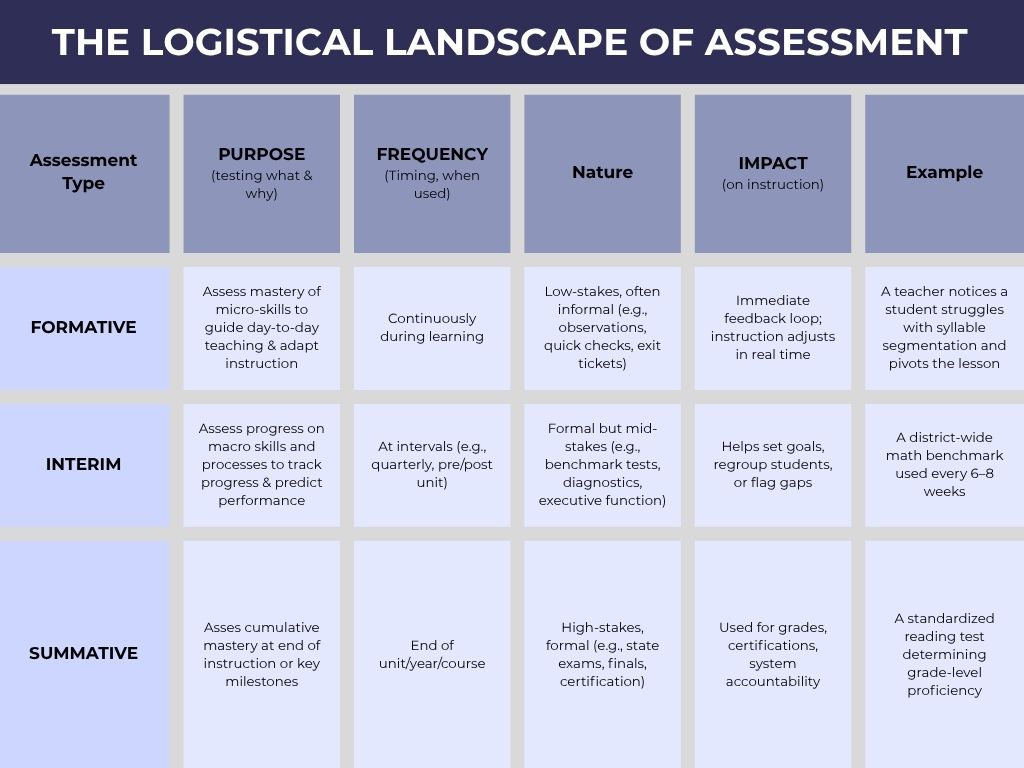
One typical way of understanding and categorizing assessments is to use the spectrums offered by three parameters: purpose, frequency, and impact. Purpose is simply what the assessment is intended to study. Frequency can refer to almost daily, certain times of the year, or regularly, at say the 4th grade. Impact, which I find the most interesting, asks how do the results provide necessary information to guide how students are taught, if at all.
Testing has long been used to punish, to filter, and above all, to rank (see summative below). If you’d like a firsthand experience of testing as barrier, try navigating a written driving exam, Spain’s version offers a particularly vivid case. But none of these purposes serves to advance education in general, instruction specifically, or learning at all. And yet we’ve organized much of education, and adult life, around this reductive scoreboard logic, despite how little it actually tells us. I, for one, am not comforted by the thought of sharing the road with someone who earned their license merely by surviving a bureaucratic gauntlet. What measurable skill did that really require? When, exactly, did they become a worthy driver? What parts of their own process and skill did they come to understand?

Not what you’ve learned, where you’re strong, or how to grow, just that you got through.
Most people are aware of standardized tests used to rank students and educational systems, administered at certain grade levels. Their purpose tends to be to test how well a student, class, school, or educational system performs compared to others of a similar situation. These tests probe arrival at milestones, called benchmarks, what the student should be able to do or know at a certain age or after completing a course. If you encounter any kind of test, other than of your patience, you will have encountered these the most, such as the aforementioned driver’s exam, national educational benchmark tests, college entrance exams, or any test for certification. These assessments are typically known as summative, their frequency is the least (thank god), they try to get a global perspective of learning or mastery, and other than to shame or laud anyone, they don’t remotely impact how or what students are taught, they simply don’t elicit that kind of information. We keep summative assessments around out of habit and hierarchy, not because they give us what we actually need to support growth.
Interim assessments are more frequent, used to predict a given student’s journey on the way to mastery. They are administered pre or mid- instruction, and sometimes at intervals such as early into a course and then towards the end. Rather than the on/off switch of standardized tests, these may assess foundational skill development, cognitive processes (like executive functioning) that affect learning, or working understanding of a topic. These assessments are intended to flag potential areas that could use reinforcement or provide students with necessary strategies and scaffolding for success.
Advances in the neuro and cognitive sciences have allowed us to develop a more thorough understanding of how we learn. We understand that full mastery is made up of a complex ecosystem of acquired primary skills, each formed of multiple subskills, all working together. Armed with this knowledge, we can quickly and informally assess mastery of a sub-skill either right before and during instruction. This kind of assessment is called formative as it offers granular information immediately useful for adjusting a lesson in real-time to efficiently guide a student to mastery.
THE PEOPLE
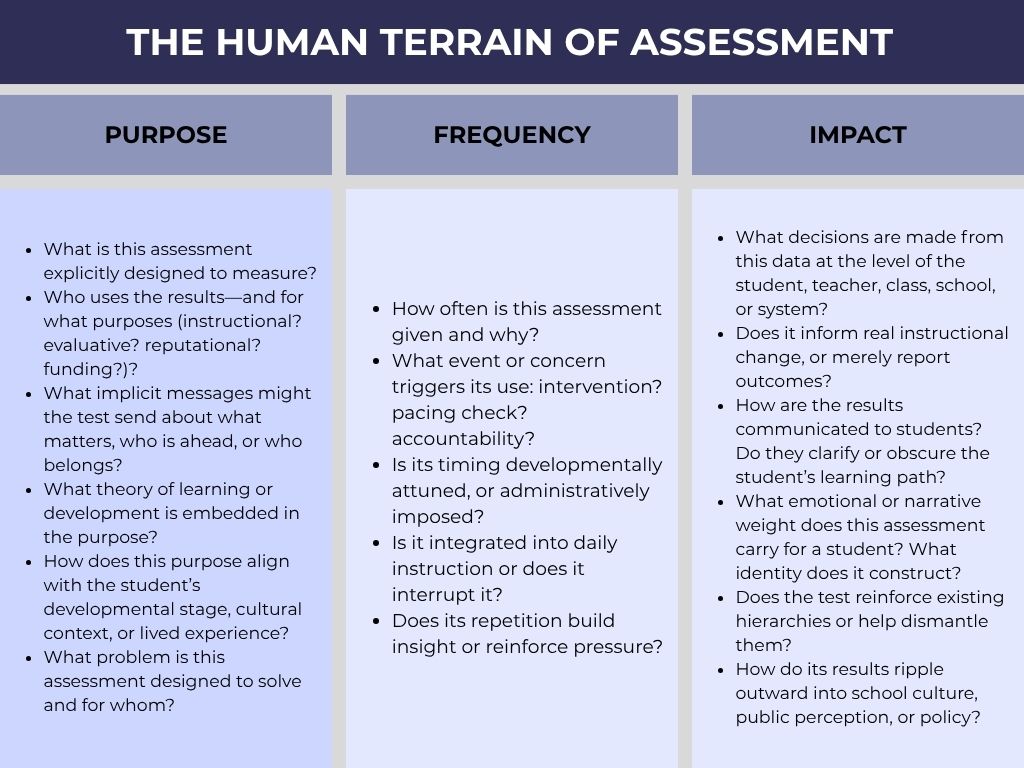
But this framework, purpose, frequency, impact, is only the entry point. To understand assessment’s true force, we have to look not just at its design, but at the people it touches and how. Obviously, the purpose of any given assessment is grounded in assumptions formed by the methodology of the educators (researchers) and the immediate society that they are in. Assessment is not a neutral act, it enters the room with culture, intention, and consequence. It is almost always disruptive and somewhat “violent.” The entire procedure can provoke sincere questions of social justice (cultural bias embedded in questions favoring one group, or the understood definition of mastery of a subject) and most importantly, student development, directly affecting identity and sense of agency.
In educational psychology specifically, and psychology in general, context, situation, and narrative are more powerful determiners of behavior and success than individual capacity and personality. For example, a well-meaning but inelegant administration of an interim assessment for first grade admission, could establish in a child’s mind their identity, as role, in the coming educational journey even before the school’s doors open. Not understanding what is being asked of them, the student could find the assessment process confusing and threatening, telling them that this place is not for them (from an actual case).
Thankfully, education is evolving. By looking at development and learning as composed of both structured and situational processes, we’re recognizing how to set students up for success and really teach, rather than merely rank. For example, neurodivergence is no longer seen as a deficit to be corrected, but as a distinct pattern of perception, shaped by the brain’s unique chemistry and structure. This shift calls not for correction, but for calibration, adjusting methods and environments to fit how an individual child naturally learns.
NOTE: structured — the ecosystem of interconnected subskills and primary skills working together; and situational — we each go about that development differently with different circumstances and realities affecting our journey.
I know that as we develop a nuanced understanding of cognitive identity (the way our brains uniquely process, learn, and make meaning) allows us to design education that meaningfully and practically affirms individual journeys. We may be traveling toward similar developmental goals, but the route, pace, and terrain vary for each of us. That essential understanding will accelerate and enhance our learning and development lifelong.
THE LAND
Assessments have evolved with our understanding, functioning more as tools for insight than instruments of ranking. And yet, we still lean too heavily on ranking. Summative assessments continue to dominate, socially and institutionally, even though they offer the meagerest of insight. They rarely, if ever, serves us. What real value do we gain? Validation? Shame? That reflex alone unravels the myth of educators as clinical observers. None of us stand outside the learning process. Parents, teachers, people, we are all shaped by the same cognitive forces, elbow-deep in the same soil.
When we understand the truth that learning is a shared terrain and lifelong, assessment becomes an activity we use to grow together, not a scorecard we impose. Neuro and cognitive science reminds us that while our developmental roadmap may be shared, the navigation of it is personal. By walking those paths visibly, with our students and each other, modeling curiosity, struggle, and delight, we don’t just access growth, we develop a society dedicated to it.

This shift has radical implications, not just for classrooms, but for culture. Imagine a society where the dominant “tests” of life aren’t summative but formative, where progress is measured not by accumulated status, but by evolving skill, perspective, and purpose. Instead of comparing résumés and bank accounts, we’d know to check in on our continual development of mastery, reflect on how we’re learning, and grow alongside one another and our students. That’s not just better education. That’s a better way to live.
We are always children sitting on our haunches by a stream.