
If you ever find yourself in the middle of a zombie apocalypse, the key to your survival is to not join the horde.
You’d think that is obvious. Apparently not.
A general, helpful rule of thumb is that if someone who doesn’t have your best interests in mind offers you limited options, the wise move is not to negotiate but to walk away. The same applies to those trying to profit off your distraction. In digital culture it is possible and in fact necessary to do exactly that, walk away, join the resistance.
Walking Away from the Casino
We don’t argue with mediocrity, we chart another course. Even without the risk, a well lived life means choosing where we place attention and how we build connection. Rather than join the horde you can join the rebellion, choose what and how you use tech and engage with digital culture deliberately as if your life depends on it.
In part 4 of this series, I mentioned how we need an economy built on marketplaces that resemble the Roman Forum, a place of real civic and value exchange, where ideas are tested, refined, and built upon. Instead we’re given a cheap version of Vegas, what I call the zombie economy.
Reclaiming executive function, and your life, begins with three gestures: walking away from what corrodes, choosing deliberately how you engage, and joining the rebellion through tools that don’t depend on cheap tricks for fast cash.”.
It’s Vegas vs. the Forum, one holds your future and wellbeing, the other doesn’t.
Executive Functions as Skills of Navigation
The skills of executive function show us not only how collapse happens, but how recovery begins. Each one has been corroded by the zombie economy, yet each can be reclaimed through small, deliberate practices.
Working memory is flooded with trivia until no thought takes root. To restore it, draft first yourself before reaching for Google or AI, letting your own words carry weight before asking for refinement. Inhibition has been eroded by endless novelty, but it can be rebuilt when we design friction into our lives — baking instead of buying, placing the phone out of reach, treating pause as an act of dignity. Cognitive flexibility collapses when everything demands instant response; it returns when we schedule transitions, when we allow ourselves the time to shift direction rather than expecting to turn like a sports car at every demand.
Emotional regulation has been hijacked by media designed to inflame, but it can be restored in slower spaces: conversations, books, art, anything that requires digestion rather than binge and purge. Task initiation stalls in an endless stream of distraction, yet momentum is always possible when we begin with one small action, then the next, then the next. Planning and prioritization dissolve under the pressure of perpetual now; they recover when we map goals into steps and sequence them toward the horizon. Organization falters when every notification insists on being urgent, but it strengthens as we give order to space, ideas, and materials — making clarity visible. Self-monitoring becomes distorted when algorithms supply empty feedback loops; it becomes real again when we pause to check progress, recalibrate, and correct course. And time management, impossible when hours vanish into digital noise, returns when we treat time not as a clock but as capacity, something to be allocated with care.
These are not glamorous acts. They are disciplines. And like art, they require patience, rigor, revision, vision. From the caves forward, art has always been our rehearsal for living meaningful lives.
Art as Discipline, Not Ornament
To paint, compose, or sculpt is to practice working memory, inhibition, sequencing, patience, and revision. Art has always been our rehearsal space for executive function. This makes it essential, not optional.
It is the process of building a life of daily actions that restore coherence. The executive functions we’ve allowed to atrophy can be strengthened, the same way those who live with neurodivergence have had to do consciously all along.
Walking away from the zombie economy means refusing to feed the casino. It means stepping into smaller, slower, more human spaces: the Fediverse, Mastodon, blogs, and real conversations online and off. It means treating technology as a tool for life as art again, not a master
Years ago, before Facebook, I joined a fitness platform that doubled as a forum. The conversations felt like they were happening in real life over coffee or a beer, present, respectful, even joyful. Until one day, a member, young, handsome and fit, suddenly posted doubts about his looks, fishing for compliments, way off-topic and wildly out of place. Imagine someone commandeering a conversation is real life, with a statement like that. Others authentically tried to reassure him, but as you can tell it didn’t fix his self doubt and instead signaled the coming apocalypse. Within a short time the platform was unusable, full of raw ego, the posing and trolling we are used to today. Like the internet in general, what had been authentic became hollow.
But what was lost can be found, rebuilt with awareness to be relevant today. This is the digital forum as Forum that we need. Life is an art that we must learn to re-fine.
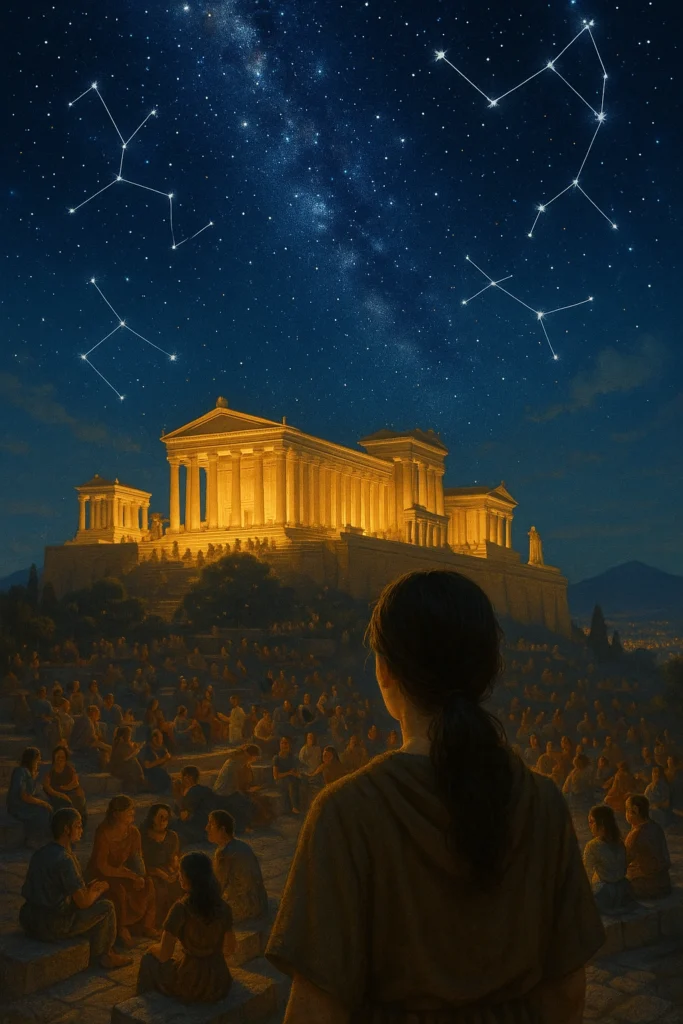
Together, away from the cheap casino, we will build the acropolis and the city of lights,.
Building Something Real
The zombie economy will collapse under its own weight, but it doesn’t have to take us with it. Walking away is only the first move. The next is to build again — not spectacle, not distraction, but spaces designed for meaningful lives.
The fediverse is one such attempt. Unlike the monoliths of social media, it isn’t a single platform but a constellation of them — Mastodon for conversation, PeerTube for video, Pixelfed for images, and many more — all connected but not owned. Each is smaller, slower, more human by design. Instead of one casino dictating the rules, the fediverse works more like a federation of neighborhoods, each with its own culture but all able to speak to each other. It is not perfect, but it is proof that we can choose tools that support authentic connection rather than consumption.
What matters is the principle: stop feeding the slot machines, meet again in the Forum. Use digital tools for scaffolding genuine exchange. Let these spaces remain imperfect, quirky, resistant to takeover — because their value lies not in scale but in integrity.
Reclaiming executive function is not a private luxury. It is a civic act. Only with coherence can we tackle climate change, reform education, or coordinate on anything that requires sustained focus. The art of navigation isn’t lost. It is practiced daily in these small, deliberate acts. As a civilization we can return to navigating by the stars — building constellations of connection and forums of exchange that endure.
Read the Rest of the Series:
This is Part 5 of a 5-part series on Executive Function — what it is, how it breaks down, and why reclaiming it matters now more than ever.