
We now accept what artists and researchers have known for a long time: identity is a performance. We choose which facets of ourselves to show in which context. We curate impressions. Some parts of the self feel immutable, but many are constructed, refined, or shed as we evolve.
When people talk about identity, they usually mean character traits, sexuality, ethnicity, gender, social roles, or aesthetic preferences. We still treat identity as something to discover, as if we’re a monument to be unearthed. In truth, identity behaves less like a fixed object and more like a quantum field: full of permutation, contextual, fluid. But even as our language about what we mean by identity grows more nuanced, we almost never talk about it from the perspective of what’s doing the actual making of meaning, our brain. We have little notion of our cognitive identity.
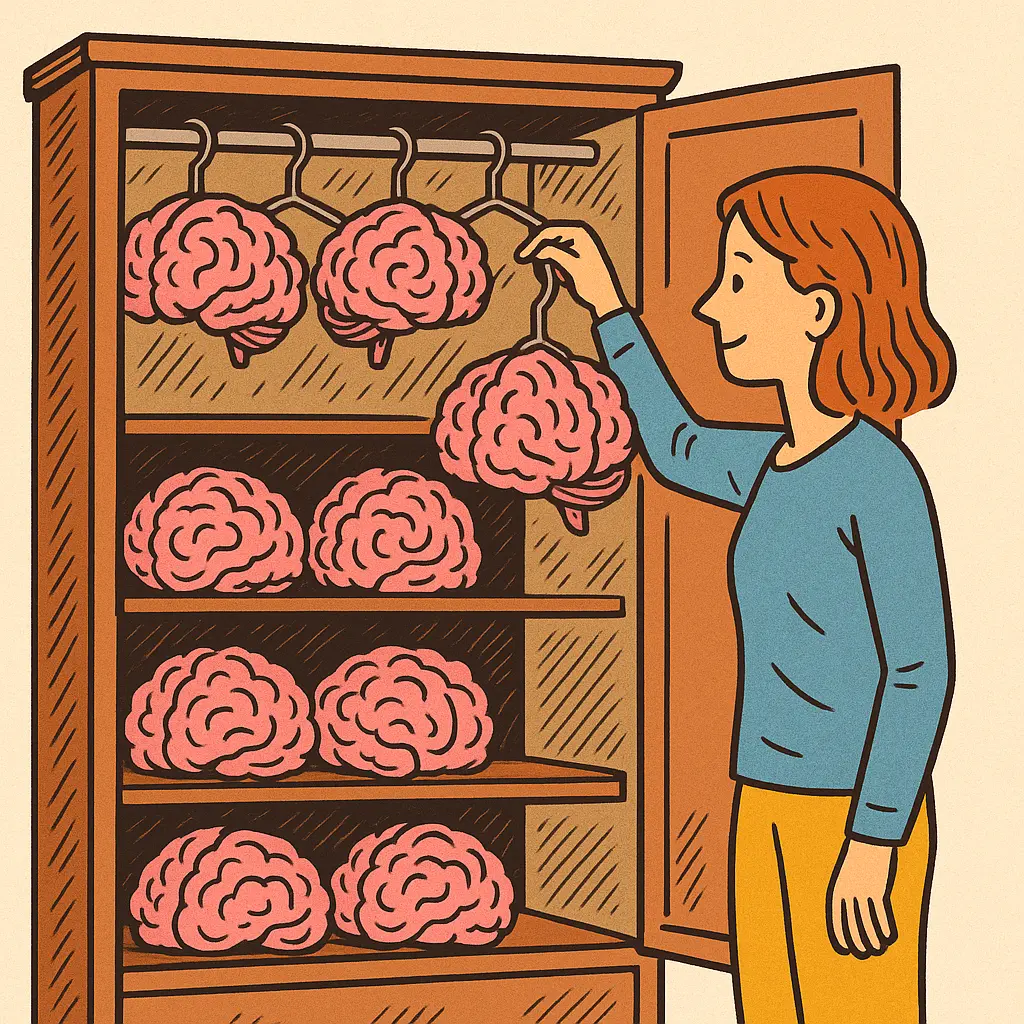
Maybe you’ve taken one of the popular modern variations of the Myers-Briggs Personality Type Indicator and been told you’re an ENFP or an ISTJ. Perhaps you’re familiar with the DISC, Enneagram, or Big Five. They place you in a predefined category from within a specific range of outcomes, similar to a horoscope. At the very least they can help you feel seen. However, while very useful, these cannot be confused with a real understanding of your identity. You share the exact same results with millions and millions of others. So how is it that your wardrobe is more original than your brain?
There are thousands of other assessments too of varying relevance, some give you metrics across spectrums in emotional stability or innovative thinking, others can tell you which Spice Girl you are. But once you’ve been seen, what’s next?
In education, we’ve long understood the power of diagnostic assessments. A good diagnostic doesn’t just say whether a student knows something. It explains why they struggle, or why they soar. It breaks down skills into subcomponents and identifies the gaps. That clarity turns frustration into strategic momentum. It gives students agency over their learning and development. These assessments are used effectively (if too rarely) in language acquisition, reading comprehension, and much more.
The same is true for adults. Or it can be. But we still cling to outdated assumptions about learning and age. We treat childhood as the only arena of development. But your brain doesn’t stop developing just because you’re paying taxes (how it grows changes, though). The capacity for growth never expires, nor does the responsibility for it either.
Your brain is the most powerful tool you own, rich or poor, thriving or flailing, Scary Spice or Posh. It’s also your greatest resource for shaping a meaningful life. Yet we rarely take responsibility for our cognitive development, let alone our cognitive identity. There’s no shared script for it. No rite of passage. No map. We’re socialized to believe that adults are cognitively “finished” and that any further development is about recovery and therapy, not expansive growth.
That’s not true. I’ll have none of it.
“I won’t have it. The world is wilder than that in all directions, more
dangerous and bitter, more extravagant and bright. We are
making hay when we should be making whoopee; we are raising
tomatoes when we should be raising Cain, or Lazarus.”
Annie Dillard, Pilgrim at Tinker Creek (1974)
To develop, you first need to understand what you’re working with. Your brain isn’t a computer or a personality type. It’s a vast, living ecosystem of neurological and cognitive structures, functions, and processes. You could spend a lifetime mapping its terrain. In fact, you should.
So when it comes to cognitive identity, the better question isn’t “Who are you?” but “Who are you when you’re… (insert physical or mental adventure here)?”
…solving a problem, launching a project, improvising in chaos, learning a new language, city, or artform, seeing a pattern no one else sees?
We now know, such as for those of us with neurodivergent brains, even your so-called cognitive weaknesses may be superpowers in disguise (granted sometimes very well disguised).
So to know what you are working with, you need a framework, a way to talk about your cognitive patterns with precision and without judgment. I’ve built one.
It starts with what I call your brain’s primordial message, an inner orientation that reflects your role in the world and how you engage with it. It’s something your brain works on from childhood and will keep doing, job title or not. It is a concept that would make sense to your seven-year-old self (assuming you’re not seven while reading this) and to your eighty-year-old self, too.
From there, the framework maps your high-end cognitive processes: how you handle complexity, solve problems, and perceive and navigate the world. It also tracks how those processes are evolving. Finally, it aligns these insights with the core competencies and applied skills you’ve already demonstrated through experience. The result is a dynamic portrait of your cognitive identity and a practical roadmap for using it.
When you align these elements, your purpose, your deep cognitive functions, and your real-world skills, you have a much better idea of what you should be doing as well as how. You can understand what kind of work will really engage and energize you, how you naturally solve problems, and what kind of challenges will help you grow. Rather than guess you can strategically plan your next move. This opens up developmental opportunities. I believe this is the key to real quality of life.
See: Rethinking Maslow: Breaking with a hierarchy of scarcity to cultivate neuroecological abundance.
See: Rethinking Maslow: Breaking with a hierarchy of scarcity to cultivate neuroecological abundance.
But just like physical fitness, cognitive development doesn’t “just happen.” It’s a deliberate process.
Know where you’re starting. Pick a target. Determine the milestones. Use the right tools. Go, adjusting to reality along the way.
My approach is informed by my formal and informal study and research in neuro and cognitive science, which I enrich with divergent disciplines such as theology, quantum theory, esoteric traditions, fine art, and my years of educational practice and system design. But honestly, you don’t need my system. You just need a system, one that helps you understand and steer the most valuable resource you have: your mind.