
Navigating Reality: The Illusion of Fixed Meaning
It may seem like some things just are, their meaning fixed and obvious. Likewise, we tend to believe that we choose our beliefs with deliberation and steer our decisions with clarity. But the brain does not operate like a compass that can point to truth when you have a clear head. The brain doesn’t chart meaning, it generates it in real time.
Each moment, our brains interpret vast input at incredible speed, long before conscious awareness catches up. We mistake this seamless interpretation for fact, for truth. But meaning is something we build, beginning deep within the nervous system that then works its way through our brain, being tagged and categorized along the way, filtered by as well as reaffirming our sense of self. This process is how we navigate the world, and it is always under way.
We think we are reading the world, when it’s more accurate to say that we are defining it as we go.

The Hidden Process: Before You Know You’re Navigating
Long before you have a conscious thought about anything, your deep brain is hard at work processing your experience, looking for information that it finds relevant. Regions like the amygdala are scanning the raw data picked up by your senses for anything it may find relevant. Along with the insula and anterior cingulate, your deep brain flags what might matter: anything novel, threatening, familiar, or compelling as well as dismissing what is not. It is a fluid and rather complex categorization shaped by emotion, learning, and bodily state. The salience markers it develops are not objective data points. They are rankings, immediate, and embodied. They say, “this matters, this way,” and in doing so, impose meaning before you even have an opportunity to consciously question their valuation. This emotional tagging system is the first step in constructing relevance.
Then these cataloged signals travel swiftly into the prefrontal cortex, where you assemble them into enough of a story to act on. So, emotion isn’t irrational. It’s the very efficient product of a highly complicated neurocognitive process. In an instant, it condenses complexity into something you can act on. However, in feeding you coordinates, your deep brain has already imposed bias by choosing what to prioritize and why.
You’ve taken raw data and formed a detailed map and are moving through it before you’re even aware there’s a route on it to choose.
Drawing the Map: Constructing Reality’s Terrain
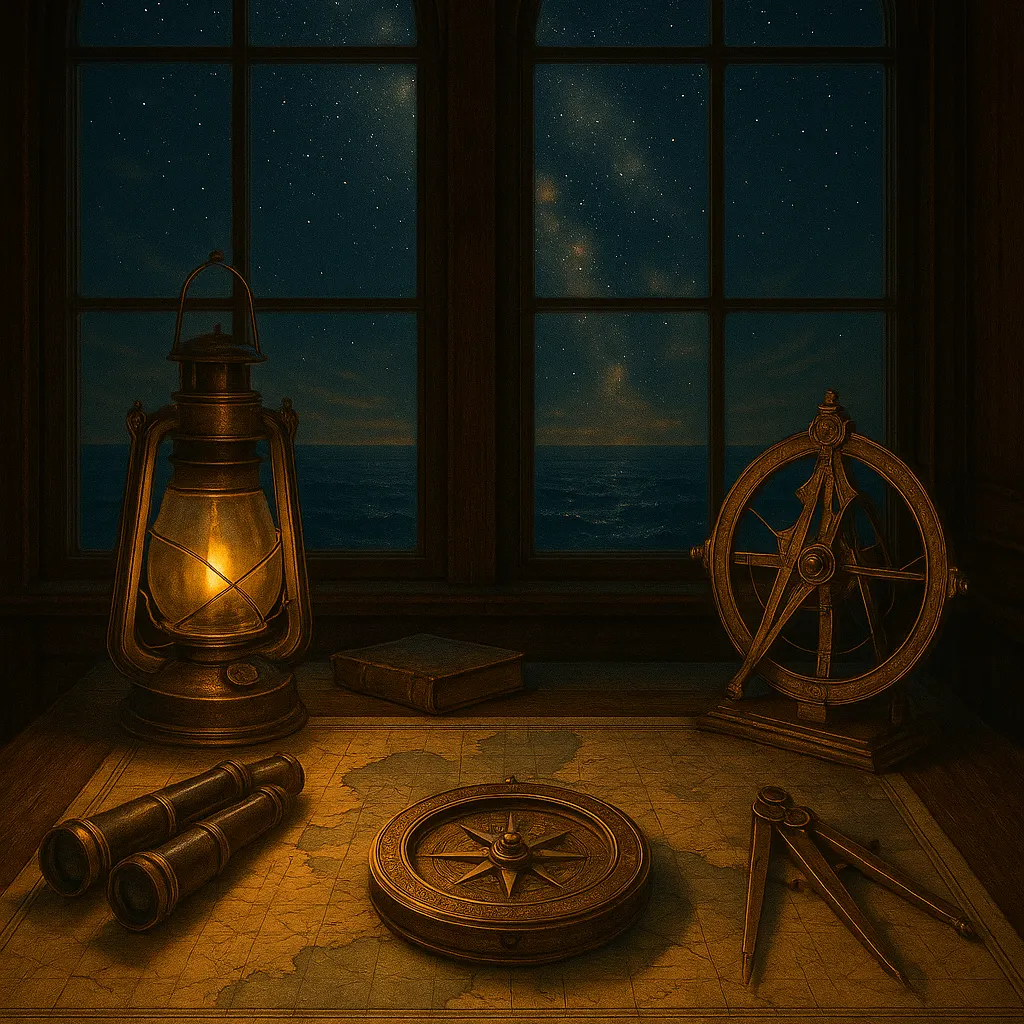
What the deep brain flags as meaningful becomes the material of your internal cartography, a map of what matters, what doesn’t, what threatens, what inspires. You’re not just mapping mountains and rivers, you’re deciding what counts as mountains or rivers. What populates your map does so because you decided it was worth putting on the map in the first place through your own process of cartography.
The fixed points you’re navigating between, were fixed by you, or more specifically your deep brain. The meaning of reality you think is so factual and obvious, doesn’t just appear, it is constructed by your brain. While it seems universal, this terrain is personal. What one person avoids, another seeks out. A winding trail for one may be a well-lit boulevard for another. These differences aren’t moral or logical; they are interpretations. What feels real is actually just what feels familiar.
Moment by moment, the map of fixed reality you’re reading, you just created.

Creating the Compass: How We Decide What Matters
Old world maps were often decorated with mythical animals on them to mark the unfamiliar as dangerous. The Lenox Globe of 1510 actually has the words on it, “Here be Dragons” (Latin: hic sunt dracones). We’ve done the exact same to the maps we’ve drawn to navigate reality.
The complex emotional tagging system of your deep brain is not only telling you what makes up the map, it’s telling you how and where the meaningful directions are. What is passable or not was decided by you. Your map shows meaningful space that can be navigated, your compass tells you how and which direction to go. These signals that say “go this way” or “don’t go there” are the result of reinforcement, not revelation.
Your compass is built from repetition, social influence, and past outcomes. You learned what earned reward or sparked rejection. You absorbed values from those around you and internalized the directions they pointed toward.
You are not just holding the compass; you tuned its needle and then you follow it. At the same time, your brain is inventing the map and then deciding where true north lies.
Setting the Patterns: How Meaning Becomes Instinctual
Where did all this pre-meaning come from? Patterns begin forming as soon as your consciousness emerges. Repeated emotional experiences create highways in your neural circuitry, shortcuts that turn signals into instincts.
The people around you reinforce these shortcuts. They model, mirror, and respond, embedding cultural norms into your internal map. Over time, these grooves deepen. They feel natural, even inevitable.
But familiarity is not truth. The most traveled path isn’t necessarily the best one. It’s just the one you know.
This is how you created your instinct. And you need it. It’s a very useful tool that gets you through most of the day. You do not have the time or energy to engage with your complex navigational process at every moment. But instinct is not ancient wisdom, just memory with authority. It’s formed from what has been working until now. That becomes the path you walk by default. Instinct works until it doesn’t. That’s when someone has to take the helm.

The Journey: Meaning in Motion
Just as the fixed points on your personal map of reality are constructions, meaning that you made them fixed, so is the notion that it is all unmoving and immutable. Each moment we test, reinforce, and revise our internal systems by acting. Every step updates the map and compass we’ve constructed as no step is exactly like the one before. We are always on the move, evolving. The trail you take reshapes the terrain, which reshapes the trail, and so on.
Meaning is not static. It is generated in motion. Our beliefs are clarified, challenged, or calcified through what we do. Looked at together over a period of time, single steps form trails. In turn, and in collaboration with our society, we form tradition by grouping those trails together. But tradition soon recedes into legend because humans never stop moving. We stretch out this meaning to the horizons behind and in front of us. But that’s not how we live. We live in the step we’re taking right now, in the present. That step feels reasonable because it aligns with the meaning we just created and imposed. Overall, we tend to take steps, then assign meaning later.
We reinforce our interpretation of reality through living it. The maps we drew and the compasses we tuned aren’t just guides; they’re shaped by every step we take. This cycle is how instinct is reinforced but also shows us where conscious navigation becomes possible, if not necessary. We’re making it all up anyway.

Navigating with Intention: Acting Meaningfully
For most of life, autopilot works well enough. It’s instinct, built from patterns that have served you. But it’s not exact or fully present. When something truly matters, when the stakes are high, or the work unfamiliar, autopilot will drift if not fail. It cannot measure and account for complexity it has not learned yet. It can’t keep in mind new factors it has to consider and demands it has to meet. Letting old coordinates steer a new voyage is like setting sail without establishing where you are going, how long you’ll be gone, what provisions you’ll need, or how you can resupply.
Any meaningful project or relationship will demand that you take the helm, examine your goals, and chart your course deliberately. For meaningful work, you must pause. Ask: Where am I going? Why am I going there? And by what values am I navigating? While this work seems heavy and time consuming, it is not. You’re doing it anyway. Without this essential neurocognitive work, you will wander, waste time, effort, and resources.
Exploration is noble when discovery is the goal. The resources expended in the experiment are well spent, as they were intended for that. But if you need to get anywhere, you’ll need to chart a course.

Dead Reckoning: The Art of Purpose Making Without Absolutes
Dead reckoning was the process sailors used to calculate where they ought to be before the invention of celestial navigation, or when the stars were not visible. Celestial navigation provided fixed absolutes in the sky from which sailors could figure their position. While we feel we are navigating by absolutes, like the sailors with their sextants, we in fact are not. We’re dead reckoning, making it up as we go along, all of it, the sea, the boat, the rocks, the stars, and constellations we navigate by – we’re the makers of meaning.
Purpose isn’t an abstract concept. It is a process, a neurocognitive sequence of filtering, assigning relevance, encoding emotion, and taking action. It happens moment by moment, whether you recognize it or not.
You are always underway. But how are you steering?
When it matters, do you take responsibility for how you make meaning and consciously participate in structuring that process? When it matters, do you take the helm or let the currents decide?
You are never anchored. The strength of your purpose floats like the needle of a compass between unconscious autopilot and mindful intention.