
In one secondary school I had worked with in the US, two chemistry teachers with adjacent classrooms spent their own money and free time to turn both into two different sets of the starship Enterprise from TNG. Each day they wore their uniforms and invited their students to join in their simulation. Activities, lessons, and benchmarks from the curriculum were restructured into scenarios within the Star Trek universe. It took a little while for them to work out all the kinks and get into a seamless flow, but their fandom and ingenuity delivered far greater rewards than the sum of their work and investment and far more than they could have anticipated. The students, barely born when TNG ran, responded to the set-up as passionately as the teachers, not making the classes very popular but instilling a passion for learning that was reflected in their grades.

Recently, when talking with a colleague, who is also an accomplished actress, while discussing the power of context and narrative, we imagined a scenario: she had landed the role of Wonder Woman in an upcoming film and the shooting began in a month. She realized that while it would be hard work, she could easily achieve that ripped look to pull off a superhero through a proper regime of diet, exercise, and possibly working with a trainer. The thing is that she knows now exactly what to do regardless of the promise of the role. While she is fit above average normally, like any of us, she feels she could improve. Body image aside, the situation and narrative is not enough for her to make this a priority even to get to a goal less strict than that of the famous Amazon.
In both examples, narrative plays an important role in driving action. In both cases the program or curriculum already exists. The roadmap is not missing. In the first example teachers used narrative to instill drive in their students and in the second it’s used to make a vague goal into an achievable target.
In his must-read 2022 book, Laziness Does Not Exist, social psychologist Dr. Devon Price, delves into how the research has long understood the role of situation, context, and narrative in predicting behavior. Procrastination, he writes, is not a character flaw or problem to be solved with discipline, but a symptom of an individual’s situation and position within that. The context creates a narrative in our head that causes us to delay or fail to perform completely. Thinking that this can be solved by trying harder is as delusional as thinking you can move the moon off course by concentrating hard enough.
In an earlier article I pointed out how we use methodology grounded solidly in neuro and cognitive sciences to teach language acquisition, literacy, to children. Yet we then turn around and teach adults a second language with no real strategy or processes long debunked. The body of research in this field is generally called the Science of Reading. It has been proven to apply to all languages with an alphabet and so tends to have a different name in other languages if at all. The point is the thesis of how we learn and use language based on the way the brain works, literacy is achieved through the mastery of a set of primary skills, each made of sub skills, that all work together in a rich ecosystem in the brain. As the brain achieves mastery in these distinct skills, language quite literally flows out without consciously clambering through grammar rules. Through research, we are successfully applying this thesis to other disciplines as applicable and to human development as a whole. However, this comprehensive curriculum to achieve language mastery is not enough.
Imagine the entire set of skills detailed out as a map in front of you showing you the path from beginner to fully literate in a particular language. This map alone lacks terrain and live reports on the weather. I’m straining the metaphor to show how the map is not enough. It is absolutely groundbreaking and necessary. But without the proper context and narrative, you or any student won’t get very far down its path.
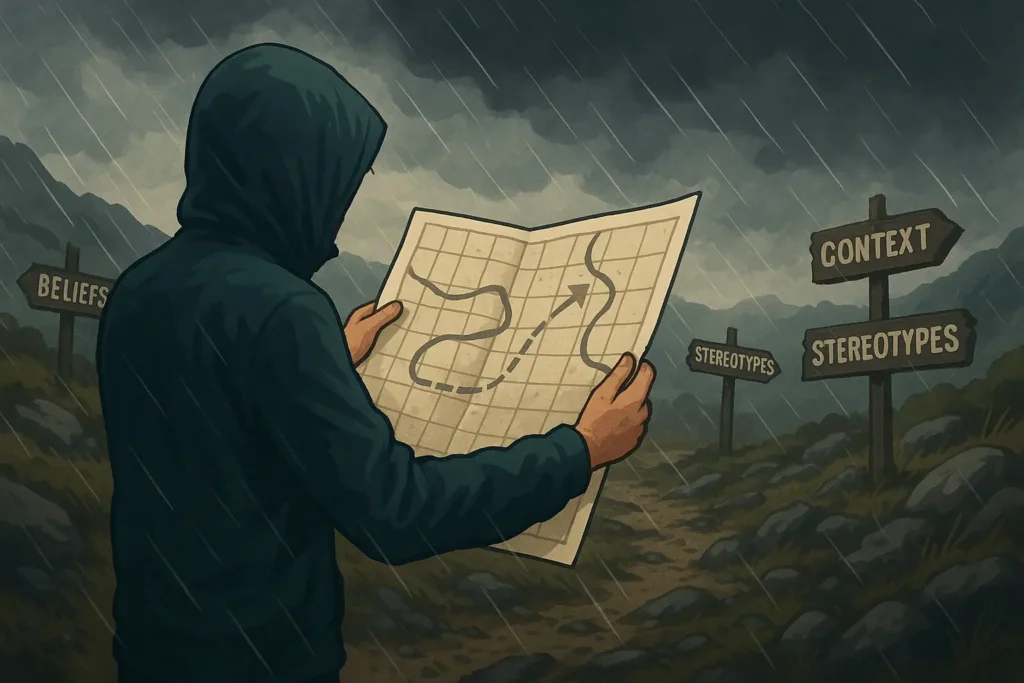
For children, this context obviously extends outside the classroom. Conditions at home will enhance or delay certain developmental skills and determine educational success. For example, an unstable home, filled with conflict, causes young children to develop peripheral vision rather than perpendicular or binocular vision, required for reading. Even a stable home without books or parents who read fails to extend the relevance and power of reading in the greater world in the mind of the student. It’s well researched that students whose parents read fare far better than those that don’t, a challenge exacerbated by our increasingly digital lives (and Tik-Tok rot).
It’s important to note that while parents seem to be at fault, blaming anyone is unhelpful. In fact blame is a situational structure that blocks development. If we want to grow individually and collectively we need to look at blocks in development not for the purposes of performatively “taking” or placing responsibility but to understand the mechanisms causing a situation so that we can efficiently disentangle ourselves from them.
Within the classroom, skill with situational navigation can empower or obstruct even the best curriculum. This is why we have a continuously improving set of skills for the teacher simply called best practices, as in any industry. When I was regularly consulting in the classroom, we explained that these practices would streamline the teacher’s work even when they were having a “bad hair day.” It was a colloquial way of developing metacognition of how one was good at what they did, consciously competent, so that their personal mood or situation could be subsumed into their professional situation. For teachers, this is absolutely imperative given the vast responsibilities they have to perform in demanding circumstances.
In the case of adults, the challenge for development is not the lack of will, but the narrative context they find themselves in, which includes what they believe they are inherently capable of. For example, your brain wants to learn language, it loves to communicate. But you might have decided that you are not good at speaking other languages or learning in general. You might think it’s too late or not “your thing.” These feel true only because you believe them to be. Although, also telling yourself otherwise is not going to substantially change the narrative. Referring back to the scenario of getting fit for a film role, the essential pieces that changed the motivation were the sense of purpose aligned with a realistic and easy to articulate and follow plan of action. These two effects changed the situation in this imaginary case through narration.
This mental exercise of imagining a situation with purpose and plan that could change one’s situation so as to address blockage, shows that if we are more intentional with our sense of self, using simple narrative structures innovatively in unison with well defined strategies and plans, all designed to work with our personal contextual present, we could develop in helpful ways, rather than struggle in wishful limbo. Obviously, this is not simple “manifestation,” it requires a holistic shift of certain elemental ways we have of thinking about our value, capacity, and past. Simply demanding that we “fix” our wrong thinking of, say, our value, isn’t going to get us anywhere. We must investigate how we live the “value” of ourselves as a process, the situation in action we reinforce through multiple microactions and almost unseen habits. We investigate without shame, without performative responsibility, instead with curiosity and gratitude (for the lessons — it sounds new agey, but works).
I particularly like this statement from Dr. Price:
“It’s really helpful to respond to a person’s ineffective behavior with curiosity rather than judgment.”
He attributes this awareness to the work of Kimberly Longhofer (writing as Mik Everett), who leveraged their own journey through disability and homelessness to show that situations do not define people at all. We ignore the value of anyone in difficult situations to our own detriment. What follows is that just as we acknowledge our cognitive identity (or at least personality), we should also understand our approach to our narrative patterns that form our situations. These approaches to situation are not whats but hows, not fixed truths but learned processes, which we can use to bring us towards peace rather than stress.
This further demonstrates my notion of seeing identity not as a monolith but a quantum field or wave, defined not by fixed traits but by how our cognitive patterns express themselves across possible situations. Observation collapses potential into choice, and the self takes form in relation to context. Who we are isn’t just who we are, it’s who we become when the moment calls us forth. Cognitive identity is a wave of potential that becomes observable only when refracted through the lens of real-world situations.
Consider an adult learner who’s always struggled with math. She avoids numbers in daily life, believing she’s “not a math person.” But then, she’s offered a promotion — one that involves budget oversight. The job comes with training, mentorship, and a specific goal. Framed within this new story, her relationship to math changes. It’s no longer a judgment of her intelligence; it’s a skill to serve her growth. Within months, she’s not only managing budgets but helping others demystify the same tasks that once froze her. The math didn’t change. The story did.
The thing here is that the situation is formed of the set of circumstances you have at the moment. Many of these may not be readily mutable. However, they aren’t the most important part of the situation that determines your value and capacity, they are just there. The way you configure them and your relationship to them does. Many times we are simply accepting society’s interpretation of these circumstances, rich means you’re valuable, your job or partner status defines you, etc. These are by default reductive and if laziness does exist, it’s in this process of stereotyping. The truth is that different narrative practices can radically reconfigure the meaning of the same set of circumstances, your role could be victim or agent, villain or antihero, loser or learner, and so on. The same person who finds themself “homeless” can be forming a powerful story of transformation, step by humble step. They are not a fixed point but a waveform: capable of collapsing into despair or rising, when met with a reframed context, into self-definition.
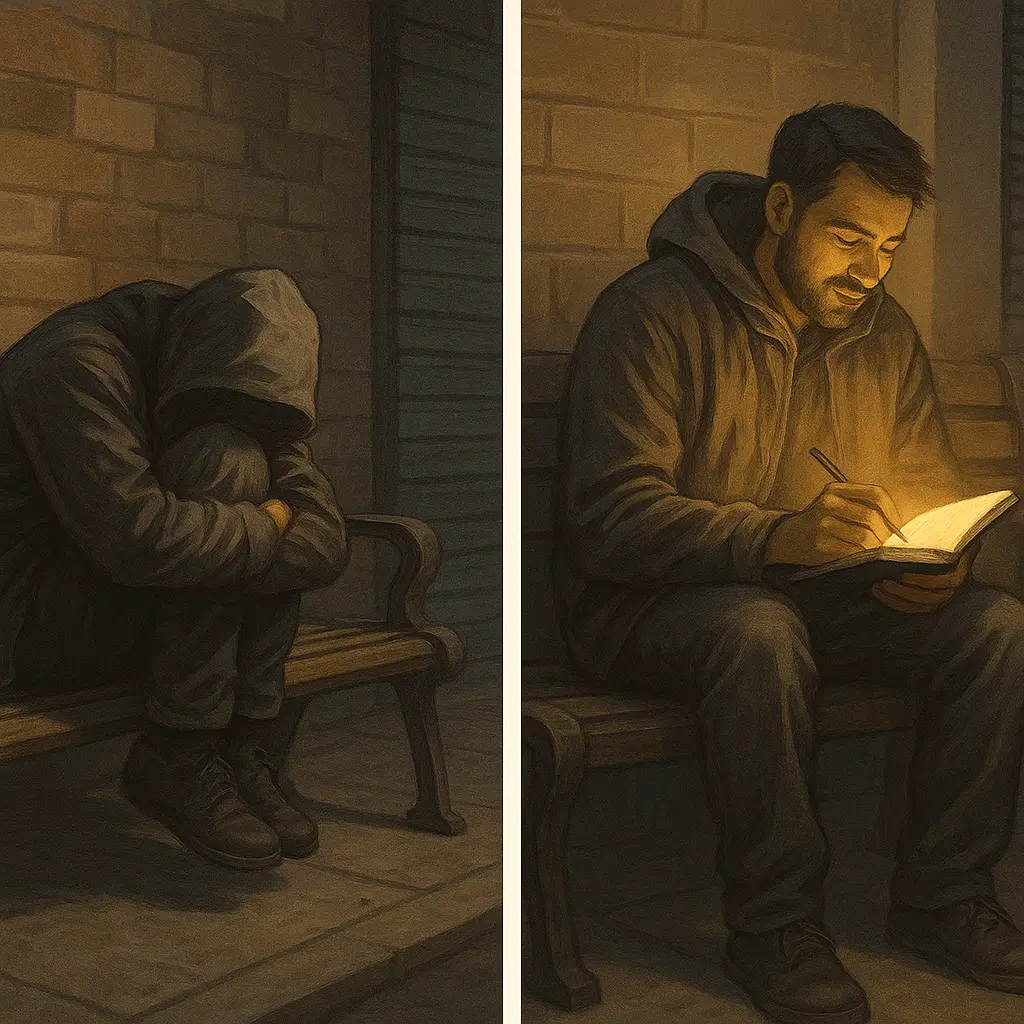
Same situation. Different narrative. Different self.
The story you believe you’re in determines the action you’re willing to take, no matter your strengths. To develop you must see yourself not only with agency but within a narrative that makes action meaningful. Our story isn’t a limited statue we chisel out from stone. It’s a field, always forming, shaped by what we see, and how we choose to see it.

NOTE: I use the term “taking responsibility” in quotes to refer to the performative action reserved for apologies. In the right context, it is cathartic and liberating. However, “taking responsibility” in that manner in the context of investigating why you are blocked, or don’t develop, can also be a cop-out, emphasizing the shame and blocking any ability to actually do anything about anything.