
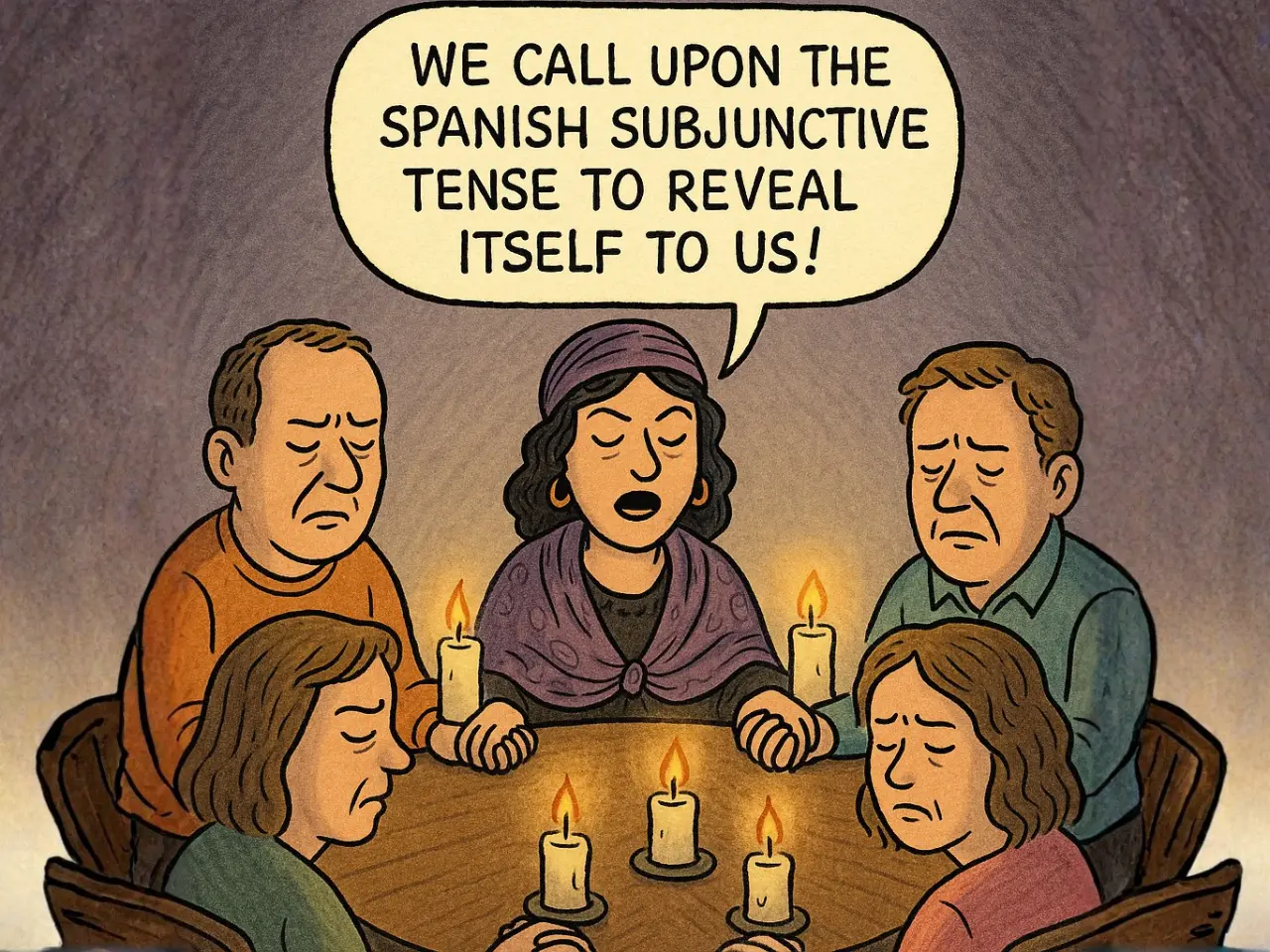
If your brain has already mastered fluency once, it stands to reason that the most efficient path to doing it again likely lies in retracing those original steps. Yet most adult language instruction veers wildly from this principle, defaulting instead to rule memorization and grammar before mastery of basic syllables.
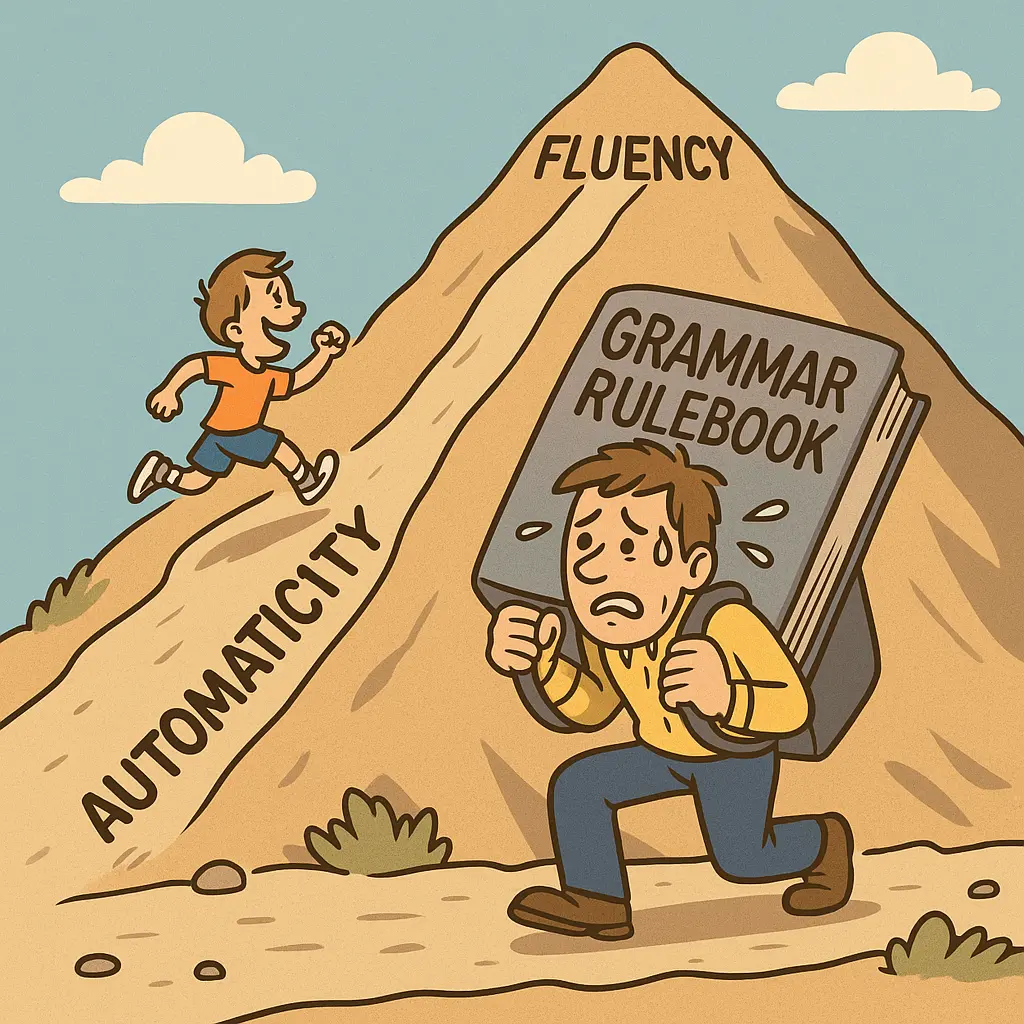
First language acquisition has been studied for decades. We’ve moved past the era of phrenology-for-the-classroom and into more rigorous understandings of language development. And yet, until quite recently, many schools across the U.S. used the now-debunked Three-Cueing system, which claimed children learn to read through 3 cues, semantic, syntactic, and graphic (context, sentence structure, and visual cues; Larry, Moe, and Curly). This is linked to the While Language theory, which believed students developed language mastery through immersion or maybe it is osmosis. In reality, that’s about as effective as learning to swim by watching synchronized diving.
It always amazes me that people who would carefully plan and take strategic steps toward goals like financial independence believe that something as complex and crucial as literacy or fluency should just happen through immersion. It’s like expecting to grow your savings account by hanging with the well-to-do. Most likely, you’ll end up as staff.
The reasons we are studying language acquisition are to build effective systems for teaching and, perhaps more importantly, to better understand the brain itself. With advances in neuroscience, we’ve come to see that fluency is not through magical exposure. It’s the result of layered mastery: a cascade of cognitive sub-skills working in concert to achieve something fluid and whole. Like a gymnast in flight, the grace of the outcome is made possible by dozens of synchronized sub skills on micro-movements, body awareness, timing, strength, and more, all practiced to the point of automaticity. The accomplished gymnast enters a state of flow with all these collaborative skills.
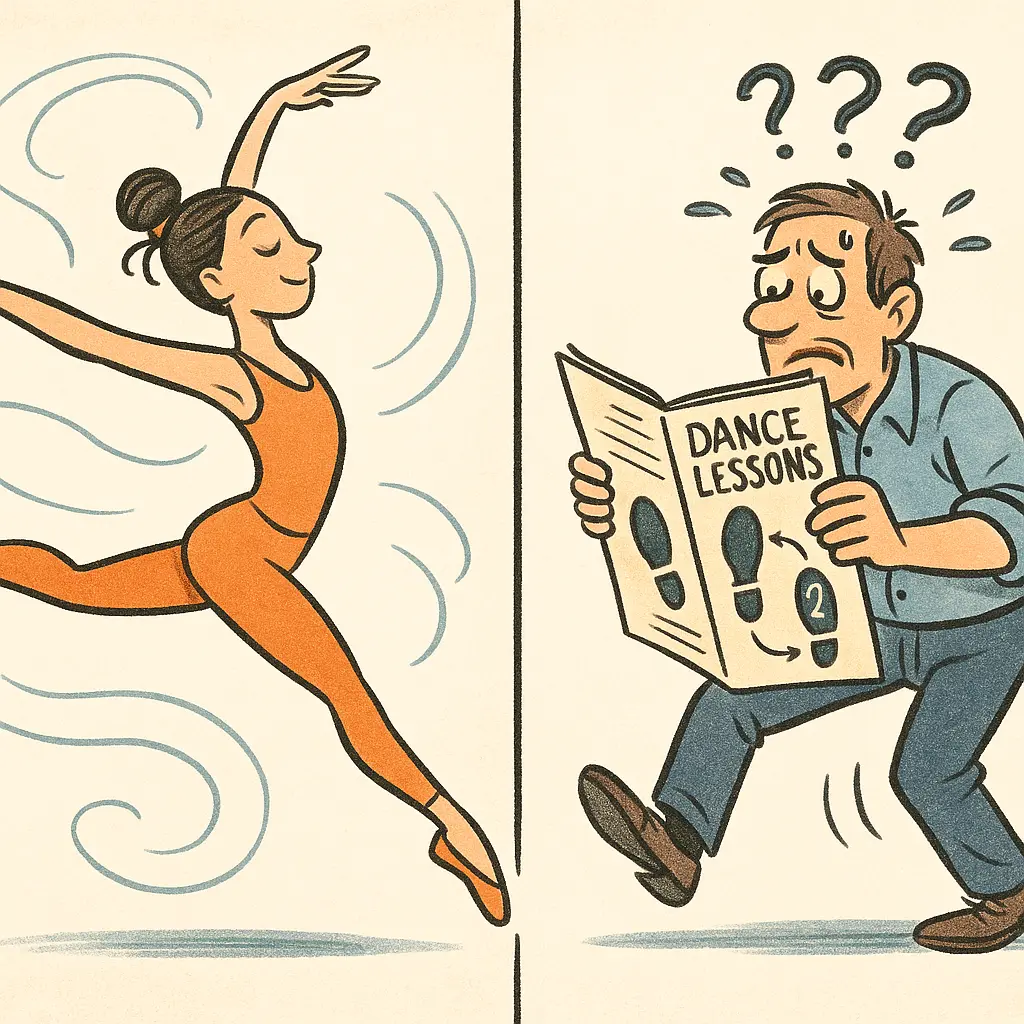
Similarly, you are not consciously aware of all that’s happening when you speak. You don’t painstakingly construct your sentences, you just open your mouth and have at it. Your phonemes, syntax, vocabulary, and rhythm flow together in effortless sequence while your focus rests, if anywhere, on meaning (well, one hopes). The complexity is truly astounding, but you navigate it unconsciously.
We now know that language is acquired through a structured sequence of neurological and cognitive processes realized as developments. A child begins with phonological awareness, the ability to hear and differentiate sounds, then builds on that phonics, decoding, fluency, and beyond. Each of these primary skill areas is made up of many sub-skills, which are themselves developmental. With the right input and guidance, even struggling learners can repair gaps, a missing sub skill or two, and move forward very quickly, within days of systematic and explicit instruction. This is the backbone of the Science of Reading, which is used in most classrooms now in many languages (the name is not important as it’s not an official program from any one source. It’s a synthesis of decades of research on how language is actually learned).
Whether or not your teachers followed this approach, your brain did. And that’s the key. The Science of Reading reflects how the brain builds fluency through interdependent sub-skills, developed in logical sequence. It’s not just pedagogy, it’s neurology.
If this is how the brain achieves fluency in a first language, why don’t we use the same map when teaching adults a second one?
It’s safe, and being proven accurate, to extend this developmental compass to other complex domains of knowledge. Many follow similar layered acquisition patterns. With a bit of research we are discovering the primary and sub skills for other disciplines and overall human development. At least this is my thesis.
In the case of language, these layers are not arbitrary. They mirror how the brain transforms sound into symbol, symbol into pattern, and pattern into meaning. However, this isn’t to suggest rigid instruction. Brains aren’t computers. You cannot simply plug in a curriculum like the science of reading and expect mastery. Real learning and effective instruction are dynamic and adaptive. We also know that circumstance and context matter as much as skill sequence. The process is also iterative, the brain is not learning each skill in isolation before going on to the next. The brain wants to learn and is leaping backwards and forwards sometimes at a fantastic pace. Instilling this understanding of learning and development creates lifelong learners.
So, we know how fluency develops. We know how to recover or accelerate it when it snags. There is no reason adult learners can’t benefit from the same insight. If anything, with proper context and the right dynamic structure, they might progress faster.
So again, the question: if your brain has already achieved fluency and works in this stepwise neurological process, why should learning a second language be approached any other way regardless of age? Why are we reinventing the wheel starting with a block? Why are adults learning the subjective tense before they can properly discern the syllables of a new language? We have the map of how to get where we want to go, just no one is using it.