
ECOLOGY
The study of the human being as a coherent existence.
Neural Coherence Ecology (NCE)
Theory & Model
Neural Coherence Ecology treats the human being as a coherent internal ecosystem, simultaneously interdependent with an external ecosystem, society. It proposes that the ongoing living alignment of four core neurological Infrastructures in continuous exchange with that external ecosystem, the state and work of coherence, is what sustains homeostasis, and that sustained homeostasis is quality of life.
The crucial difference between the human’s internal ecosystem and another example of an ecosystem is human higher-level cognition and agency. An ecosystem like a coral reef is adaptive and dynamically stable, coherent, under the conditions that it evolved within. But it has neither agency nor self-reflection. Humans possess a qualitatively different capacity to become aware of conditions and deliberately intervene in them. Higher-level cognition is a trait of resilience and includes the capacity to predict and test notions, self-awareness, and language. Humans, especially in groups, can interact with their conditions, move, build, invent and use tools of increasing complexity, and steward other ecosystems to their own benefit. But such capacity is a double edged sword. Human interventions can either accurately respond to their conditions or misread them. Incorrect assumptions, unexamined solutions, and misinformed reactions can undermine stable lives with disastrous results. Doing the work of tending one’s internal ecosystem well, with vigilant awareness exercised in an attitude of humble curiosity, is the only coherent response.
Rather than treat the human being as a machine or a computer, NCE treats the individual as an internal ecosystem, interdependent with an external ecosystem, society. Higher-level cognition matures only inside a social environment capable of sustained feedback, correction, modeling, and shared attention, which is why society is a biological imperative rather than a setting the human being happens to occupy.
Within NCE, quality of life, wellbeing, is defined as sustained homeostasis across the human being. It is not the attainment of hierarchical needs, and it is neither the absence of dysfunction nor a subjective report. Both of those would locate the condition in a part or in an impression of a part, and homeostasis of this kind is a property of the ecology as a whole.
The Four Infrastructures
Of the coherent human being’s existence
Non-hierarchical and interdependent. The order in which they are listed reflects conceptual convenience, not sequence, dependency, or precedence.
Rhythmic Homeostasis Infrastructure: Rhythm
Sustains the physiological baseline of the organism, the timing and internal state that hold across the day and across longer cycles, and that remain stable and predictable enough to be relied upon by a brain capable of higher-level operation.
Sustained absence of the conditions it requires produces exhaustion, sensory instability, and chronic alarm, diverting resources toward basic survival maintenance. Tended to sustain coherent rhythmic stability.
Emotional Activation & Modulation Infrastructure: Activation
Sustains the internal emotional and energy climate of the ecosystem. It provides the flexible capacity to shift between high-energy engagement and calm, among many other states, as circumstances require.
Sustained absence of the conditions it requires manifests as chronic hyper- or hypo-arousal, burnout, panic, or pervasive apathy. Tended to sustain coherent equanimity.
Cognitive Patterning & Integration Infrastructure: Patterning
Sustains the models by which the organism anticipates and interprets what it encounters. It filters and synthesizes large volumes of raw input rapidly into coherent and usable mental models and internal narratives, and it revises them wherever those models meet what they did not predict.
Sustained absence of the conditions it requires manifests as cognitive overload, attentional fatigue, or decision paralysis. Tended to sustain coherent integration.
Social Synchrony & Expansion Infrastructure: Synchrony
Sustains the connection of the individual to the people and community they live among. It carries the accurate reading of complex social cues, empathy, and the modeling of other minds (theory of mind), and it is the means by which an individual extends their neural ecology into a shared social space.
Sustained absence of the conditions it requires manifests as isolation, sensory overwhelm in groups, chronic misreading of cues, and a sense of being out of step with one’s community. Tended to sustain coherent expansion.
Together, the four Infrastructures constitute an ecological model of neural interdependence. Each participates in the work of the others, and the state of each registers in the rest. The consequence is that homeostasis is not divisible by Infrastructure. This is where models that arrange human requirements into a sequence of tiers fail. They treat a lower tier as completable on its own, when in practice no tier is available in isolation from the rest.
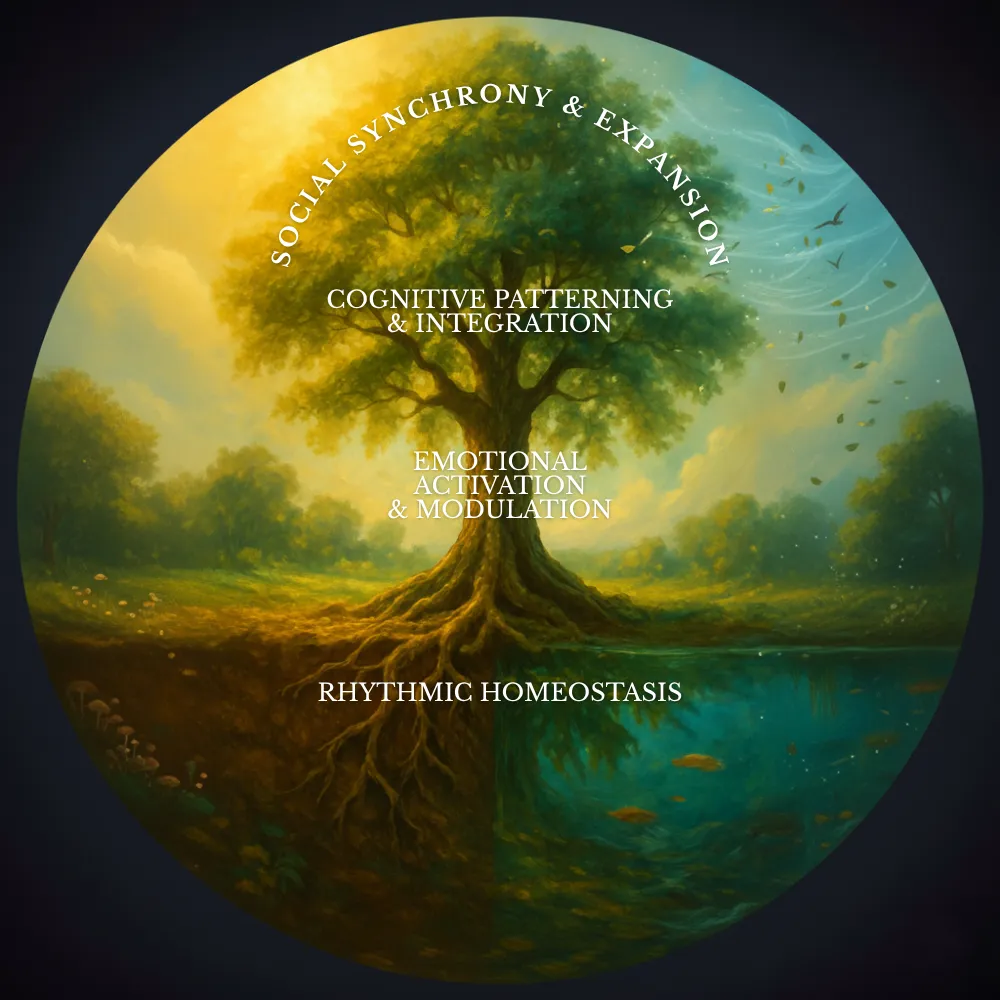
Coherence
Coherence describes parts standing together so that the whole endures and is intelligible as a whole. This framework uses the term strategically, to describe various important and helpful nuances of what it means in this use.
Within that application the term carries three distinctions. They are layered and interactive, rather than ranked. The first is the given from human existence. The second is the work described towards sustainable wellbeing. The third is the developmental horizon, the potential of refined homeostasis and human capacity..
The given. The human being is coherent: an interdependent ecosystem whose parts operate in sustained relation, not a quilt of mismatched components and not a mistake. What supports the claim is persistence.
The work. The ongoing living alignment of the four Infrastructures under real conditions, sustained through pattern and tending over time. In this register coherence is not a fixed state and not an achievement. It is daily, it does not conclude, and it must be practicable by anyone.
The developmental horizon. The state in which the alignment endures in sustained integration, so that engagement with the world and others is generative rather than costly and no part of the ecology is being spent to hold another together. Like mastery, it is developed into a sustained existence. It is not a one-time goal, nor ends. It is the obvious and accessible range of most coherence, but is not required of anyone as described.
STEWARDSHIP DOMAINS
Each a theory and model in its own right. Each the same ecosystem entered at a different vantage.
NCE is addressed through three domains: Functional Coherence, Developmental Coherence, and Social Coherence. Each describes the same ecosystem entered at a different vantage: how it operates day to day, how it develops across a life, and how it functions in relation to others.
They are not components of the model of the four Infrastructures, and they do not divide those Infrastructures between them. Nor are they layers to be worked through in sequence. Each is a way into one ecosystem, which is why a single element appears in all three: rhythm is a daily operating condition in Functional Coherence, something that matures and is refined in Developmental Coherence, and something a society either protects or erodes in Social Coherence.
They are called Stewardship Domains because each names what can actually be tended at its scale. Functional Coherence identifies the functions a person coordinates day to day, Developmental Coherence what can be cultivated over time, and Social Coherence the conditions a community builds or fails to build. Tending, and the responsibility that governs it, are the practice; the domains are where the practice applies.
Each domain requires individual responsibility and collective conditions together, and none of the three is possible in isolation. What differs across the three is the distribution, not the interdependence. In each, the steward has responsibility and not control.
Functional Coherence Theory & Model (FCT)
Functional Coherence is the operational domain of NCE. It describes how four stewardable functions, Focus, Cognition, Emotion, and Drive, coordinate in daily life, producing either stability and effective action or fragmentation, strain, and overload. When tended well, these functions express as Focus Navigation, Cognitive Composition, Emotional Harmony, and Drive Alignment. Functional Coherence treats these patterns as ecological outcomes rather than deficiencies: signals that can be understood, tracked, and changed.
This model exists to make baseline wellbeing practical and sustainable. Functional Coherence is applied in the Neurodiversity Protocol (NDP), coherence-based design, and the evaluation of whether a routine, environment, workflow, or support plan is stabilizing, destabilizing, or restorative. Read more on the Functional Coherence page.
The Multifunctionality Property. The Functions are not a second account of the four Infrastructures and do not correspond to them. Each Infrastructure participates in multiple Functions and each Function is performed by multiple Infrastructures. Regardless of the similarities in the names, such as the Cognition Function and the Infrastructure of Cognitive Patterning, there is absolutely no one-to-one correspondence between the sets.
Developmental Coherence Theory & Model (DCT)
Developmental Coherence explains how coherent capacity develops over time, how conceptual structures form, refine, and transfer across domains and across the lifespan. It defines mastery as integration and usable transfer, and it provides the basis for mapping development into explicit, teachable pathways. Within Developmental Coherence, the Purpose Throughline names the mechanism by which meaning becomes identity and identity becomes sustained action.
Developmental Coherence is operationalized through: Mastery Progression Theory and Model (ARTESIAN’s theory of how mastery emerges, in whatever form the student and context require).
Developmental Coherence takes shape in: Story Builder, and it informs the developmental sequence of DRIVEN and DRIVEN ART, phases, milestones, and progression logic. Read more on the Developmental Coherence page.
The Other Face of the Work
DIVERGENTE is the artistic and phenomenological expression of the same inquiry NCE pursues scientifically. Where NCE describes the human being as a coherent ecology and meaning-making as a neurological process, DIVERGENTE explores what it feels like to live inside that ecosystem, through narratives across media. The creative work generates phenomenological material the science alone cannot access; the theoretical framework gives the creative work a structural depth and conceptual precision it would not otherwise have.
Read Further
Everything on this page is an overview. The thinking is developed in full in the essays, which is also where the current long-form work on Social Coherence is being written.
Social Coherence Theory & Model (SCT)
The domain of NCE concerned with the ecosystem in relation: how individual ecosystems function together, and how social systems can be built and revised so that they sustain the ecosystems composing them rather than extract from them.
Its ground is the biological imperative of society. The individual and the social are not sequential, and this domain does not describe what becomes available once individual needs are met. Homeostasis is never solitary for a species whose higher-level cognition matures only inside sustained social feedback, which means the social conditions are conditions of individual homeostasis rather than a later concern.
Its theoretical ground is the neurobiology of fairness and reciprocity: humans are unusually cooperative among animals, and sustained cooperation depends on specific structural conditions rather than on goodwill. Social Coherence specifies those conditions as equitable opportunity for individual development, role differentiation that reflects actual variation in capacity and interest, authentic value exchange that distinguishes genuine contribution from extraction, and the voice, dignity, and belonging that cooperation requires.
Where these hold, the exchange between individual and society is informative and sustaining. Where they fail, the same exchange extracts, and the individual ecosystems composing the society destabilize. Read more on the Social Coherence page.