
Author: Milo de Prieto

  • Developing the Art of Celestial Navigation

    Developing the Art of Celestial Navigation

    Restoring Executive Function Part 5

    If you ever find yourself in the middle of a zombie apocalypse, the key to your survival is to not join the horde.

    You’d think that is obvious. Apparently not.

    A general, helpful rule of thumb is that if someone who doesn’t have your best interests in mind offers you limited options, the wise move is not to negotiate but to walk away. The same applies to those trying to profit off your distraction. In digital culture it is possible and in fact necessary to do exactly that, walk away, join the resistance.

    Walking Away from the Casino

    We don’t argue with mediocrity, we chart another course. Even without the risk, a well lived life means choosing where we place attention and how we build connection. Rather than join the horde you can join the rebellion, choose what and how you use tech and engage with digital culture deliberately as if your life depends on it.

    In part 4 of this series, I mentioned how we need an economy built on marketplaces that resemble the Roman Forum, a place of real civic and value exchange, where ideas are tested, refined, and built upon. Instead we’re given a cheap version of Vegas, what I call the zombie economy.

    Reclaiming executive function, and your life, begins with three gestures: walking away from what corrodes, choosing deliberately how you engage, and joining the rebellion through tools that don’t depend on cheap tricks for fast cash.”.

    It’s Vegas vs. the Forum, one holds your future and wellbeing, the other doesn’t.

    Executive Functions as Skills of Navigation

    The skills of executive function show us not only how collapse happens, but how recovery begins. Each one has been corroded by the zombie economy, yet each can be reclaimed through small, deliberate practices.

    Working memory is flooded with trivia until no thought takes root. To restore it, draft first yourself before reaching for Google or AI, letting your own words carry weight before asking for refinement. Inhibition has been eroded by endless novelty, but it can be rebuilt when we design friction into our lives — baking instead of buying, placing the phone out of reach, treating pause as an act of dignity. Cognitive flexibility collapses when everything demands instant response; it returns when we schedule transitions, when we allow ourselves the time to shift direction rather than expecting to turn like a sports car at every demand.

    Emotional regulation has been hijacked by media designed to inflame, but it can be restored in slower spaces: conversations, books, art, anything that requires digestion rather than binge and purge. Task initiation stalls in an endless stream of distraction, yet momentum is always possible when we begin with one small action, then the next, then the next. Planning and prioritization dissolve under the pressure of perpetual now; they recover when we map goals into steps and sequence them toward the horizon. Organization falters when every notification insists on being urgent, but it strengthens as we give order to space, ideas, and materials — making clarity visible. Self-monitoring becomes distorted when algorithms supply empty feedback loops; it becomes real again when we pause to check progress, recalibrate, and correct course. And time management, impossible when hours vanish into digital noise, returns when we treat time not as a clock but as capacity, something to be allocated with care.

    These are not glamorous acts. They are disciplines. And like art, they require patience, rigor, revision, vision. From the caves forward, art has always been our rehearsal for living meaningful lives.

    Art as Discipline, Not Ornament

    To paint, compose, or sculpt is to practice working memory, inhibition, sequencing, patience, and revision. Art has always been our rehearsal space for executive function. This makes it essential, not optional.

    It is the process of building a life of daily actions that restore coherence. The executive functions we’ve allowed to atrophy can be strengthened, the same way those who live with neurodivergence have had to do consciously all along.

    Walking away from the zombie economy means refusing to feed the casino. It means stepping into smaller, slower, more human spaces: the Fediverse, Mastodon, blogs, and real conversations online and off. It means treating technology as a tool for life as art again, not a master

    Years ago, before Facebook, I joined a fitness platform that doubled as a forum. The conversations felt like they were happening in real life over coffee or a beer, present, respectful, even joyful. Until one day, a member, young, handsome and fit, suddenly posted doubts about his looks, fishing for compliments, way off-topic and wildly out of place. Imagine someone commandeering a conversation is real life, with a statement like that. Others authentically tried to reassure him, but as you can tell it didn’t fix his self doubt and instead signaled the coming apocalypse. Within a short time the platform was unusable, full of raw ego, the posing and trolling we are used to today. Like the internet in general, what had been authentic became hollow.

    But what was lost can be found, rebuilt with awareness to be relevant today. This is the digital forum as Forum that we need. Life is an art that we must learn to re-fine.

    Together, away from the cheap casino, we will build the acropolis and the city of lights,.

    Person overlooking a large illuminated temple at night under a sky filled with constellations.
    A real digital forum of authentic, artful exchange shouldn’t be a dream, but a reality.

    Building Something Real

    The zombie economy will collapse under its own weight, but it doesn’t have to take us with it. Walking away is only the first move. The next is to build again — not spectacle, not distraction, but spaces designed for meaningful lives.

    The fediverse is one such attempt. Unlike the monoliths of social media, it isn’t a single platform but a constellation of them — Mastodon for conversation, PeerTube for video, Pixelfed for images, and many more — all connected but not owned. Each is smaller, slower, more human by design. Instead of one casino dictating the rules, the fediverse works more like a federation of neighborhoods, each with its own culture but all able to speak to each other. It is not perfect, but it is proof that we can choose tools that support authentic connection rather than consumption.

    What matters is the principle: stop feeding the slot machines, meet again in the Forum. Use digital tools for scaffolding genuine exchange. Let these spaces remain imperfect, quirky, resistant to takeover — because their value lies not in scale but in integrity.

    Reclaiming executive function is not a private luxury. It is a civic act. Only with coherence can we tackle climate change, reform education, or coordinate on anything that requires sustained focus. The art of navigation isn’t lost. It is practiced daily in these small, deliberate acts. As a civilization we can return to navigating by the stars — building constellations of connection and forums of exchange that endure.


    Read the Rest of the Series:

    This is Part 5 of a 5-part series on Executive Function — what it is, how it breaks down, and why reclaiming it matters now more than ever.

  • The Lost Art of Collective Navigation

    The Lost Art of Collective Navigation

    Restoring Executive Function Part 4

    Our digital culture delivers the same value as a zombie’s sex appeal.

    This isn’t the work of evil masterminds. It’s the handiwork of mediocre opportunists. There’s no conspiracy other than trying to pretend these shortcuts to building real society and markets, hastily stitched together, is sustainable. The tech-bros posture as visionaries, but the design isn’t brilliant — it’s basic. A casino for your brain, engineered not to develop you but to drain you of personal and financial value.

    We’re not Luddites resisting technology. We’re resisting entropy and mediocrity. We want real progress. We want better.

    Slot Machines & Firehoses

    While there may have been an actual desire at the beginning to innovate real progress, the effort collapsed into a scramble for short-cuts to wealth. The drive for cash replaced the drive for value. Instead of innovating real benefit, they went for a quick buck using design shortcuts, public subsidies, and con-games – like devices that need to be replaced every 3 years.

    There’s a reason Google’s corporate motto used to be “don’t be evil.” The people who said it knew there was a real danger of becoming, well, what they’ve become, a conglomerate mess of mediocrity undermining society. Collective intelligence is a powerful force at the tribe level, up to a hundred people. At the corporate level, collective IQ regresses exponentially. Corporations exist not because of visionary leadership, groundbreaking innovation after innovation, or value to society and the market, but only because of lethargy. They don’t earn their place, they grab it and hold on through bloat.

    Consequently, the digital landscape produced from a couple decades of clamoring for money over actual progress is rather dystopian. Progress is something you build on, not something you have to dismantle to start over again to do right.

    Our digital culture is at best the Las Vegas of design inside and out: a cheap, flashy, noisy facade. It’s culture in the most basic definition. Just barely. Nothing of this will or should last. The user experience and interface of devices, websites, and platforms has been directed not by artists and the finest of human achievement but by the lowest. The digital structures and rooms we spend most of our time in are tacky casinos. We think Paris Las Vegas Hotel & Casino is actually Paris because we don’t know any better. Digitally we’ve never been to the real city of lights.

    Collective Collapse, Publicly Subsidized

    The collapse of executive function isn’t just personal, it’s collective. When attention fragments at the individual level, it scales up into dysfunction at the cultural level. You can’t build coherence out of incoherence. A scattered society cannot coordinate. It goes to war with itself.

    Shared focus is what makes human collaboration possible. It’s how we built cathedrals, launched space programs, and developed vaccines. Musk and Bezos aren’t advancing progress, they’re taking advantage of public subsidies and years of dismantling of the collective intelligence that built the original space program to put their names on it, slowing it down.

    Likewise the zombie economy doesn’t reward collaboration — it rewards noise and superficial appearances. The long arc of problem-solving, the patient labor of discovery and refinement, the creation of an artful life, gets drowned out by quarterly earnings calls and algorithm updates.

    The result is that meaningful progress stalls. The hard work of cumulative knowledge, the kind that builds on itself generation after generation, is interrupted. Instead of a body of shared achievement, we get fractured fragments: viral posts, outrage cycles, short-term hacks. We aren’t stacking stones into an acropolis, we’re scattering gravel into the wind.


    The shallow spaces where this collapse happens reveal everything. We should be meeting in the Forum — a place of real civic and value exchange, where ideas are tested, refined, and built upon.

    At scale, this lack is devastating. A society without executive function cannot navigate solutions for climate change, cannot reform education, cannot coordinate on anything that requires sustained focus. 

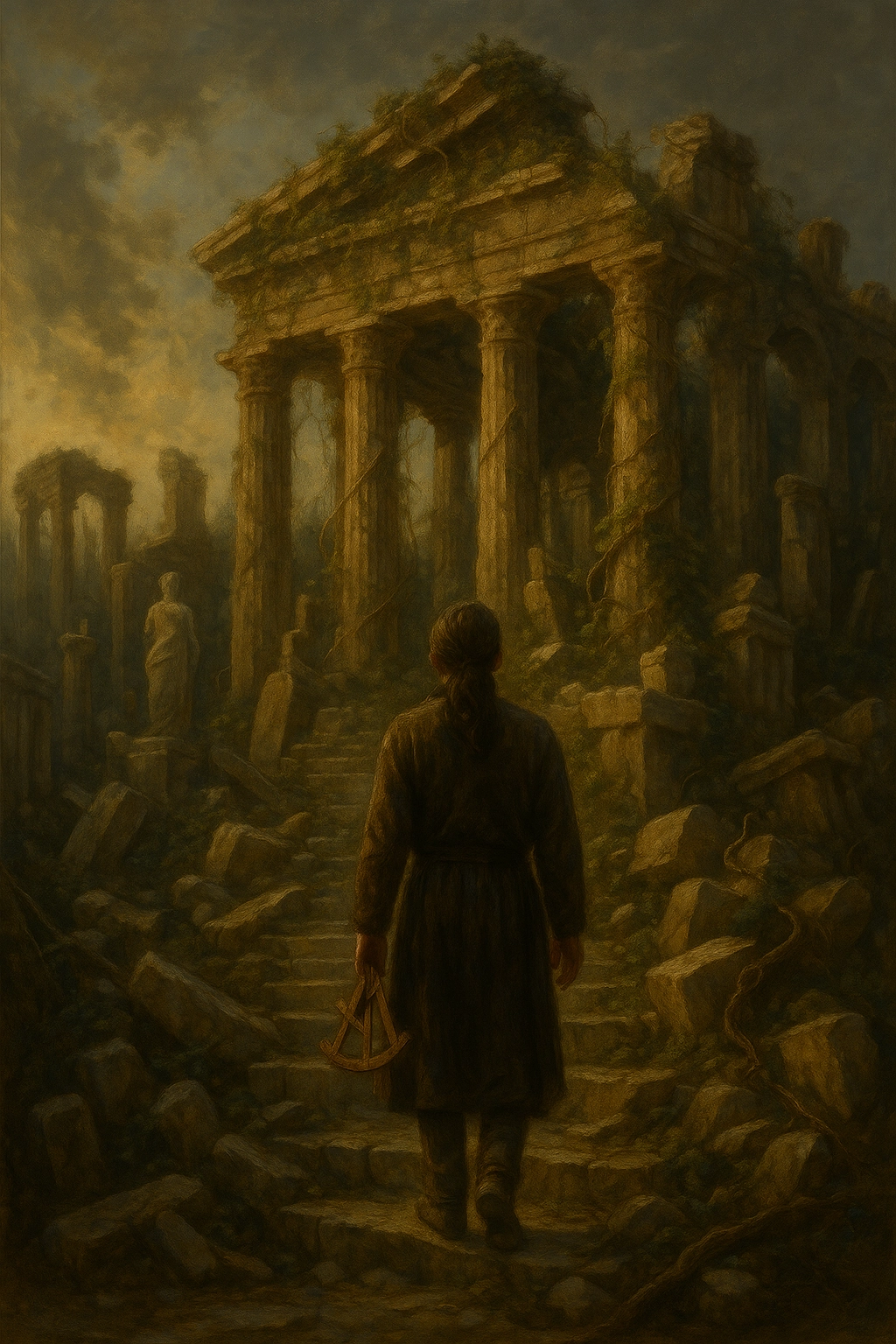
    Person walking toward ancient ruined columns while holding a sextant.
    A civilization that loses the art of navigating collectively collapses.

    False Prophets, Fake Value

    Art, fine art, the hard work required to create it, is the discipline — in both senses — we need to reclaim executive function.

    Where art refines complexity into meaning, contemporary design collapses into the basic, not the brilliant. Humans created art from the days of cave living forward as we need it. 

    The absence of fine art, sublime design, is both the warning and solution. You can’t bypass the hard work required to build real value.

    Strip away their shortcuts, the government handouts — the subsidized infrastructure, the tax loopholes, the deregulation — and the so-called “drivers” of the economy aren’t driving anything. They’re dragging us backward.

    If they were real entrepreneurs, they’d be building sustainable value. That’s an art. Instead, they’re chasing rockets while the rest of us try to make payroll on a platform optimized for distraction.

    We all know it, but keep playing along, building our careers and ambitions on a structure of false returns.

    The valuations are fake. The innovation is fake. The returns are fake. The economic engine is held together with tax breaks and borrowed time. It’s collapsing all around us, the question is do we continue to slide with it or do we begin the work of building something real? That’s an art — and like all art, it demands rigor, patience, and vision.

    What if we simply… stopped?

    What if we walked away?

    What if Facebook, Instagram, Twitter, YouTube, and Amazon collapsed into the algorithmic husks they’re becoming — ghost towns of bots selling to bots?

    What if we used real search engines instead of Google: a data vacuum, optimized for ad delivery and behavioral manipulation?

    These platforms aren’t giving us value. They’re giving us noise. 

    Remember blogs? Newsletters worth reading? Real conversations?
    Remember when the internet was weird, human, imperfect — and real?

    We don’t need to reclaim “social media.” We need to reclaim being social.

    The tools exist. The alternatives exist.

    What’s missing is the awareness that we have the power to choose.

    Let them sell to the bots.

    We can build something better.


    The zombie economy is a casino running on credit — cognitive and financial.
    We don’t have to keep betting against ourselves.
    It’s time to build for real.


    Read the Rest of the Series:

    This is Part 4 of a 5-part series on Executive Function — what it is, how it breaks down, and why reclaiming it matters now more than ever.

  • Navigating by Different Stars

    Navigating by Different Stars

    Restoring Executive Function Part 3

    The Divergent Mind

    Not everyone navigates by the same stars. Even with shared landmarks, the path between them can be wildly different.

    For the neurodivergent mind, the basic signaling that supports daily navigation is inconsistent at best. The brain didn’t develop typically, but that doesn’t make it broken. It’s not moral failure. It’s a different internal celestial map.

    Neurodivergence—covering conditions like ADHD or autism—isn’t a diagnosis. It’s meant to recognize cognitive differences that shape how executive function develops and operates. This language emerged from social justice movements to open up honest public discussion and create environments of grace, support, respect, and real optimization. Our diversity in general is the very key to human success. In this case, you’ll see how this diversity specifically is essential to it now.

    In the neurodivergent mind, the typical feedback loops between impulse and restraint, emotion and action, intention and execution may be delayed, scrambled, or fail to fire altogether. When the internal guidance system falters, even minor tasks become unstartable. A plan that made perfect sense at 10AM collapses under the weight of 2PM. The internal systems that create stability for most are unreliable. And shame takes root in the gap between intention and execution.

    This isn’t laziness. It’s what navigation looks like when your sextant is intermittently functional, or the stars themselves are fundamentally different. From the outside it looks like madness. The reality is more subtle: a different landscape, interpreted through a different filter, producing entirely plausible, but sometimes completely wrong, conclusions. The immediate solution is simply sharing this navigational process with others who understand and can provide reliable course or map adjustments. This solution, creating a shared, open conversation, also allows others to benefit from neurodivergent “superpowers.”

    Those of us navigating by different stars develop strengths that don’t register on standard maps. We pattern-match across noise. We connect disparate ideas. We improvise when systems fail. But the cost of pretending to be neurotypical is real. We burn through cognitive fuel faster. Masking, translating, self-monitoring—it’s all hidden labor, and it adds up. Better to design for difference than demand conformity. We’ll all benefit when we tap each other’s navigational strengths and gifts.

    Youth and the Zombie Economy

    The current digital landscape offers no scaffolding. For the neurodivergent and for youth—whose systems are still developing—it’s deliberate sabotage.

    They aren’t being trained in attention, regulation, or goal-directed behavior. They are being systematically trained out of it.

    Children are most at risk. Many parent groups agree to not give their children a smart phone until the age of 9. The communal approach is key and laudable, but delaying access to smartphones isn’t a fix, it just postpones the inevitable. 

    Screens are the enemy in the same way telescopes, cameras, and printing presses were in their time. They were demonized until normalized, and now even considered beneficial. The solution must be a comprehensive restructuring of how the tools are used, who they benefit, and the market in which they operate. The market is the key: “show me the money.” It’s where we live out what we really believe.

    So, instead of honing their executive function, youth are being trained to shortcut it.

    Instead of holding a thought and exploring its depths, they scroll. Instead of sequencing action toward a goal, developing focus, or learning to build substance, they’re taught to swipe, skim, and chase pings.

    It’s not their failure when they can’t pursue goals, focus, or develop in a system designed to profit off of disorientation. Why blame individuals in an economy that actually rewards scatter and undermines focus, pushes cheap novelty for its own sake and rejects depth as unnecessary.

    It’s important to not get distracted by the symptoms. In children, what looks like apathy is often just cognitive overload. The “lazy” student is overwhelmed. The “inconsistent” adult lacks scaffolding. The “unfocused” teen is drowning in input no brain was designed to handle.

    This is a developmental collapse.

    An entire generation raised on noise is trained to seek shortcuts, not build value. They look for get-rich-quick schemes, like those that made tech-bros and influencers wealthy without having to sacrifice or read much. Forget hard work, that means you failed. And the neurodivergent? We carry double the load—expected to succeed with tools that were built to take advantage of our weakness.

    Person on a ship looking up at constellations drawn in glowing lines in the night sky.
    The stars of the neurodivergent mind are as “real” as those of others, and suggest a course to a new economy that works for everyone.

    The Solution in the Diagnosis

    Neurodivergence isn’t something to fix. It’s a difference to understand. The condition signaled by the term neurodivergence is like being born with an arm. No drug will grow it back. The diagnosis is effective for giving those who need it an intervention to help function in daily life. Medication may act as a prosthetic, helping bridge the developmental gap in executive systems. But it isn’t a cure. It supports basic function. It doesn’t rebuild it.

    What’s needed are practical, durable strategies that work even under stress. But two caveats matter:

    1. Even the best strategies fail without proper systems. Willpower, the “just do X” mindset doesn’t work when the part of the brain that executes X isn’t reliable. Solutions must be deployed methodically, scaffolded with pacing, structure, and internalized feedback loops. This is where tools like gamification are useful.
    2. The neurodivergent unintentionally undermine themselves, getting trapped in overstimulation cycles. In an attempt to meet the need of missing stimuli they overcorrect and navigate into situations that quickly tip into overstimulation. They then seek sensory deprivation to recover, causing the cycle to repeat. While “less is more” is a sublime universal absolute, the neurodivergent is inherently blind to the measurement and only notices the extremes at either end. They are either in a desert in a drought or the ocean during a hurricane. That’s extreme, which also makes my point.

    The people around them—parents, teachers, friends, partners—need to understand these patterns and build support accordingly. Development requires mentorship, modeling, and repeated practice. And for neurodivergence, the path may need to be wider, gentler, and more precisely lit. Not easier—just better designed. The more aware society is of the need, work, and benefit for all, the better.

    In a world that runs a market built to undermine executive function, we’re all starting to feel it. We’re all, in a way, becoming neurodivergent.

    So, the strategies that help those of us with a diagnosis succeed—scaffolding, innovative structure, proper use of gamification—aren’t just for some. They’re the foundation for all of us. And when we make them part of public design, everyone benefits. We tap into our collective intelligence to make them real, effective, and lasting.

    We don’t need to accept business as usual. We can live in a world designed to support each person’s development and thriving. We have all we need to do it. The only reason we aren’t doing it now is because we’re burning ourselves out trying to make sense of the zombie economy, when it’s complete nonsense. Instead, we can construct a viable market and economy that builds, rewards, and provides real value.

    Or we can buy Zuckerberg another yacht.


    To take the helm back, we need all hands on deck, to navigate by all the stars.

    Taking a page from the neurodivergent life experience handbook for success and better living (handed out in the meetings), we can steer, not with willpower, but with innovative method and intention.
    Skill by skill, for systemic transformation.
    For all of us.
    Because the exact work the zombie economy subverts
    is the exact work we need to do.


    Read the Rest of the Series:

    This is Part 3 of a 5-part series on Executive Function — what it is, how it breaks down, and why reclaiming it matters now more than ever.

  • The Stars Within You

    The Stars Within You

    Restoring Executive Function Part 2

    A 5-Part Guide to Reclaiming Focus, Coherence, and Cognitive Agency

    Executive function is how the brain charts and stays on course.
    This 5-part series maps what happens when that function collapses and how we take the helm again. You’re reading Part 2. Links to the rest are at the end.

    When working well, executive function is far more than a compass. It’s celestial navigation: a complex system of integrated skills that charts a course and keeps you on it, moment to moment and over time.

    Celestial navigation requires a sextant. Your inner sextant is built from neural networks and chemical modulation, constantly reading experiential input. You use it to interpret constellations of observation, memory, and meaning, aligning what you perceive with how you act.

    The ecosystem of executive function is not only what causes you to move forward, achieve goals, and make sense of your day, it’s also how you structure your moment-to-moment quality of life. It determines if you feel grounded or scattered, capable or defeated, sovereign or hijacked.

    Below is a breakdown of the core skills that make up this inner system. You’re sailing by them constantly, whether you know it or not.

    Working Memory — The ability to hold key information in mind while using it — remembering a set of instructions, tracking a thought mid-conversation, or keeping your place in a mental map as new stimuli arise.

    Inhibition — The capacity to pause, resist impulse, and choose what not to do — not interrupting, reacting emotionally, or chasing the next notification instead of staying present.

    Cognitive Flexibility — The mental agility to change course when needed — to pivot between tasks, adopt new perspectives, or update your thinking in response to changing conditions.

    Emotional Regulation — The ability to feel without capsizing, to manage emotional intensity without shutting down or spiraling — essential for navigating conflict, stress, or even creative flow.

    Task Initiation — The threshold between intention and action — the ability to begin, to push off from inertia, to start sailing even when the waters ahead are unclear.

    Planning & Prioritization — The skill of mapping a course from a destination, a goal into steps, and those steps into sequence — deciding what matters now, what can wait, and how to structure time and effort toward the horizon.

    Organization — The internal and external structuring of cargo: space, ideas, and materials — making order visible and usable, reducing chaos by clarifying where things belong and how they relate.

    Self-Monitoring — The meta-awareness to check your progress, recognize errors, and recalibrate in real time — not just completing tasks, but improving them as you go.

    Time Management — The skill of estimating, allocating, and adapting your use of time — seeing not just the clock, but your actual capacity within time.

    Your success and productivity are not dependent on willpower. They develop through an internal system that’s intricate, vulnerable, and trainable. It operates with or without your awareness, and like any complex system, it does its best work when conditions are optimal.

    Our present zombie economy does not provide optimal conditions. In fact, it deliberately does the opposite.

    Gamification, for example, can be a powerful tool. At its best, it can align attention and effort with real well-being: supporting learning, movement, reflection, even habit formation.

    But in the hands of a system built on attention capture and monetized distraction, gamification becomes a weaponized interface to override your growth and turn you into a zombie.
    Doomscrolling. TikTok loops. Auto-play everything. 

    What could be used to build meaning and value instead creates compulsion. It doesn’t just distract you from your course, it commandeers the very functions meant to keep you on it. 

    Person inside a dim cabin examining a sextant by lamplight.
    To hijack your attention for profit, the zombie economy cripples your internal navigation system, reducing productivity and success.

    Here’s how the zombie economy actively undermines you:

    • Working memory is flooded with irrelevant input, your attention span is frayed and becomes acclimated to the noise.
    • Inhibition is weakened by endless novelty. Instead of knowing how to and enjoying pause, you keep scrolling.
    • Cognitive flexibility is reduced to superficial skimming from one shiny object to the next, never deep enough to learn or adapt.
    • Emotional regulation is hijacked by manufactured outrage or artificial affirmation.
    • Task initiation collapses under endless stimuli, because why start when something else is already happening?
    • Planning and prioritization dissolve in the face of apps that flatten time into now, now, now.
    • Organization becomes chaos when every notification insists on being top priority.
    • Self-monitoring is distorted by algorithmic feedback loops, dopamine hits instead of insight.
    • Time management? Impossible. Because when time disappears into the digital noise, there’s no sense of what was lost.

    There are two outcomes of this engineered zombie apocalypse:
    1. First, instead of honing a strong executive function system to navigate by, you become accustomed to the digital noise, mistaking chaos for normal.

    2. Second, because your brain was never meant to function in this way, even when life appears “fine,”you carry a baseline of anxiety and low-grade exhaustion.

    This system is intentionally designed for this, it’s a hijack, not a glitch.

    The goal is simple: take control of the vessel, and use it for someone else’s profit.

    Those profiting from this dopamine-fueled zombie economy stumbled into its success, but now posture as masterminds. They’re sacrificing your development and freedom for their gain. And the chains, not being visible, are that much stronger.

    The stars within you are not gone, just obscured by pollution.


    The erosion of meaningful life isn’t a failure of willpower.
    It’s the designed outcome of systems built to hijack our minds for quick benefit.

    You are not failing.
    Your navigation is being jammed.

    But this isn’t permanent.

    Your executive function isn’t weak, it’s overloaded, operating under constant siege.

    The cure for the zombie economy is methodical.Skill by skill.
    System by system.
    We take back the helm.


    Read the Rest of the Series:

    This is Part 2 of a 5-part series on Executive Function — what it is, how it breaks down, and why reclaiming it matters now more than ever.

  • Losing the Compass in a Storm of Digital Noise

    Losing the Compass in a Storm of Digital Noise

    Restoring Executive Function Part 1


    Zombie apocalypse movies aren’t science fiction. They’re documentaries.

    Executive function is the prefrontal cortex’s ability to steer you between the rocks of impulse and distraction, and stay on course. At any moment, your environment floods you with stimuli: raw sights, sounds, smells, micro-choices. Your deep brain scans these inputs, decides relevance, and categorizes them for you. You may notice this low hum of stimuli in the periphery, but can stay on course in your present activity. 

    Executive function draws on a set of integrated skills: working memory, inhibition, time management, and more. Together, they form your internal structure for filtering, focusing, planning, and executing. This system is essential to your well-being and success.

    Yet our current socio-economic systems are designed to hijack that very function to control attention and sell it to the highest bidder. The results are profound. But the antagonist is not technology. Tech is merely the tool. The problem is how, and for whom, it’s being used.

    For example, look at any chat program. Your inbox likely holds messages from loved ones, colleagues, and advertisers, all stacked together with equal weight. There’s no filter. You have to prioritize in real time – and hold those categories in mind indefinitely. The tech deliberately doesn’t help you, like your brain does for sensory input. There’s only off and on, no channels. You either try to remember to respond to certain messages at the right time or be distracted in the moment.

    The makers of these chats aren’t interested in creating channels as they know you’d put ads and business messages, crucial to their business model, in a digital drawer that you’d rarely, if ever, check. They need the flood of messages to stay as is.

    Chat tech, instead of enhancing communication, has crushed it. Consequently, our communication, even to those we love, tends to be transactional and logistical; we don’t have the bandwidth to even authentically check in.

    The joy of communication has been replaced with ambient dread.

    Rather than talking to each other, it is common to send memes or links. These would be fine if we actually also had conversations. The consequences mean that we have fewer and fewer meaningful conversations in exchange for being “on call.” It’s even affecting our conversations in person. Without realizing it, we’ve become more connected to our devices than to each other. It didn’t happen suddenly, but through a slow drift into crowded, noisy isolation.

    Recently, a friend was telling me how as she got older, she found that jet lag hit her harder. I said that I don’t think it’s actually a result of age. Exhaustion is a refrain I hear from everyone, even the young.

    We live in a time of chronic overstimulation. What passes for normal is low-grade anxiety born of over-connectedness. We miss professional opportunities as they are lost in a storm of useless ads, but worse, we’ve lost connection with our loved ones and ourselves.

    And it’s not just adults. Students, too, are being trained out of the very functions they most need to build. The world that should scaffold their cognitive development now scatters it instead. 

    For the neurodivergent this isn’t just a storm. It’s a digital hurricane. What for others is disorienting, for us can be a hellscape. We are expected to self-navigate in systems actively working against us.

    Person at a ship’s wheel in a storm, reaching toward a floating compass.
    Tech, like chat programs, are optimized to cause us to lose grip on our own direction.

    We’re trading the cognitive compass of executive function for technologies “optimized” not for human well-being, but for the gains of a privileged few. 

    With higher functions hijacked, our brains are being eaten.


    It doesn’t have to be this way.
    The ones who built this system aren’t masterminds — they’re mediocre opportunists.

    You’re probably smarter than they are.

    You don’t have to surrender your cognitive agency to their small-minded economy.

    You can undo what they’ve built.
    Return their zombie apocalypse and economy to where it belongs: B movies.


    Read the Rest of the Series:

    This is Part 1 of a 5-part series on Executive Function — what it is, how it breaks down, and why reclaiming it matters now more than ever.

  • The Mystery of the Vanishing Growth

    The Mystery of the Vanishing Growth

    and the Case of the Missing Purpose: The clue behind every failed endeavor.

    The Purpose Throughline

    Growth is simple when purpose, workflow, and product form a coherent identity. I help projects refine and build that neurocognitive throughline, turning vision into traction.
    Identity is always forming — it’s the brain’s default action, yours and your client’s, whether you participate or not. The brain’s core function is making meaning: it filters perception through emotion, organizes it into narrative, and positions the self within that story in order to act.

    If leaders don’t engage consciously, identity still forms, but chaotically, leaving teams in mystery and confusion instead of clarity. When vision, team structure, workflow, and product align into an actionable identity, growth isn’t chaotic and sporadic but sustainable. When they don’t, every step is an uphill grind.

    That’s why, despite the extraordinary potential of their product, I walked away from one of my most promising clients.

    The First Clue

    The validity of a project is always visible, even if we pretend not to notice. It’s a mystery only if you refuse to look at the evidence. You can sense when there is “no there there.” Teams sense it. Clients do too. Everyone needs the same cognitive throughline of meaning, otherwise, what’s obvious to one side feels incoherent to the other.


    The absence of this essential shows up as warning signs. Ignore them if you like, distracted by potential, but eventually reality asserts itself, as it did for me and this client.

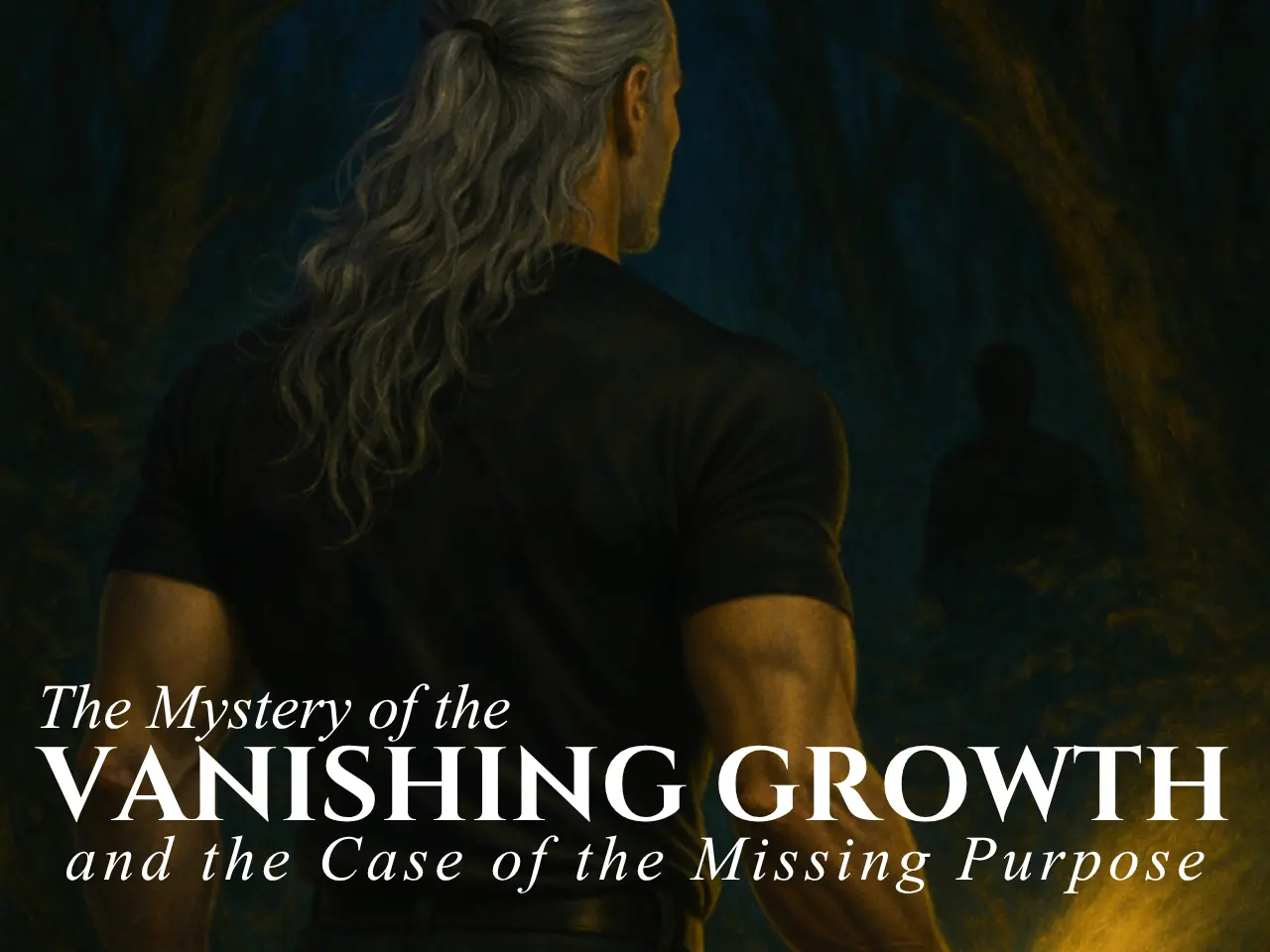
    Book cover showing a man with long gray hair holding a flashlight in a dark forest, with a shadowy figure ahead.
    The missing clue behind every failed growth story.

    The Red Herring

    The client, like many I’ve encountered, believed their only problem was sales. They treated everything else—the product’s market relevance, even internal alignment, a clear identity—as irrelevant distractions. But sales can’t compensate for a missing throughline. In this case, the missing work wasn’t hidden, it was sitting in plain sight, like the culprit in every second-rate mystery novel

    When the fundamentals aren’t developed and aligned, every sale is a grind. Even the ones you manage to close demand endless handholding, because there’s no coherent identity, no ecosystem of support, nothing to carry the customer relationship forward. The effort required to keep each client quickly outweighs the value of winning them.

    That’s exactly what happened here. Sporadic sales occurred, but loyalty vanished the moment the bespoke attention stopped. Growth itself seemed to vanish into thin air, the case of the missing purpose revealed in plain sight.  Despite the promise of the product, it sat isolated—spare, unsupported, and unclear in its purpose. To potential clients, it never quite added up. 

    This is the danger: when purpose and identity aren’t defined intentionally, they’re defined by default. Confusion becomes the culture of the project. Then they aren’t owned by everyone and connected to action, so wasted energy becomes routine, and the organization slips into what I call executive dysfunction: an endless cycle of chasing meager sales and running in circles.

    Layered white cake with a tall wedge-shaped opening through the center.
    Without a clear throughline, positioning is just sugary icing on an empty cake — everyone can taste it.

    The Detective’s Mistake

    Detectives (consultants) are meant to investigate, diagnose, and hand their findings to those responsible. My mistake was going further. I investigated thoroughly, collected substantial feedback from the market, and even mapped potential product pathways. While I reported the findings and suggested simple solutions, instead of workshopping these insights with the client, at their direction I built the solutions myself. What I created was compelling, but it was never theirs.

    As usual, the solutions weren’t complicated. I built a comprehensive positioning framework: messaging, strategies, and proposed an entire ecosystem that supported deployment and adoption for all demographics, designed to simplify traction and foster loyalty.

    But the problem was that I built it alone, not with the client, but for them. It was not my intention, but lack of internal traction and direction, lack of purpose, left me trying to fill holes by myself. At first I created examples of what could be done easily and quickly to develop product relevance and loyalty. But since emerging tech provides incredible support for those who know how to use it, I soon found myself rapidly developing extensive resources for effective engagement in hours that would have taken months. 

    One part stood out: an exhaustive, cognitively-enhanced communication library. It allowed the team to generate real-time responses, perfectly aligned with identity and strategy. I even mapped near-future product pathways. The potential was breathtaking. But none of it mattered, because instead of co-owning the framework, the client merely nodded along, approving in words but never acting in practice. They never accepted the missing pieces as a case to solve, and I had mistaken their lip-service for commitment.

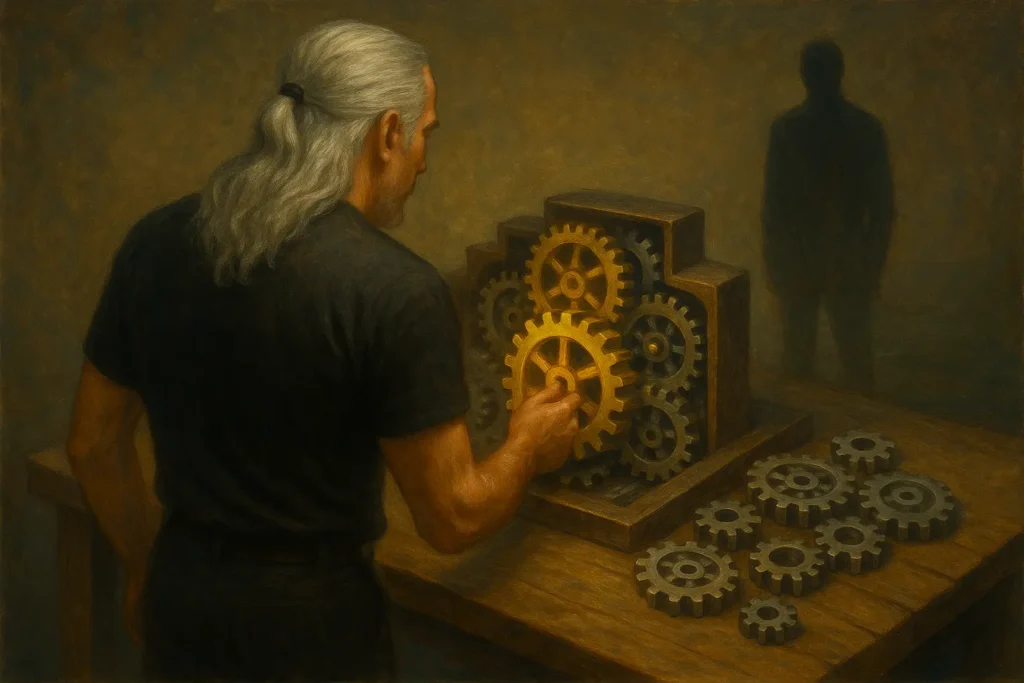
    Person with long gray hair placing a gold gear into a wooden mechanism on a table.
    No matter how good what I build is, the work is irrelevant if it isn’t developed with and owned by those it’s meant for. It still exists in mystery, unable to connect to real, sustainable growth.

    The Reveal

    While I could have stayed and milked the opportunity for more money, it would have been inauthentic. The real issues were ignored, so I couldn’t have provided any real value. The client and I never shared real goals or processes, and despite my attempts to bridge the divide, they were never truly interested in working together.

    They went through the motions. They would say they wanted to move forward, even ask me for strategies to fill gaps or re-engage potential clients. I would prepare those strategies quickly, but nothing ever happened. We cycled through plans without follow-through.

    I ignored my intuition—and my own eyes. I chose to be enchanted by the product’s possibilities rather than grounded in the lack of internal traction. When the follow-through never came, instead of seeing the inaction for what it was, I only increased my messaging, hoping that more clarity would spark movement. It never did.


    That was my mistake. A detective doesn’t make everything right, they work to solve the case with the client. You cannot impose purpose, identity, or meaning on an organization. These things have to be co-owned. Without authentic ownership, even the best strategies won’t take root. Growth cannot really happen or survive in mystery. Anything built on shallow purpose and identity is weak at best, and quickly vanishes.

    The Final Verdict

    Walking away from the client wasn’t failure. It was the only honest ending.

    Detectives know when the case is over. You can present the evidence, line up the suspects, and even point to the missing piece — but you can’t force anyone to see it or act on it. In this case, the client insisted the culprit was simply “a lack of sales,” unwilling to admit why the sales they did have vanished, or that the missing purpose was the real story all along.

    For founders, leaders, and teams: the organizations that are taken seriously and achieve real results are the ones that treat structure, positioning, and workflow as essential as the product itself. They form the foundation of your executive function.

    For myself: I saw the femme fatale client — all enchanting potential and thrilling opportunity — coming a mile away. The fatal flaw wasn’t the product; it was a leader who never spoke the throughline aloud, never owned it, and left identity to form by default. I should have known better than to compromise the value I bring for short-term gain or vague promises of future rewards. But I let the illusion pull me in. Like any detective, I’m still learning.

    The hardest work in business is not chasing sales — it’s solving the real mystery: building the real, shared meaning that makes growth inevitable.

    Large compass and scattered gears in the foreground, with a figure standing by a dark ocean.
    True direction rests on a clear understanding of purpose and identity. Without them, growth is a mystery.