
Author: Milo de Prieto

  • Do You Take Responsibility for Your Own Cognitive Identity and Development?

    Do You Take Responsibility for Your Own Cognitive Identity and Development?

    Your uniqueness is vital to your and your local community’s wellbeing.

    We now accept what artists and researchers have known for a long time: identity is a performance. We choose which facets of ourselves to show in which context. We curate impressions. Some parts of the self feel immutable, but many are constructed, refined, or shed as we evolve.

    When people talk about identity, they usually mean character traits, sexuality, ethnicity, gender, social roles, or aesthetic preferences. We still treat identity as something to discover, as if we’re a monument to be unearthed. In truth, identity behaves less like a fixed object and more like a quantum field: full of permutation, contextual, fluid. But even as our language about what we mean by identity grows more nuanced, we almost never talk about it from the perspective of what’s doing the actual making of meaning, our brain. We have little notion of our cognitive identity.

    Maybe you’ve taken one of the popular modern variations of the Myers-Briggs Personality Type Indicator and been told you’re an ENFP or an ISTJ. Perhaps you’re familiar with the DISC, Enneagram, or Big Five. They place you in a predefined category from within a specific range of outcomes, similar to a horoscope. At the very least they can help you feel seen. However, while very useful, these cannot be confused with a real understanding of your identity. You share the exact same results with millions and millions of others. So how is it that your wardrobe is more original than your brain?

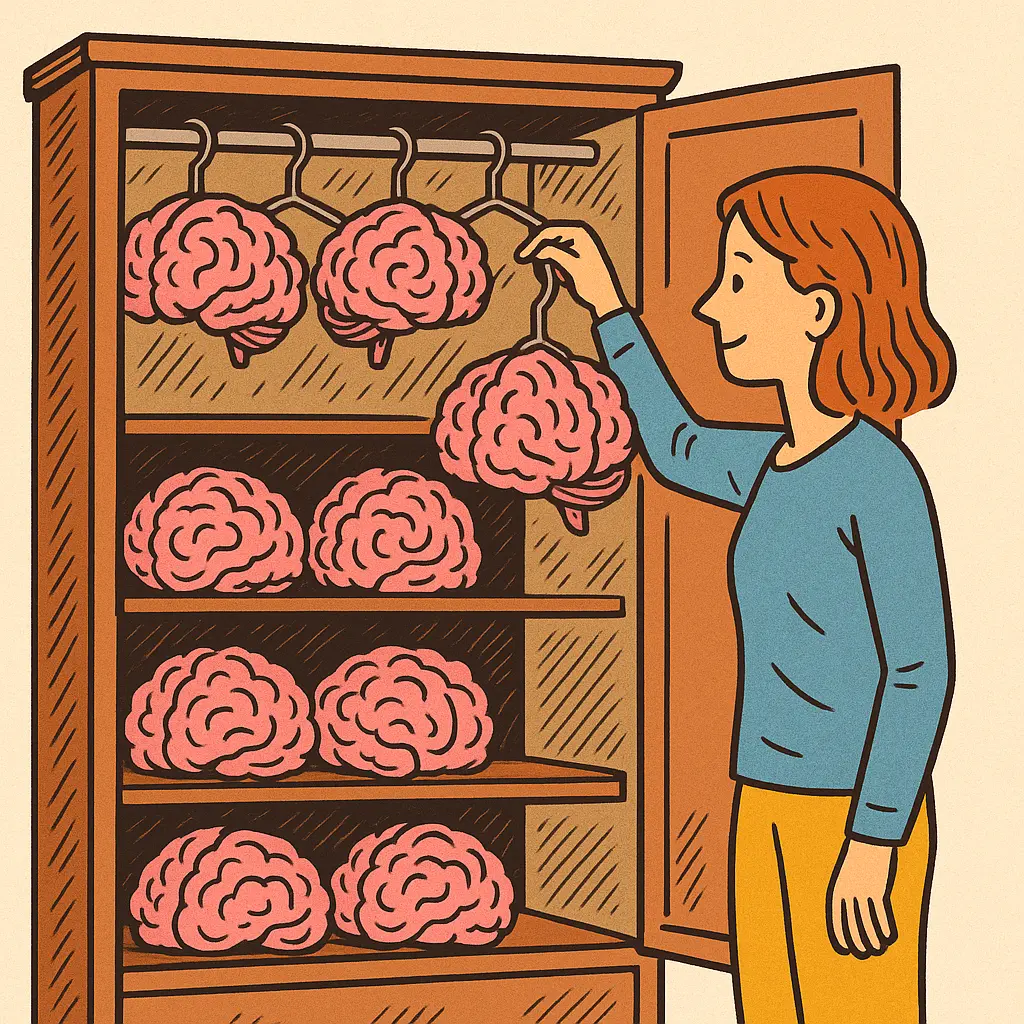
    Woman opening a wardrobe filled with brains on hangers and shelves.
    How is it that we accept our wardrobe is more unique than our brain?

    There are thousands of other assessments too of varying relevance, some give you metrics across spectrums in emotional stability or innovative thinking, others can tell you which Spice Girl you are. But once you’ve been seen, what’s next?

    In education, we’ve long understood the power of diagnostic assessments. A good diagnostic doesn’t just say whether a student knows something. It explains why they struggle, or why they soar. It breaks down skills into subcomponents and identifies the gaps. That clarity turns frustration into strategic momentum. It gives students agency over their learning and development. These assessments are used effectively (if too rarely) in language acquisition, reading comprehension, and much more.

    The same is true for adults. Or it can be. But we still cling to outdated assumptions about learning and age. We treat childhood as the only arena of development. But your brain doesn’t stop developing just because you’re paying taxes (how it grows changes, though). The capacity for growth never expires, nor does the responsibility for it either.

    Your brain is the most powerful tool you own, rich or poor, thriving or flailing, Scary Spice or Posh. It’s also your greatest resource for shaping a meaningful life. Yet we rarely take responsibility for our cognitive development, let alone our cognitive identity. There’s no shared script for it. No rite of passage. No map. We’re socialized to believe that adults are cognitively “finished” and that any further development is about recovery and therapy, not expansive growth.

    That’s not true. I’ll have none of it.

    “I won’t have it. The world is wilder than that in all directions, more
    dangerous and bitter, more extravagant and bright. We are
    making hay when we should be making whoopee; we are raising
    tomatoes when we should be raising Cain, or Lazarus.”
    Annie Dillard, Pilgrim at Tinker Creek (1974)

    To develop, you first need to understand what you’re working with. Your brain isn’t a computer or a personality type. It’s a vast, living ecosystem of neurological and cognitive structures, functions, and processes. You could spend a lifetime mapping its terrain. In fact, you should.

    So when it comes to cognitive identity, the better question isn’t “Who are you?” but “Who are you when you’re… (insert physical or mental adventure here)?”

    …solving a problem, launching a project, improvising in chaos, learning a new language, city, or artform, seeing a pattern no one else sees?

    We now know, such as for those of us with neurodivergent brains, even your so-called cognitive weaknesses may be superpowers in disguise (granted sometimes very well disguised).

    So to know what you are working with, you need a framework, a way to talk about your cognitive patterns with precision and without judgment. I’ve built one.

    It starts with what I call your brain’s primordial message, an inner orientation that reflects your role in the world and how you engage with it. It’s something your brain works on from childhood and will keep doing, job title or not. It is a concept that would make sense to your seven-year-old self (assuming you’re not seven while reading this) and to your eighty-year-old self, too.

    From there, the framework maps your high-end cognitive processes: how you handle complexity, solve problems, and perceive and navigate the world. It also tracks how those processes are evolving. Finally, it aligns these insights with the core competencies and applied skills you’ve already demonstrated through experience. The result is a dynamic portrait of your cognitive identity and a practical roadmap for using it.

    When you align these elements, your purpose, your deep cognitive functions, and your real-world skills, you have a much better idea of what you should be doing as well as how. You can understand what kind of work will really engage and energize you, how you naturally solve problems, and what kind of challenges will help you grow. Rather than guess you can strategically plan your next move. This opens up developmental opportunities. I believe this is the key to real quality of life.

    See: Rethinking Maslow: Breaking with a hierarchy of scarcity to cultivate neuroecological abundance.

    See: Rethinking Maslow: Breaking with a hierarchy of scarcity to cultivate neuroecological abundance.

    But just like physical fitness, cognitive development doesn’t “just happen.” It’s a deliberate process.

    Know where you’re starting. Pick a target. Determine the milestones. Use the right tools. Go, adjusting to reality along the way.

    My approach is informed by my formal and informal study and research in neuro and cognitive science, which I enrich with divergent disciplines such as theology, quantum theory, esoteric traditions, fine art, and my years of educational practice and system design. But honestly, you don’t need my system. You just need a system, one that helps you understand and steer the most valuable resource you have: your mind.

  • Rethinking Maslow

    Rethinking Maslow

    Breaking with a hierarchy of scarcity to cultivate neuroecological abundance.

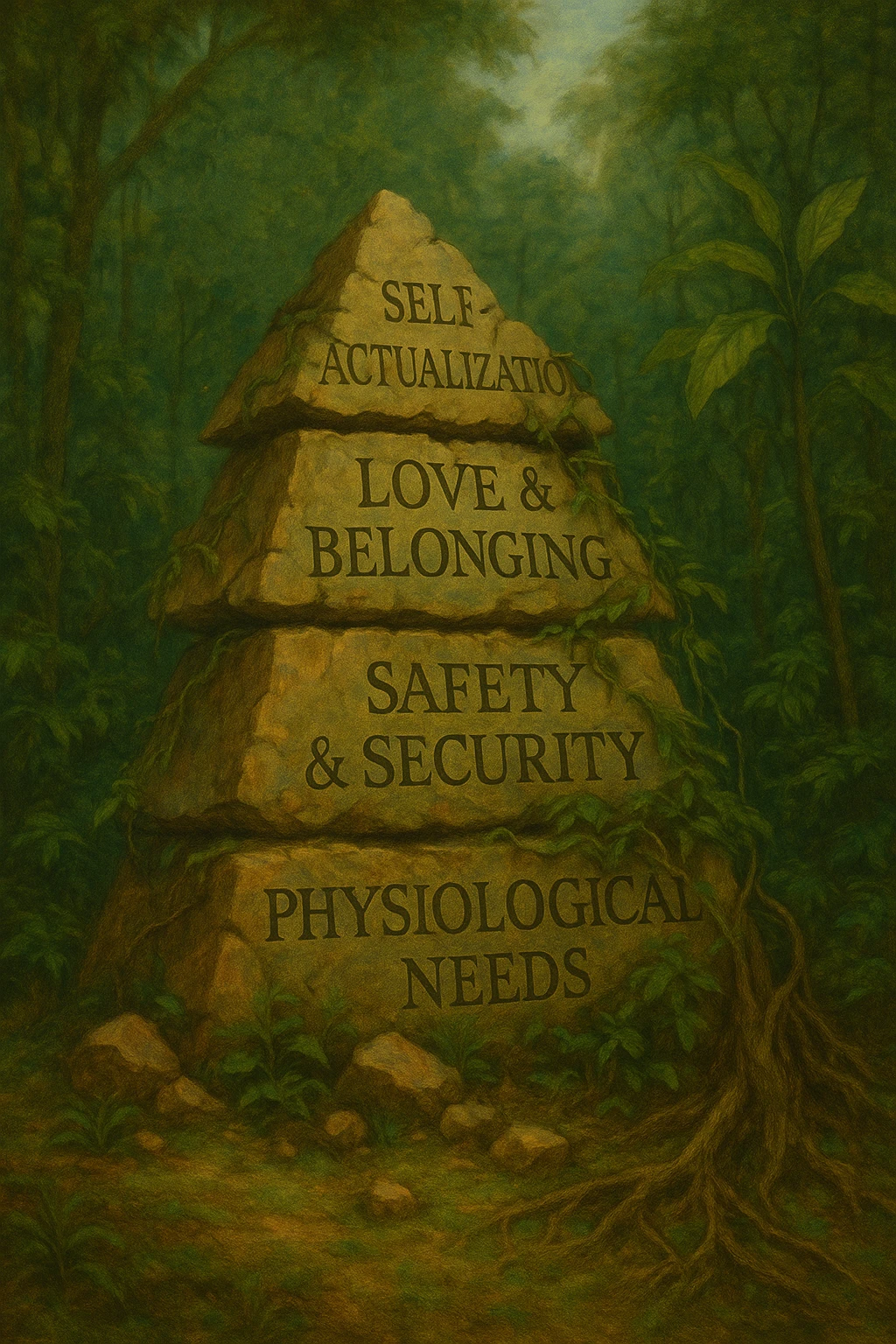
    In 1943, Abraham Maslow proposed that human needs exist in a hierarchy, a model later famously codified into a pyramid. This visual suggested a rigid, stacked system: if basic needs for food and shelter were unmet, higher cognitive functions were not possible. He placed self-actualization at the peak, treating meaning and purpose as a kind of cognitive luxury only accessible once all lower tiers were fulfilled.


    It’s a compelling framework, but its rigid, stacked architecture fundamentally misrepresents the interdependent, co-regulatory nature of the human brain. Modern neuroscience shows us that needs like meaning, connection, and flow aren’t indulgences; they are structural requirements for a well-functioning brain and nervous system, actively sought out even in the absence of safety.

    A crumbling version of Maslow's pyramid with "physiological needs" on the bottom, "safety & security" above that, "love & belonging" above that, and "self actualization" on the top.
    A scarcity model of needs in a system that only grows when the lower sections are sufficiently strong is a narrative that can limit basic wellbeing. The brain’s actual processing is dynamic and co-regulatory.

    The true problem with the pyramid is the subtle but devastating narrative it creates: if you’re struggling to meet basic physiological needs, higher functions—creativity, reflection, purpose—must be postponed or dismissed as luxuries. To internalize that view is to inhibit your own development.

    A Note on Intent: This essay is not a critique of Maslow himself, who framed his model as an observation of typical motivational prepotency, not a fixed prescription. Rather, this is a critique of any framework that reductively interprets human existence through a capitalist lens of scarcity, which is precisely how the prescriptive pyramid has been used. Capitalism is a constructed economic framework with narrow aims, not a human or biological reality, and such frameworks can only manage the vastness of human experience by compressing it into abstractions that strip away its substance. It is the equivalent of expecting a rainforest to behave like a filing cabinet.

    The Neuroecological Model: Tending the Systems for Sustainable Thriving

    Rather than stacking needs by social convention or survival logic, a neurobiological model should reflect what the brain and nervous system require, daily or cyclically, to regulate, grow, and function. This shift treats the brain not as a machine with linear outputs, but as a dynamic ecosystem to be tended as we would a garden, coastal reef, or forest. This is the grounding for our new understanding.

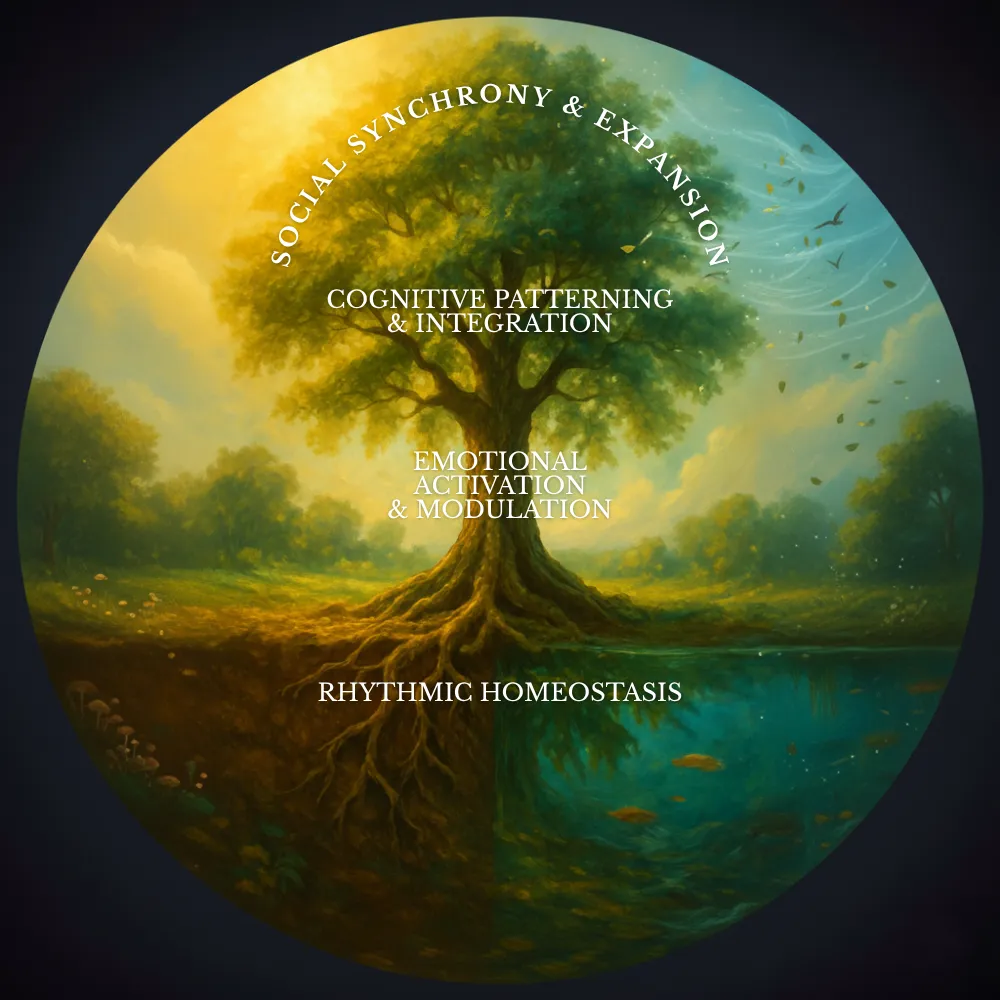
    This updated framework organizes our essential needs not by rigid hierarchy but by frequency of use, systemic impact, and cognitive cost. It identifies four neurological system groups that operate collaboratively in a dynamic, interdependent environment.
    This reorganization liberates possibility by achieving a profound conceptual shift: it reframes the human experience from a deficit to be solved (drudgery) to an opportunity to be enjoyed (tending).

    The core of my thesis is this: when we prioritize the brain’s essential systems, treating the brain as an ecosystem to be tended such as a tree, we don’t simply survive, we optimize. The work of integration—of tending your own “internal tree”—is not a hard-won, exhausting chore requiring radical sacrifice and intensive discipline. Built on dynamic systems theory, this work is meant to be as practical, natural, and obvious as knowing when to water a plant or seek the sun.

    An illustration of a tree showing its roots below the ground and leaves above. The 4 neuroecological systems are described on them: The roots are "Rhythmic Homeostasis," The trunk is "Neurological Activation & Regulation System," the branches are "Cognitive Patterning & Integration System," and the leaves are, "Neurological Synchrony & Expansion System."
    The neuroecology model replaces the pyramid with a living system: a tree of interwoven functions. Each domain supports the others in continuous, generative feedback—no one part is optional. Your PURPOSE, like the canopy, is not a reward at the top—it is the natural unfolding of a well-nourished system.

    The Four Neuroecological Systems

    Rhythmic Homeostasis System (Foundational Neuroregulation)

    • Core Components: Sleep, Nutrition, Movement & Breath regulation, Light/Dark exposure (circadian entrainment).
    • Impact: Without these, the brain’s capacity for all other functions collapses. These are hardwired biological cycles—non-negotiables.

    Neurological Activation & Regulation System (Neurochemical Flexibility)

    • Core Components: Sexual expression, Touch and safety (co-regulation), Novelty and stimulation, Emotional expression (limbic processing).
    • Impact: These needs maintain neurochemical flexibility. Without them, chronic stress, anxiety, or hypoarousal can dominate.

    Cognitive Patterning & Integration System (Meaning-Making)

    • Core Components: Deep Focus & Flow, Meaning-making & narrative coherence (default mode network), Self-reflection and internal modeling.
    • Impact: This is where purpose fits—not as an aspirational extra, but as a daily integrator of experience and action.

    Neurological Synchrony & Expansion System (Social Intelligence)

    • Core Components: Belonging & recognition, Creativity and symbolic abstraction, Altruism and transcendence.
    • Impact: These support a brain’s need to extend, to relate beyond the self and to tap into emergent or collective intelligence.

    Conclusion: Your Purpose & Individuality is Core to the System, Not a Final Reward

    The prescriptive interpretation of the pyramid has an insidious corollary: Those who believe they’ve earned the luxury of self-actualization often pursue it without the systemic grounding necessary for true integration. Their efforts become hollow, performative, or even self-destructive.

    Interestingly, Maslow’s model has been interpreted as both a critique and a byproduct of capitalism, where needs are commodified, and scarcity becomes its own form of reward. A dystopian, yet revealing frame.
    Rather than being the final step, actualization, or purpose, can be redefined as an organizing mechanism: a way to align attention, effort, and emotional meaning. Purpose is not a final reward but a vital system, rising through every branch of life, essential to survival and quality of life.

    An illustration of a pyramid with roots tearing the stones apart. Inside grows a tree glowing with life.
    Maslow’s pyramid inadvertently commodified wellbeing — turning our inherent capacities into milestones we must earn through compliance with economic structures. But true quality of life doesn’t follow a hierarchy. The brain does not wait for permission. It seeks meaning, love, and coherence even in the absence of safety, and sometimes because of it. Wellbeing isn’t something to climb toward — it’s something to root, reclaim, and grow.
  • Losing Your Soul, Not Skynet

    Losing Your Soul, Not Skynet

    The Real Danger of LLMs

    NOTE: I use the term LLM rather than AI because intelligence, as currently understood, is a biological process — the capacity of a living system to perceive, adapt, and generate meaning from experience and within context. LLMs do none of these things; they predict statistically likely outputs from patterns in text. The term AI obscures that difference more than it illuminates it.

    This week I started a guest role at a local university to develop the best use of LLMs for undergraduate students. The opportunity began as a late night debate on the threat of these new tools. The fear was that students would use it to cheat.

    We covered 3 possible lines of attack: 

    1. Ban – Outlaw LLMs (good luck with that), 
    2. Regulate – Guide usage of LLMs through rules and procedures. For example, just as students must show their work in math, have them include the exact prompt they used as an addendum on all work. For testing, pivot from rote to aptitude assessment. 
    3. Embrace – Lean into LLMs by incorporating them into classroom instruction as a kind of indefatigable grad student. Deploy them deliberately to guide the students in developing the essentials of critical thinking, writing, research, organizing thought, and creating thesis statements and interesting questions. 

    The third option was also directed at professors, who tend to be experts in their fields but not always in teaching. Academia is for research and exploration for their own sake. However, the art and science of guiding minds in the process of becoming is a completely distinct discipline. It used to be assumed that this development happened naturally in the rarefied gauntlet of university life. Now society has pivoted to helicopter parenting at all stages, and universities have followed suit, padding the rough edges that once chiseled the mind. The third approach, embrace, uses tech as a tool to liberate professors to focus on their expertise while scaffolding students in skills they need now and for a lifetime.

    I drafted the scaffolding: policy, training, and student onboarding. Included were suggestions on how to adjust testing, assign and grade homework, and deliver on the promise of using LLMs to develop critical thinking in the classroom. I created a process to guide students in the prompts for research, organizing data, and writing basic essay formats. It was thorough and included using LLMs to adapt my framework to develop their own living individual voice and writing guide.

    On the first day, I arrived ready to present the framework I’d built. Instead, I was told to interview the students. At first, I thought it was just an exercise, so I asked neutral, open-ended questions about their use of LLMs. Their answers shook me.

    LLMs can scaffold the development of our unique voices further, or erase them entirely.

    They were already disillusioned. Relying on LLMs for everything, they felt they had lost the ability to write at all. LLMs produced passable work, but it was generic, void of their soul. They were trapped in a cycle. Already the university was at the mercy of a single voice, not Skynet but something worse: mediocrity. I hadn’t expected their insight or visceral distaste for the shortcut. I had underestimated them, just like the university had. They were not in danger of using LLMs to cheat; they were in danger of being erased.

    Undergraduate years are when students must forge their voice, their ability to argue, to defend, and to build worthy concepts. It’s where curiosity and personality take shape, forming the foundations of a rewarding life. Failing now means they will likely never develop these skills later. The professional world assumes you’ve already honed your capacity and are ready to produce more. What was a shortcut temptation at university becomes an expected tool for productivity. If they can’t think conceptually, why hire them at all? LLMs can already do the rest.

    Even as I built the approach for professors, I was thinking of the students. I knew the real danger of treating LLMs as a shortcut. Without a deliberate structure for critical thinking, expressive dexterity, and original voice, the students would pay the highest price. What I hadn’t expected was that they already knew and resented it.

    The students expressed a helpless ennui, wanting authenticity but finding relying on LLMs a pull too strong to resist.

    So, in addition to the work above, I developed a process for the students themselves. I built an adaptive process for creating a self-authored style sheet: a way to prompt both students and LLMs to develop and honor their cognitive identity and voice. Rather than doing the work for them, LLMs could scaffold their growth, with the student interjecting at crucial, strategic points. LLMs would do the heavy lifting, freeing them to climb higher, faster.

    It isn’t foolproof, it isn’t meant to be. Caging people or forbidding tools never works. This is for those who take responsibility for their own development. It lets them use LLMs to enhance, not surrender, their soul. Much more remains. The real work is learning how to deploy LLMs for personal growth. The lure of this tool is its radical productivity. But that goal alone is quantity over quality, a dead ocean of mediocrity. The point of any tool is to serve us, not replace us.

    Technology should carry our weight, not our soul.