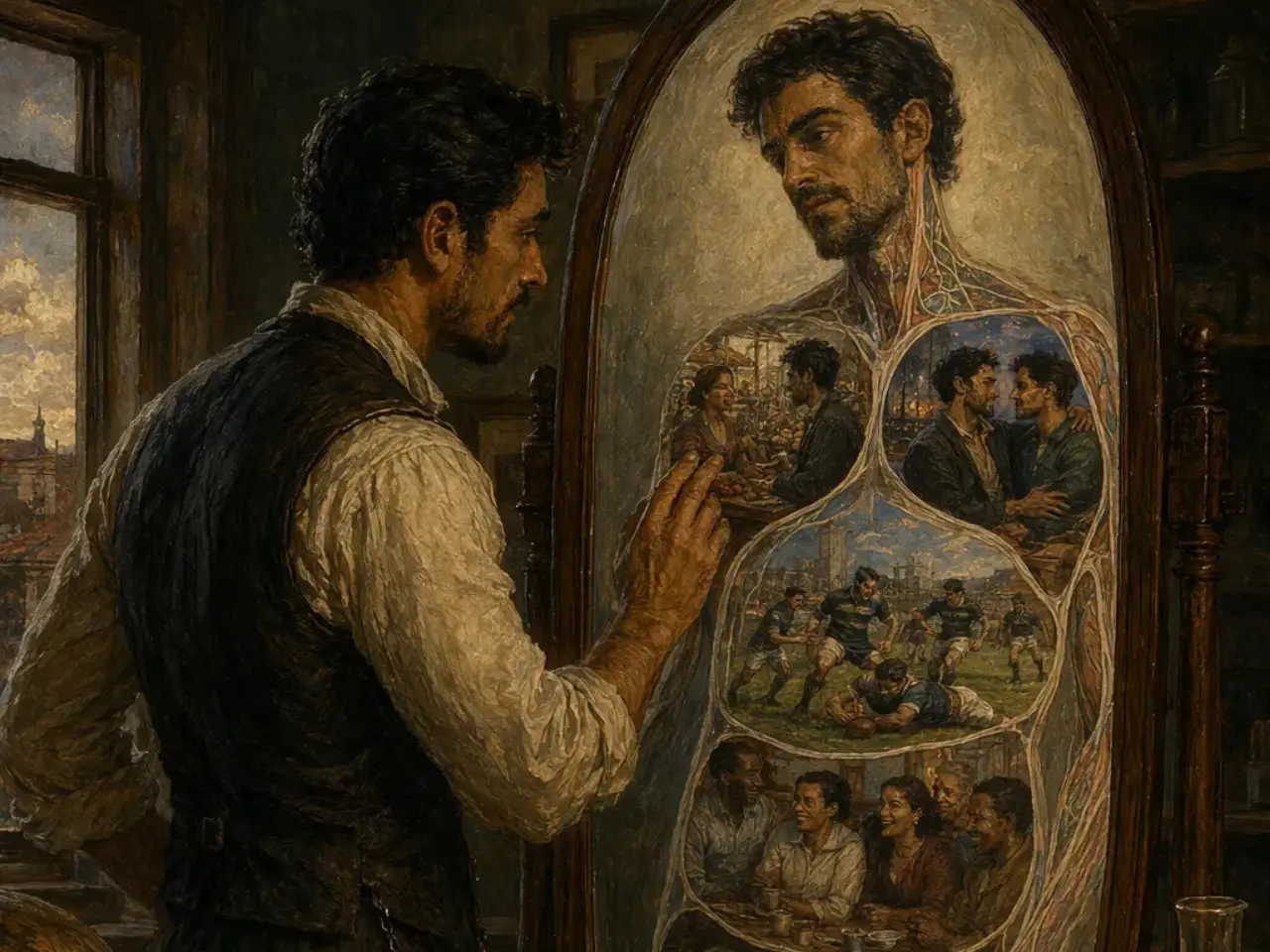
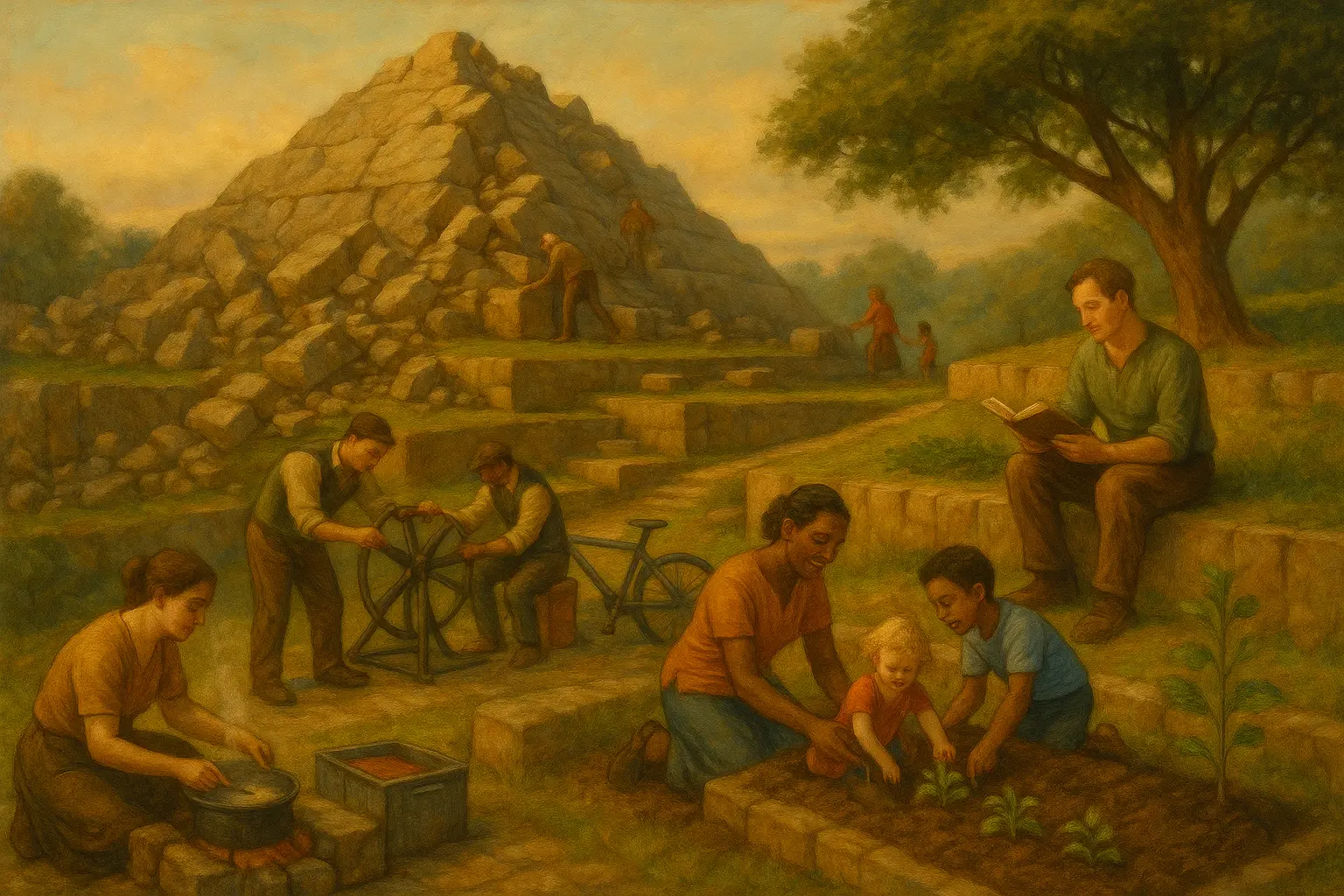
A four part series on what human beings actually are, the social ecology we depend on, and what to do about the world we’ve built that works against both.
The human being is a coherent – intrinsically whole, the parts genuinely interdependent and mutually sustaining – self contained ecosystem tempered and tested through the intensive feedback loop of evolution into stable function. Rather than a Frankenstein-like quilt of systems cobbled together from evolution’s biological grab-bag, we make sense. Although, the way we’ve come to treat this stable system many times does not. Among the advantages of this ecosystem is its extraordinary meaning making process, an elaborate capacity that facilitates higher level cognition, such as complex problem solving. Cultivation of this advantage is not only essential to our existence, but what the rest of human potential depends on.
Many species evolved intelligence, social bonds, and intricate cooperation. In humans, however, these traits have become far more extensively elaborated, including especially sophisticated language capacity and higher-order problem solving coupled with metacognition. The latter combination facilitates our ability to model reality, reflect on our own thinking, revise beliefs, teach deliberately, coordinate with strangers, and build systems that outlast any individual.
It is not a failure to have impulses. The failure is poor integration: when a threat or appetite system rushes behavior without being shaped by higher-level context and developed calibration, outcomes degrade in predictable ways. This is especially true in contexts that require deliberation and coordination. In humans, these impulse systems are a part of a single organism-level ecology, integrated across timescales, where higher cognition coordinates and trains faster responses rather than replacing them. What is distinctive in the human lineage is not the disappearance of these infrastructures, but the expansion of executive capacity: more ability to shape reflexes, represent longer timelines, compare options, and revise behavior based on consequences and feedback. Our potential is not in erasing these impulses, but in the opposite direction, refining and enhancing them to create even higher quality opportunities for human life.
Human existence and development is ecological: layered within, cultivated without. It requires respect, authenticity, and responsibility for proper stewardship.
The coherent human being requires coherent stewardship: the adaptive coordination of many interacting needs and signals, across time, using feedback to stay aligned with reality to act and grow. At the individual level, this stewardship is what it looks like when a person can notice an impulse, interpret it in context, and choose an action that serves both immediate functioning and longer-term stability. At its best this is not merely to navigate an impulse, but to deftly channel it for growth. It means that the person can hone and train this impulse as a raw capacity for notable developmental achievements. We continue to demonstrate developmental capacity across our biological infrastructures (physical, cognitive, and connective/social) with meaningfully open-ended expansion. At the collective level, the same logic applies: societies are ecosystems that either scaffold this capacity, through norms and mutual respect, education, institutions, and distributed responsibility, or they degrade it by rewarding short-term reflexes that destabilize the whole system.
We prove conceptual thinking and social coherent stewardship and coordination in many contexts. We have the capacity, we simply have failed to build conceptual thinking (which in my definition includes taking action) and its development explicitly into our social norms and values as a baseline.
Our distinguishing advantage is the capacity to steward all our systems using higher-level cognition developed in social scaffolding. We can and need to scale this cognitive capacity deliberately, including the ability to form and revise models of how things relate (constraints, trade-offs, causal links) so we can hold complexity without collapse and act with relevance rather than with reactions driven by stress. The resources and clues for this coherent stewardship and development are provided to us in our biology: the need to channel, enjoy, and develop our own impulses and the reward they can provide when harmonized across our living; our capacity to manage and enhance these processes to our benefit and participation in community; and the need for a healthy society, built on mutual respect, collaboration, and shared goals of stability and growth. When we attend to our biology and capacity with clarity, navigating the complexity of our existence for our own wellbeing, that individual coherence propagates outward into the community’s stability as well. Our existences are interdependent and our individual wellbeing correlates to our society’s wellbeing. Our human advantage also means that we are not in this work of stable wellbeing and development alone.
While each human obviously is one organism, the complexity invites us to also consider the human being as a contained ecosystem. We are invited not to manage ourselves as machines but steward ourselves as we would a garden. We do however exist in a greater ecosystem, society, which is interdependent with our biology.
Cultivating Mental Health & Revealing Human Potential
Tending your unique mind as part of a living ecosystem is the primary act of wellbeing, the one discipline from which human potential and a truly thriving society emerge.
1. The Inherent Design – Difference as a Source of Strength
From as early as I can remember, I felt like an alien visiting this planet.
At first, it was neither a source of shame nor a badge of honor, just a fact of being that I enjoyed. My family, while far from perfect, nurtured my curiosity and self-expression. The first time I came out to them, eliciting no surprise, was at the age of six.
Before school, that difference was a kind of magic. My uniqueness fueled my imagination; the world felt endless, full of things to learn and invent. I delighted in discovering what I could do and what the world might become. But once I entered the machinery of society and formal schooling, I began to learn that what I had taken as strengths, my intensity, my boundless attention, my way of connecting patterns, were considered by others something to manage, or at best, to tame.
These differences became difficult, neither rewarded as they were at home nor concealable in public. And I was never good at concealing myself. Soon, much about me began to be treated as a problem, defining me as someone who didn’t quite belong. Alongside my emerging sexuality, another example of diversity was surfacing, one that seemed to unsettle adults far more.
I was an erratic engine that burned too hot and never idled. Around the age of twelve, I was diagnosed with ADHC (I prefer C for condition vs D for disorder). For the record, my family welcomed the sexuality diversity but was less enthusiastic about the neurological one. Even today few are really prepared.
The diagnosis itself wasn’t entirely helpful. It offered a name but not a way to think about my experience. Unless you’re an expert, the term disorder tends to stop understanding as it offers a category that seems to explain everything. It wasn’t until later that I began to come to terms with it, searching for a way to navigate my inner turbulence.
It was hard not to let the label define me. I started listing my abilities, both the obvious and the hidden, the ones still waiting to be developed. Even so, it felt as though something was wrong with me, even when I didn’t want to be right. Being wrong is interesting, but it can also be lonely.
The more I studied the science of the condition through the lens of human development, the more my understanding began to shift. I came to see that mental health, for all its clinical precision, is not a matter of correction but of cultivation. The brain is a substantial part of a living ecology, your whole being, that must be tended, not a broken circuit waiting for repair.
In fact, this work clued me into a possibility that the goal is not to correct or erase difference but to learn how to live with it, nourish it, and guide it toward coherence.
When I was a kid, at first I imagined a boundless world. I reveled in my uniqueness and that I would grow up to be extraordinary. But then society quickly taught me that my differences were more problems to be fixed or hidden than strengths to develop. The key to our survival and evolution is returning to that individual spark for each of us.
2. The Importance of Diagnosis – Burning and Flooding the House
Human beings tend to need something dramatic to pursue change. Otherwise, we keep accepting the status quo as tolerable, even when it isn’t.
The Diagnostic and Statistical Manual of Mental Disorders takes an observational approach. The key word is disorder. It pathologizes what can be seen, defining certain behaviors as problems rather than variations. Many of these behaviors are universal: anyone under enough pressure can lose focus, feel anxious, or react impulsively. The “disorder” label applies when the continuity, intensity, and impairment of those behaviors cross a line that makes ordinary functioning unsustainable. That distinction is important as it tells us when intervention is necessary and what kind it should be.
Think of diagnosis as identifying a fire in a house. You have to name the problem before deciding the intervention, whether it needs a single bucket of water or a full emergency response. Modern medicine’s great gift is its ability to mobilize once the alarm sounds. Medication, therapy, and insurance systems all depend on that first declaration of dysfunction. Without it, help rarely arrives.
However, a house that has been diagnosed as on fire and then treated, is no longer considered a house on fire. The problem has been solved. The next intervention is repairing or rebuilding. When a person stabilizes, we tend to keep them under the label of “on fire.” We forget that diagnosis should be temporary. It’s a signal for certain actions, not a life sentence.
Two larger faults compound this systemic problem. First, with the brain we can only observe outcomes, behavior, not the complex internal processes that produce them.
Second, our culture still expects every individual to function in total independence, as if self-sufficiency were the natural human state. It isn’t; it’s a political invention. We are more at home in an interdependent community, like a tribe. Measured against this impossible standard, everyone fails at some point.
So not only are we expected to act more or less the same, an absurd demand given the sheer variety of human existence, but to forget that human existence is an adventure with no formula. Stress, grief, and fatigue are ordinary. Unique to each of us is our own neurodevelopmental journey. Some paths, as well as all paths at some points, cross difficult terrain. Regardless of a neurodevelopmental diagnosis, many may see various kinds of patterns in their life experience. For some, the experience of ADHC can be imagined as a house on fire, while some experiences associated with Autism Spectrum conditions can resemble a house being flooded.
The obvious truth is no human develops perfectly, partly as there is no perfect. Neurodiversity describes the natural variation in how human nervous systems develop and function. Conditions such as Autism, ADHC, and other diagnoses describe conditions that can significantly affect daily functioning. They are grounded in neurodevelopment, which is ongoing. Neurological development and neurological functioning continually interact with each other and with real conditions, so no two people, no matter how similar, develop and function exactly the same way. This is the source of each person’s unique voice that I am studying as a form of their purpose and developmental potential. To acknowledge the important variation, conditions like ASC describe it as a spectrum. In that example it’s actually in the name. It is not only true of that condition but of neurology (neurodevelopment and neurological functioning) in general. Instead of a spectrum, this incredible variation where no two people are the same, is better imagined as a nebula of possibilities. A line does not do the reality justice. Each human experience is one of many possible configurations rather than a simple scale from less to more. Also, no one is fixed in any one place as the experience is constantly adjusting.
A clinical diagnosis is not a mappable “region” of this metaphorical nebula. That means that there is no predictable neurodevelopmental path that consistently fits the diagnoses. Diagnoses do not work that way anyway. Clinical diagnoses approach human neurology from a completely different angle for a completely different purpose. The nebula image describes all humans. This type of clinical approach is only focused on helping those who need it. It is NOT trying to categorize all humans in any way. The diagnosis describes a condition relevant to neurological operation because someone needed it. It doesn’t describe the person. By diagnosing someone, the clinician is not categorizing them, but instead mustering support for them. It does not imply that those without a diagnosis are in another category called “healthy” or “normal.” It is simply working to help those individuals who need it. A diagnosis is used when a person’s experience is particularly persistent, sufficiently intense, and functionally consequential. Then the diagnosis activates a helpful response and opens a toolbox for care. It is possible that another person with a similar neurology does not require a diagnosis as they live in a coherent situation, with a community and lifestyle, that scaffolds their difference well enough to avoid requiring intervention. Obviously there are some experiences that are so intense that a diagnosis is absolutely necessary. Regardless, everyone can benefit from a coherent situation (the whole point of NCE).
This exposes the real problem with how diagnosis is used. It was designed as a triage tool to identify distress and trigger support. However too often it is confused as a permanent identity, categorizes a person, and implies that those without a diagnosis are “healthy” or “normal.” Metaphorically, once the alarm sounds, no one remembers to turn it off.
A diagnosis should mark the beginning of understanding, not the end. It tells us when systems and structures are failing, not who we are. Many diagnoses are triggered because the person’s environment is particularly unhelpful. This is one of the reasons people confuse these neurodevelopmental conditions as “adult onset” something. There is no such thing. The specific, clinically diagnosed neurodevelopmental conditions described originate in genetics and are present from the outset of a life. Many of their patterns are difficult to discern unless experiences are somewhat intense. Usually they are dismissed as one thing or another, which is fine. Diagnosis is not important unless someone really needs help. Its purpose is to define the boundary between what’s manageable and what’s not, between normal strain and the beginning of collapse. Once that line has been drawn and care has begun, the task must change. The fire alarm has done its job; now the rebuilding begins.
Some minds burn very hot, others can drown in their own depths. Either may be able to use the support that diagnosis offers, but not if it keeps them in a state of perpetual “emergency.” The goal of triage is to stabilize, then hand off to the work of rebuilding and maintaining the ecology that sustains life.
3. The Shift After Diagnosis – From Pathology to Ecology
Once we see diagnosis for what it is, a triage tool that clarifies one part of our cognitive identity, we can let it hand us off to other ways of understanding for growth, rather than let it hold us in place.
Take a simple example: if someone is short but wants to play basketball, height is a factor, not a verdict. To judge or dismiss on that single trait is defeatist, and dull. It ignores everything else that could create value: agility, persistence, strategy. The question isn’t can a short person play? but what unique value does this person bring to the game, how might they play differently? The same logic applies to any mind.
After the first relief of diagnosis, we shouldn’t live inside the label. The question is never Do you have X? but how does your mind work, and what does it need? Mental health, identity, and the brain itself cannot be contained in a single category, no matter how accurate or helpful it seems at first.
The language and tools of pathology, by design, stops normal operation so that it can cure. When taken out of context, the language divides the world into normal and abnormal, healthy and disordered. Once you’re placed on the wrong side of that line, your story becomes one of mitigation. Rather than about the value you contribute, the focus is on what must be reduced, managed, or hidden. The language that rescued you now restricts you.
But the brain doesn’t operate by such binaries. It behaves more like a rainforest, messy, interdependent, and capable of self-correction under the right conditions. In any ecosystem, disruption isn’t failure; it’s a signal. Diversity isn’t a flaw; it’s the essential characteristic of growth. When one species dominates, the forest collapses. When differences interact in harmony, it thrives.
To tend a living brain is to replace the impulse to fix with the discipline to cultivate. Once the crisis has been stabilized, the question shifts from What’s wrong with me? to What is my mind asking for?
This is the point where pathology yields to ecology. Mental health is no longer defined by the absence of symptoms but by the presence of adaptive systems in harmony. Like any gardener, we must learn to read the conditions of our own neural environment, restoring rhythm, pruning excess, nourishing what supports growth, and enhancing the mind’s natural intelligence to seek dynamic equilibrium across diversity.
When you begin to see your brain as part of your internal ecosystem rather than an engine, or computer, everything changes. The goal isn’t to become typical but to become tuned, to live in coherence with the unique pattern of your own mind. That is the work of tending, and the beginning of real freedom.
Learning to think this way, ecologically rather than pathologically, eventually led me to build a model for how the brain sustains and restores balance. I wanted a structure that explained not just why minds differ, but how they find stability within that difference. That work became what I call Neural Coherence Ecology.
The clinic is sterile so it can study life. Its purpose is real, but not where you are supposed to live. The brain’s meaning and operation is more evident in a forest, not a lab.
4. Introducing Neural Coherence Ecology – A Different Approach
Through my research and practice, I’ve come even further down this road. Treating the brain as part of the human ecosystem to tend moves us toward a better understanding not only of mental health but of human potential. Every person exists as a dynamic internal ecosystem of interdependent infrastructures and functions that sustain baseline wellbeing and support development. The work of creating equilibrium does not merely heal us, but it also grows us.
I call this framework Neural Coherence Ecology (NCE). It consists of four interdependent Infrastructures that can be imagined as a tree:
Rhythmic Homeostasis Infrastructure (Rhythm) is the “roots,” the infrastructure that supports energy availability and physiological restoration while sustaining sleep–wake rhythm, metabolic timing, and autonomic oscillation. It anchors stability; when it falters, the entire ecology weakens.
Emotional Activation & Modulation Infrastructure (Activation) is the “trunk,” the infrastructure that sustains the internal emotional and energy climate and the capacity to move flexibly among states such as high-energy engagement and calm. It is where energy is mobilized for engagement and released for recovery. Its health depends on flexibility, the capacity to shift smoothly between mobilization and rest.
Cognitive Patterning & Integration Infrastructure (Patterning) is the “branches,” the structural canopy of the brain. It actually includes the entire integrative scaffold that allows perception to become meaning. It’s where what we experience is processed into how we understand it. When tended, it supports clear thought and adaptive planning; when unduly stressed it undermines wellbeing.
Social Synchrony & Expansion Infrastructure (Synchrony) is the “leaves and tendrils” the connective mycelium between self and others. It’s where we coordinate between self and environment and others, enabling empathy and belonging. It thrives in reciprocal exchange and deteriorates in isolation.
Obviously, these distinctions and definitions are academic. The infrastructures of the Neural Coherence Ecology overlap by design. Just as in a building where a floor of one space is the ceiling of another, neural and physiological structures perform multiple purposes. They are not absolute or symmetrical. The natural world resists the Enlightenment’s craving for clean order. These categories are only conceptual scaffolds, temporary bridges so we can build processes of nurture and development.
The real absolute is this awareness: these infrastructures are one whole, interacting continuously. The metaphor of a tree or garden is to highlight the type of work required. It replaces thinking of the brain as a machine with something far more helpful and actually easier to manage than a machine, once you get the rhythm of it.
The goal is coherence: a sustainable, dynamic state in which these Infrastructures are each meaningfully engaged and also operate together in mutual alignment. Real coherence is not automatic; it depends on your active participation, the daily work of understanding how your mind operates, what it needs, and making choices that sustain equilibrium, your baseline wellbeing.
Tending your ecosystem means observing, adjusting, and caring for these Infrastructures so that growth remains healthy, not chaotic.
Understanding the Infrastructure is only half the picture. Knowing the nature of the soil, water, light, and air is one thing; learning how to tend them is another. That is where Functional Coherence comes in, the set of processes that allow us to operate within this living system and keep it in balance. If NCE describes your internal ecosystem’s infrastructure, Functional Coherence describes its operations. These active processes also affect sustainable wellbeing through their engagement.
These functions are how we regulate and interact with the Infrastructures of Rhythm, Activation, Patterning, and Synchrony in daily life. They help organize the specific acts of gardening each mind requires. Certain neurodevelopmental conditions can make these processes especially visible, showing where attention and care are needed most.
The Focus Function, using attention to manage perception, develops through the mindful practice of Focus Navigation: purposefully directing and sustaining concentration to maintain flow and stability.
The Cognitive Function, structuring experience into understanding, develops through the mindful practice of Cognitive Composition: among other things, the practice ensures that thought deliberately informs action, especially at critical moments of choice.
The Emotional Function, syncing affect and response, develops through the mindful practice of cultivating Emotional Harmony, so reactions become purposeful and expression restores rather than depletes.
The Drive Function, converting intention into sustained action, develops through the mindful practice of Drive Alignment, the care of self to sustain effort and purpose across time.
Together, these four functions encompass the gardener’s daily duties. Self-awareness tells us when they need tending. And importantly, the unique patterns of their operation and interaction help reveal your cognitive identity and potential.
When practiced consciously, they keep the ecosystem adaptive and self-renewing. When neglected, the systems drift apart and coherence erodes. Functional Coherence is the discipline of stewardship, the act of translating awareness into care.
Imagining the brain as a tree highlights the type of work required. It replaces thinking of the brain as a machine with something far more helpful and actually easier to manage than a machine, once you get the rhythm of it.
5. The Neurodiversity Protocol – A Practical Pathway
I’ve refined the research and theories of Neural Coherence and Functional Coherence into a comprehensive set of tools called The Neurodiversity Protocol. It applies these theories to daily life, starting with lived experience and guiding individuals from awareness of the origins of their patterns of functioning toward practical strategies for stability, growth, and excellence. While designed to help people living with certain neurodevelopmental conditions achieve manageable stability, the work is broadly applicable.
For people diagnosed with certain neurodevelopmental conditions, daily experience can include difficulty managing instability across the four rFunctions: focus, cognition, emotion, and drive. The goal of the Protocol is not to force correction, but to learn how to stabilize their operation and interaction as well as harness their potential.
The Protocol unfolds in an iterative loop:
Observation and Awareness
The first step into the cycle is to translate subjective experience into observable data, redefining symptoms not as problems to be solved, but as signals of where to begin the work.
Individuals record what they notice: changes in focus, mood, energy, or drive; patterns of disruption and recovery; environmental triggers; and cycles of productivity or depletion.
This process makes invisible processes visible. The awareness gained here restores agency. Instead of reacting to symptoms, the person studies them without bias, learning how their ecosystem operates.
Interpretation and Strategy Design
Next, these observations are mapped into a personal network of supports and strategies for equilibrium.
Examples include designing external supports for attention (Focus Navigation), creating recovery intervals for emotion (Emotional Harmony), or building systems of accountability to maintain motivation (Drive Alignment).
Each strategy is practical, repeatable, and adaptive, tools that evolve as self-understanding deepens.
Integration and Sustained Practice
The cycle continues as the strategies are integrated into daily life, sustaining stability and development rather than demanding a rigid performance.
With consistent tending, the mind’s natural adaptability strengthens, and one’s unique cognitive identity becomes a source of resilience and capability.
A clear glimpse of this process in action is the Phenomenological Tool. It demonstrates the bridge between experience and system, a method for turning reflection into data and data into design.
Through it, individuals begin to see how thoughts, emotions, and actions interact across their own ecology.
In practice, this is what tending a living brain inside your ecosystem means: structured reflection, responsive adjustment, and the steady cultivation of coherence.
The Neurodiversity Protocol is a set of dynamic, interactive tools that guide you in the necessary work of tending your brain as you would a garden for wellbeing and quality of life.
6. The Broader Vision – Coherent Society
Important principles that govern an individual mind apply to the collective although with one important caveat. Society itself is a living ecosystem of individual minds, and its stability depends on how well it integrates and employs difference in its members. A society, as biologically imperative as it is to individual wellbeing, does not have a mind or a neurology.
Across history, communities thrived when individual variation was understood as a potential contribution rather than a threat. Many ancient tribal cultures adapted roles to fit the nature of each person, recognizing that coherence came from interdependence across diversity, not sameness.
Modern systems often invert that logic, treating difference as a disorder. Diagnosis and categorization are necessary tools for care, but they cannot define identity. Once safety and stability are achieved, our task is cultivation: building environments that adapt around people rather than forcing people to adapt to rigid norms. Societies have always relied on categorization to manage populations. Modernity introduced labels as a form of identity because the social structures
This is the foundation of a coherent society, one that understands that human diversity is the key not only to baseline, individual wellbeing and development, but also collective wellbeing and development.
I’m currently developing research along what I call The Three Divergences, which expands this idea across three fields of human existence: Sex, Neurodevelopment, and Love. Together, they demonstrate that diversity describes all humans and sustains life.
True integration will not come from expanding categories but from dissolving them. Every human being represents a category of one.
Seen through the lens of Neural Coherence Ecology, self-actualization and authentic expression are neurological necessities, not luxuries. When individuals live in alignment with their cognitive identity, they contribute more effectively, create more freely, and help stabilize the shared ecosystem we all depend on.
Emotional harmony is not merely a personal state; it is a social atlas for peace. Society thrives on differentiated integration, rather than uniform adaptation. As each person develops their unique selves and strengths for their individual benefit, the work contributes to social vitality.
It seems like utopia, but if each individual dedicated themselves to the organic work of tending their own neural ecosystem, the results would profoundly transform the way we all live. We would see in our daily living how diversity is key to our survival and evolution, and life is boundless.
7. Real Wellbeing – Just the Beginning
At times in my life when I was ashamed of being an alien, embarrassed of all the ways I was different and unmanageable, I thought the goal was to stop being me or hide. It took years to understand that the point wasn’t correction at all. The diagnosis was only a doorway, and on the other side wasn’t a cure, but a garden waiting to be tended. It opens on an entire world of possibility. The solution wasn’t hiding my condition but exploring it for growth.
For a long time, I treated my mind like a malfunctioning engine. Now I see the problem was in thinking it was an engine at all. It’s a magnificent, if still brilliantly overgrown, ecosystem. It burns bright, grows wild, and needs boundaries made of rhythm and rest. The same energy that once made me feel defective now fuels the work I do, developing systems that help others find their own balance, clarity, and coherence.
That shift from management to stewardship is the real story of mental health. Each of us has a unique cognitive identity, an individual particularity of cognitive patterning and meaning-making. The work is to understand it, tend it, and trust it enough to evolve. When we do, a life of meaningful rhythm replaces the need for control. The difference between the demand of effort, attention, and discipline required for control and the effort of sustaining a lifestyle of wellbeing is key.
We are all the same, each of us a unique alien visiting this world. Human neurodiversity simply reveals this truth in sharper relief. Those of us whose patterns of development or functioning differ most visibly from the modal range are not exceptions to the rule; we’re reminders of it: Every person must learn to care for the ecology of their own mind. The same practices that stabilize an individual can restore the collective, because emotional harmony, once cultivated, radiates outward.
This is why I developed Neural Coherence Ecology and built the Neurodiversity Protocol, not as another system of forced discipline or a wellness fad, but as a way to work with the brain’s natural intelligence. The process is natural, not mechanical; it moves like a gardener with the seasons, not a drill sergeant with a whistle. More than repair, the goal and real possibility is evolution: the steady, generative unfolding of human potential.
A diagnosis is an invitation to begin your own new story. It is the opening, not the final word. For all of us, we can save the fire alarm for real emergencies, but turn it off when it’s done its job and invite the gardener to step forward. The work of health and real growth is steady, patient, and organic.
At my earliest age I reveled in my uniqueness. Shortly afterwards society made me think that my differences were problems to be fixed or hidden, instead of the very keys to my growth. The boundless life I imagined as a child, at the start, is not only possible, it’s here, more vivid than I ever dreamed.
Meaningful work isn’t a luxury, it’s the brain’s natural operation.
A magnum opus is not just a masterpiece. It’s the point where everything you’ve learned and lived converges into work that matters—where your mind’s way of making meaning meets a problem worth solving. It is not a singular achievement but a cognitive threshold: the moment our experience becomes architecture for something larger than ourselves.
I. The Quiet Crisis: The Disappearance of Meaningful Work
We’re hopefully at the tail end of an age created by non-leaders who’ve confused “optimization” for value. The word once meant refinement and collaboration for mutual benefit – to optimize meant to make something better all around. It comes from the root word for optimal, which also gives us “optimism.” We couldn’t have gotten further from that origin. Now it means compression: extracting the most from people while giving the least in return. Under this reductive logic, the economy rewards speculation and hype more than craftsmanship or coherence. The consequence is a quiet crisis. Even those with power and comfort often sense that their work—efficient though it may be—adds nothing lasting to the world.
In a culture driven by scarcity, self-actualization has been recast as a luxury, an optional pursuit once survival is secured. Yet neuroscience tells us the opposite.
Meaning-making is not decorative; it is regulatory. The brain depends on purpose, coherence, and contribution to maintain equilibrium. When these are absent, even basic functions—focus, regulation, resilience—begin to fray. A life without meaning is not lean; it is malnourished.
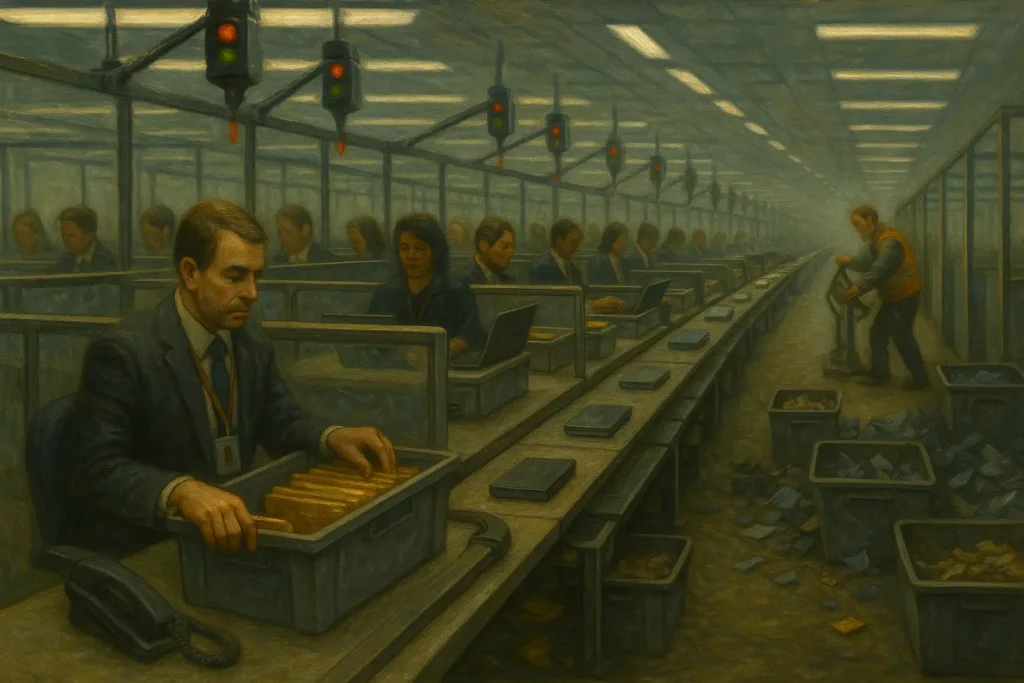
False “optimization” turns every employee into Amazon Fulfillment Center workers, even executives.
II. The False Hierarchy: Why We Postpone the Real Work
We’ve been trained to believe that the “real work” comes later—after we’ve earned enough, proven enough, survived enough. This deferral is cultural dogma disguised as pragmatism. Postponing meaning breeds learned helplessness: we stop designing our lives and start enduring them.
Maslow’s hierarchy, for all its historical influence, encouraged this misconception. It stacked our needs in sequence, implying that purpose belongs to the fortunate few. But the modern understanding of the nervous system shows that purpose is not the capstone of wellbeing—it is its organizing principle. Meaning helps regulate attention and emotion; it is how the mind integrates chaos into coherence. Readiness, then, is not about resources. It is about alignment. See Rethinking Maslow.
Maslow’s Hierarchy of Needs reconfigured from scarcity to abundance. We all deserve the rewards of our powerful minds.
III. The Developmental Truth: We Become More Capable with Time
The cultural obsession with youth has blinded us to one of humanity’s quietest miracles: cognition deepens with age. Elliott Jaques’ research on cognitive complexity reveals that as we accumulate experience, we gain the ability to think in longer arcs, hold paradox, and connect across systems. A Magnum Opus—in the truest sense—requires that kind of integrative capacity.
Our society often sidelines precisely those who have achieved it. We treat accumulated wisdom as redundancy instead of readiness. Yet this is when the mind is finally able to build work that endures. What we call mastery is not speed or brilliance—it is the patient synthesis of decades into something of lasting benefit. For me, that synthesis became ARTESIAN: a framework to translate the science of human development into real structures for growth and quality of life. Yours will take a different form, but the call is the same: to convert experience into contribution.
With experience we grow capacity to harness complexity into actionable strategies. Our problem solving ability grows so we can create truly mutually beneficial outcomes and solutions that do not ignore multiple interests.
IV. The Alignment Principle: Readiness as Inner Coherence
The brain is always weaving experience into story, tagging what matters, discarding what doesn’t. This narrative imperative is the hidden current beneath every choice we make. When we ignore it, life feels fragmented; when we engage it consciously, life becomes navigable.
Alignment begins when effort matches the way our mind makes meaning. Each of us has a cognitive identity—a distinctive way we process information, solve problems, and perceive relevance. When that identity aligns with our deep values, energy returns. Work stops feeling extracted and begins to feel self-reinforcing. This is the true architecture of readiness: coherence between who we are, what we value, and what we build.
When you align your cognitive identity with your core competencies and your honed experience, you are capable of developing rewarding projects that provide lasting, sustainable growth and benefit.
V. The Call to Begin: Your Work Is Already Waiting
We are always ready to begin, because the machinery for meaning is already active within us. The task is to listen to it. Start by tracing what your attention returns to, again and again—the subjects that quietly organize your curiosity. These are not distractions; they are coordinates. Follow them. Translate them into small, deliberate acts of contribution. The shape of your Magnum Opus will emerge in the doing.
Meaningful work is the natural by-product of inner alignment to outward reality, not merely a reward for the rich. When the mind’s infrastructure aligns with reality’s needs, contribution becomes coherent. The masterpiece seems like a miracle, but it is an outcome of purpose, cultivated over time.
Coda
For those of us building frameworks, art, projects, or organizations grounded in these principles, the work ahead is collective. The more we align individual growth with systemic benefit, the more society itself becomes regenerative. This is the work of a lifetime: to build something so coherent, so interdependent, that it uplifts everyone it touches. That is what a Magnum Opus truly is—and why we must each begin ours now.
The more we align individual growth with systemic benefit, the more society itself becomes regenerative.
If you ever find yourself in the middle of a zombie apocalypse, the key to your survival is to not join the horde.
You’d think that is obvious. Apparently not.
A general, helpful rule of thumb is that if someone who doesn’t have your best interests in mind offers you limited options, the wise move is not to negotiate but to walk away. The same applies to those trying to profit off your distraction. In digital culture it is possible and in fact necessary to do exactly that, walk away, join the resistance.
Walking Away from the Casino
We don’t argue with mediocrity, we chart another course. Even without the risk, a well lived life means choosing where we place attention and how we build connection. Rather than join the horde you can join the rebellion, choose what and how you use tech and engage with digital culture deliberately as if your life depends on it.
In part 4 of this series, I mentioned how we need an economy built on marketplaces that resemble the Roman Forum, a place of real civic and value exchange, where ideas are tested, refined, and built upon. Instead we’re given a cheap version of Vegas, what I call the zombie economy.
Reclaiming executive function, and your life, begins with three gestures: walking away from what corrodes, choosing deliberately how you engage, and joining the rebellion through tools that don’t depend on cheap tricks for fast cash.”.
It’s Vegas vs. the Forum, one holds your future and wellbeing, the other doesn’t.
Executive Functions as Skills of Navigation
The skills of executive function show us not only how collapse happens, but how recovery begins. Each one has been corroded by the zombie economy, yet each can be reclaimed through small, deliberate practices.
Working memory is flooded with trivia until no thought takes root. To restore it, draft first yourself before reaching for Google or AI, letting your own words carry weight before asking for refinement. Inhibition has been eroded by endless novelty, but it can be rebuilt when we design friction into our lives — baking instead of buying, placing the phone out of reach, treating pause as an act of dignity. Cognitive flexibility collapses when everything demands instant response; it returns when we schedule transitions, when we allow ourselves the time to shift direction rather than expecting to turn like a sports car at every demand.
Emotional regulation has been hijacked by media designed to inflame, but it can be restored in slower spaces: conversations, books, art, anything that requires digestion rather than binge and purge. Task initiation stalls in an endless stream of distraction, yet momentum is always possible when we begin with one small action, then the next, then the next. Planning and prioritization dissolve under the pressure of perpetual now; they recover when we map goals into steps and sequence them toward the horizon. Organization falters when every notification insists on being urgent, but it strengthens as we give order to space, ideas, and materials — making clarity visible. Self-monitoring becomes distorted when algorithms supply empty feedback loops; it becomes real again when we pause to check progress, recalibrate, and correct course. And time management, impossible when hours vanish into digital noise, returns when we treat time not as a clock but as capacity, something to be allocated with care.
These are not glamorous acts. They are disciplines. And like art, they require patience, rigor, revision, vision. From the caves forward, art has always been our rehearsal for living meaningful lives.
Art as Discipline, Not Ornament
To paint, compose, or sculpt is to practice working memory, inhibition, sequencing, patience, and revision. Art has always been our rehearsal space for executive function. This makes it essential, not optional.
It is the process of building a life of daily actions that restore coherence. The executive functions we’ve allowed to atrophy can be strengthened, the same way those who live with certain diagnosed neurodevelopmental conditions have had to do consciously all along.
Walking away from the zombie economy means refusing to feed the casino. It means stepping into smaller, slower, more human spaces: the Fediverse, Mastodon, blogs, and real conversations online and off. It means treating technology as a tool for life as art again, not a master
Years ago, before Facebook, I joined a fitness platform that doubled as a forum. The conversations felt like they were happening in real life over coffee or a beer, present, respectful, even joyful. Until one day, a member, young, handsome and fit, suddenly posted doubts about his looks, fishing for compliments, way off-topic and wildly out of place. Imagine someone commandeering a conversation is real life, with a statement like that. Others authentically tried to reassure him, but as you can tell it didn’t fix his self doubt and instead signaled the coming apocalypse. Within a short time the platform was unusable, full of raw ego, the posing and trolling we are used to today. Like the internet in general, what had been authentic became hollow.
But what was lost can be found, rebuilt with awareness to be relevant today. This is the digital forum as Forum that we need. Life is an art that we must learn to re-fine.
Together, away from the cheap casino, we will build the acropolis and the city of lights,.
A real digital forum of authentic, artful exchange shouldn’t be a dream, but a reality.
Building Something Real
The zombie economy will collapse under its own weight, but it doesn’t have to take us with it. Walking away is only the first move. The next is to build again — not spectacle, not distraction, but spaces designed for meaningful lives.
The fediverse is one such attempt. Unlike the monoliths of social media, it isn’t a single platform but a constellation of them — Mastodon for conversation, PeerTube for video, Pixelfed for images, and many more — all connected but not owned. Each is smaller, slower, more human by design. Instead of one casino dictating the rules, the fediverse works more like a federation of neighborhoods, each with its own culture but all able to speak to each other. It is not perfect, but it is proof that we can choose tools that support authentic connection rather than consumption.
What matters is the principle: stop feeding the slot machines, meet again in the Forum. Use digital tools for scaffolding genuine exchange. Let these spaces remain imperfect, quirky, resistant to takeover — because their value lies not in scale but in integrity.
Reclaiming executive function is not a private luxury. It is a civic act. Only with coherence can we tackle climate change, reform education, or coordinate on anything that requires sustained focus. The art of navigation isn’t lost. It is practiced daily in these small, deliberate acts. As a civilization we can return to navigating by the stars — building constellations of connection and forums of exchange that endure.
Read the Rest of the Series:
This is Part 5 of a 5-part series on Executive Function — what it is, how it breaks down, and why reclaiming it matters now more than ever.
Our digital culture delivers the same value as a zombie’s sex appeal.
This isn’t the work of evil masterminds. It’s the handiwork of mediocre opportunists. There’s no conspiracy other than trying to pretend these shortcuts to building real society and markets, hastily stitched together, is sustainable. The tech-bros posture as visionaries, but the design isn’t brilliant — it’s basic. A casino for your brain, engineered not to develop you but to drain you of personal and financial value.
We’re not Luddites resisting technology. We’re resisting entropy and mediocrity. We want real progress. We want better.
Slot Machines & Firehoses
While there may have been an actual desire at the beginning to innovate real progress, the effort collapsed into a scramble for short-cuts to wealth. The drive for cash replaced the drive for value. Instead of innovating real benefit, they went for a quick buck using design shortcuts, public subsidies, and con-games – like devices that need to be replaced every 3 years.
There’s a reason Google’s corporate motto used to be “don’t be evil.” The people who said it knew there was a real danger of becoming, well, what they’ve become, a conglomerate mess of mediocrity undermining society. Collective intelligence is a powerful force at the tribe level, up to a hundred people. At the corporate level, collective IQ regresses exponentially. Corporations exist not because of visionary leadership, groundbreaking innovation after innovation, or value to society and the market, but only because of lethargy. They don’t earn their place, they grab it and hold on through bloat.
Consequently, the digital landscape produced from a couple decades of clamoring for money over actual progress is rather dystopian. Progress is something you build on, not something you have to dismantle to start over again to do right.
Our digital culture is at best the Las Vegas of design inside and out: a cheap, flashy, noisy facade. It’s culture in the most basic definition. Just barely. Nothing of this will or should last. The user experience and interface of devices, websites, and platforms has been directed not by artists and the finest of human achievement but by the lowest. The digital structures and rooms we spend most of our time in are tacky casinos. We think Paris Las Vegas Hotel & Casino is actually Paris because we don’t know any better. Digitally we’ve never been to the real city of lights.
Collective Collapse, Publicly Subsidized
The collapse of executive function isn’t just personal, it’s collective. When attention fragments at the individual level, it scales up into dysfunction at the cultural level. You can’t build coherence out of incoherence. A scattered society cannot coordinate. It goes to war with itself.
Shared focus is what makes human collaboration possible. It’s how we built cathedrals, launched space programs, and developed vaccines. Musk and Bezos aren’t advancing progress, they’re taking advantage of public subsidies and years of dismantling of the collective intelligence that built the original space program to put their names on it, slowing it down.
Likewise the zombie economy doesn’t reward collaboration — it rewards noise and superficial appearances. The long arc of problem-solving, the patient labor of discovery and refinement, the creation of an artful life, gets drowned out by quarterly earnings calls and algorithm updates.
The result is that meaningful progress stalls. The hard work of cumulative knowledge, the kind that builds on itself generation after generation, is interrupted. Instead of a body of shared achievement, we get fractured fragments: viral posts, outrage cycles, short-term hacks. We aren’t stacking stones into an acropolis, we’re scattering gravel into the wind.
The shallow spaces where this collapse happens reveal everything. We should be meeting in the Forum — a place of real civic and value exchange, where ideas are tested, refined, and built upon.
At scale, this lack is devastating. A society without executive function cannot navigate solutions for climate change, cannot reform education, cannot coordinate on anything that requires sustained focus.
A civilization that loses the art of navigating collectively collapses.
False Prophets, Fake Value
Art, fine art, the hard work required to create it, is the discipline — in both senses — we need to reclaim executive function.
Where art refines complexity into meaning, contemporary design collapses into the basic, not the brilliant. Humans created art from the days of cave living forward as we need it.
The absence of fine art, sublime design, is both the warning and solution. You can’t bypass the hard work required to build real value.
Strip away their shortcuts, the government handouts — the subsidized infrastructure, the tax loopholes, the deregulation — and the so-called “drivers” of the economy aren’t driving anything. They’re dragging us backward.
If they were real entrepreneurs, they’d be building sustainable value. That’s an art. Instead, they’re chasing rockets while the rest of us try to make payroll on a platform optimized for distraction.
We all know it, but keep playing along, building our careers and ambitions on a structure of false returns.
The valuations are fake. The innovation is fake. The returns are fake. The economic engine is held together with tax breaks and borrowed time. It’s collapsing all around us, the question is do we continue to slide with it or do we begin the work of building something real? That’s an art — and like all art, it demands rigor, patience, and vision.
What if we simply… stopped?
What if we walked away?
What if Facebook, Instagram, Twitter, YouTube, and Amazon collapsed into the algorithmic husks they’re becoming — ghost towns of bots selling to bots?
What if we used real search engines instead of Google: a data vacuum, optimized for ad delivery and behavioral manipulation?
These platforms aren’t giving us value. They’re giving us noise.
Remember blogs? Newsletters worth reading? Real conversations? Remember when the internet was weird, human, imperfect — and real?
We don’t need to reclaim “social media.” We need to reclaim being social.
The tools exist. The alternatives exist.
What’s missing is the awareness that we have the power to choose.
Let them sell to the bots.
We can build something better.
The zombie economy is a casino running on credit — cognitive and financial. We don’t have to keep betting against ourselves. It’s time to build for real.
Read the Rest of the Series:
This is Part 4 of a 5-part series on Executive Function — what it is, how it breaks down, and why reclaiming it matters now more than ever.
Not everyone navigates by the same stars. Even with shared landmarks, the path between them can be wildly different.
In some neurodevelopmental conditions, the signaling that supports daily executive functioning can be less consistent. The brain didn’t develop typically, but that doesn’t make it broken. It’s not moral failure. It’s a different internal celestial map.
Conditions like ASC and ADHC describe neurodevelopmental differences that shape how executive function develops and operates. These conditions represent that incredible neurodiversity true for all humans. Our diversity in general is the very key to human success. In this case, you’ll see how this diversity specifically is essential to it now.
In the conditions described above, the typical feedback loops between impulse and restraint, emotion and action, intention and execution may be delayed, scrambled, or fail to fire altogether. When the internal guidance system falters, even minor tasks become unstartable. A plan that made perfect sense at 10AM collapses under the weight of 2PM. The internal systems that create stability for most are unreliable. And shame takes root in the gap between intention and execution.
This isn’t laziness. It’s what navigation looks like when your sextant is intermittently functional, or the stars themselves are fundamentally different. From the outside it looks like madness. The reality is more subtle: a different landscape, interpreted through a different filter, producing entirely plausible, but sometimes completely wrong, conclusions. The immediate solution is simply sharing this navigational process with others who understand and can provide reliable course or map adjustments. This solution, creating a shared, open conversation, can also reveal capacities or strategies that might otherwise be overlooked.
Those of us navigating by different stars develop strengths that don’t register on standard maps. We pattern-match across noise. We connect disparate ideas. We improvise when systems fail. The cost of continually adapting to dominant expectations of attention, behavior, and pace is real. We burn through cognitive fuel faster. Masking, translating, self-monitoring, it’s all hidden labor, and it adds up. Better to design for difference than demand conformity. We’ll all benefit when we tap each other’s navigational strengths and gifts.
Youth and the Zombie Economy
The current digital landscape offers no scaffolding. For people with certain neurodevelopmental conditions, and for young people whose systems are still developing, it’s deliberate sabotage.
They aren’t being trained in attention, regulation, or goal-directed behavior. They are being systematically trained out of it.
Children are most at risk. Many parent groups agree to not give their children a smart phone until the age of 9. The communal approach is key and laudable, but delaying access to smartphones isn’t a fix, it just postpones the inevitable.
Screens are the enemy in the same way telescopes, cameras, and printing presses were in their time. They were demonized until normalized, and now even considered beneficial. The solution must be a comprehensive restructuring of how the tools are used, who they benefit, and the market in which they operate. The market is the key: “show me the money.” It’s where we live out what we really believe.
So, instead of honing their executive function, youth are being trained to shortcut it.
Instead of holding a thought and exploring its depths, they scroll. Instead of sequencing action toward a goal, developing focus, or learning to build substance, they’re taught to swipe, skim, and chase pings.
It’s not their failure when they can’t pursue goals, focus, or develop in a system designed to profit off of disorientation. Why blame individuals in an economy that actually rewards scatter and undermines focus, pushes cheap novelty for its own sake and rejects depth as unnecessary.
It’s important to not get distracted by the symptoms. In children, what looks like apathy is often just cognitive overload. The “lazy” student is overwhelmed. The “inconsistent” adult lacks scaffolding. The “unfocused” teen is drowning in input no brain was designed to handle.
This is a developmental collapse.
An entire generation raised on noise is trained to seek shortcuts, not build value. They look for get-rich-quick schemes, like those that made tech-bros and influencers wealthy without having to sacrifice or read much. Forget hard work, that means you failed. For people with certain neurodevelopmental conditions, that load can be greater.
The stars that guide people with certain neurodevelopmental conditions are as “real” as anyone else’s. Learning to navigate by them may help chart a course toward an economy that works better for everyone.
The Solution in the Diagnosis
A neurodevelopmental condition is not a moral failure or a defective identity. It is a clinically meaningful pattern of development and functioning that may require treatment, accommodation, or other support. The condition signaled by a diagnosis is like being born with an arm. No drug will grow it back. The diagnosis is effective for giving those who need it an intervention to help function in daily life. Medication may act as a prosthetic, helping bridge the developmental gap in executive systems. But it isn’t a cure. It supports basic function. It doesn’t rebuild it.
What’s needed are practical, durable strategies that work even under stress. But two caveats matter:
Even the best strategies fail without proper systems. Willpower, the “just do X” mindset doesn’t work when the part of the brain that executes X isn’t reliable. Solutions must be deployed methodically, scaffolded with pacing, structure, and internalized feedback loops. This is where tools like gamification are useful.
Some people with certain neurodevelopmental conditions can become caught in cycles of under-stimulation, compensatory stimulation, and overstimulation. In an attempt to meet the need of missing stimuli they overcorrect and navigate into situations that quickly tip into overstimulation. They then seek sensory deprivation to recover, causing the cycle to repeat. While “less is more” is a sublime universal absolute, some are inherently blind to the measurement and only notice the extremes at either end. They are either in a desert in a drought or the ocean during a hurricane. That’s extreme, which also makes my point.
The people around them, parents, teachers, friends, partners, need to understand these patterns and build support accordingly. Development requires mentorship, modeling, and repeated practice. For people whose neurodevelopmental conditions substantially affect executive functioning, development may require more deliberate scaffolding, mentorship, and repeated practice. Not easier, just better designed. The more aware society is of the need, work, and benefit for all, the better.
We are all beginning to experience forms of executive strain that can resemble some of the difficulties these conditions make especially visible.
So, the strategies that help those of us with a diagnosis succeed—scaffolding, innovative structure, proper use of gamification—aren’t just for some. They’re the foundation for all of us. And when we make them part of public design, everyone benefits. We tap into our collective intelligence to make them real, effective, and lasting.
We don’t need to accept business as usual. We can live in a world designed to support each person’s development and thriving. We have all we need to do it. The only reason we aren’t doing it now is because we’re burning ourselves out trying to make sense of the zombie economy, when it’s complete nonsense. Instead, we can construct a viable market and economy that builds, rewards, and provides real value.
Or we can buy Zuckerberg another yacht.
To take the helm back, we need all hands on deck, to navigate by all the stars.
To take the helm back, we need all hands on deck, to navigate by all the stars.
Taking a page from strategies developed by people who have had to manage persistent executive-function difficulties, we can steer, not with willpower, but with innovative method and intention. Skill by skill, for systemic transformation. For all of us. Because the exact work the zombie economy subverts is the exact work we need to do.
Read the Rest of the Series:
This is Part 3 of a 5-part series on Executive Function — what it is, how it breaks down, and why reclaiming it matters now more than ever.