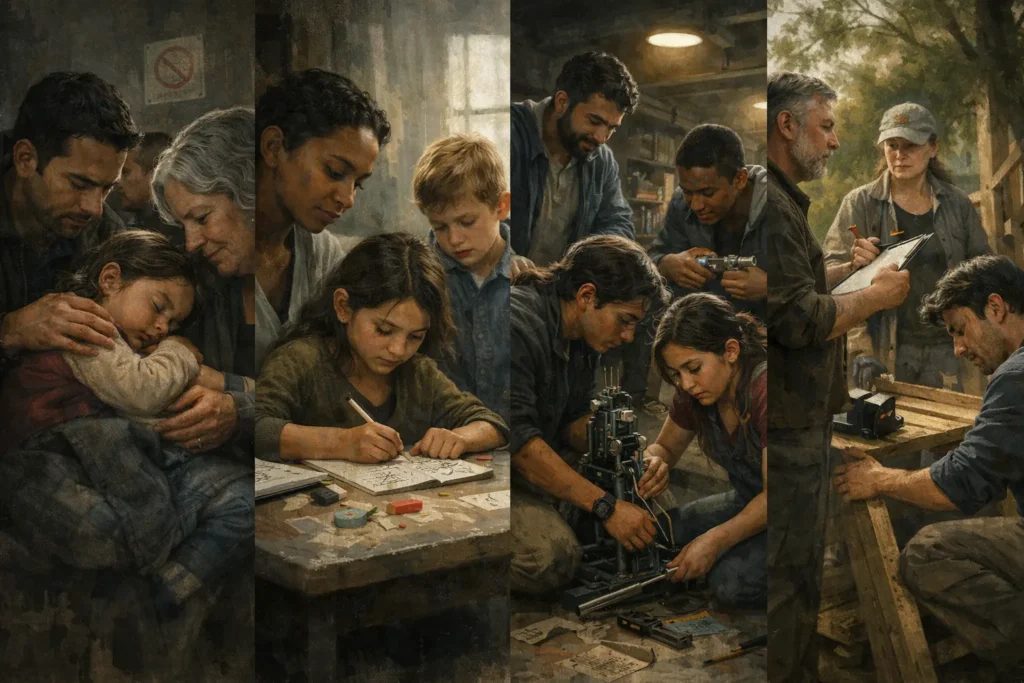
A four part series on what human beings actually are, the social ecology we depend on, and what to do about the world we’ve built that works against both.
The human being is a coherent – intrinsically whole, the parts genuinely interdependent and mutually sustaining – self contained ecosystem tempered and tested through the intensive feedback loop of evolution into stable function. Rather than a Frankenstein-like quilt of systems cobbled together from evolution’s biological grab-bag, we make sense. Although, the way we’ve come to treat this stable system many times does not. Among the advantages of this ecosystem is its extraordinary meaning making process, an elaborate capacity that facilitates higher level cognition, such as complex problem solving. Cultivation of this advantage is not only essential to our existence, but what the rest of human potential depends on.
Many species evolved intelligence, social bonds, and intricate cooperation. In humans, however, these traits have become far more extensively elaborated, including especially sophisticated language capacity and higher-order problem solving coupled with metacognition. The latter combination facilitates our ability to model reality, reflect on our own thinking, revise beliefs, teach deliberately, coordinate with strangers, and build systems that outlast any individual.
It is not a failure to have impulses. The failure is poor integration: when a threat or appetite system rushes behavior without being shaped by higher-level context and developed calibration, outcomes degrade in predictable ways. This is especially true in contexts that require deliberation and coordination. In humans, these impulse systems are a part of a single organism-level ecology, integrated across timescales, where higher cognition coordinates and trains faster responses rather than replacing them. What is distinctive in the human lineage is not the disappearance of these infrastructures, but the expansion of executive capacity: more ability to shape reflexes, represent longer timelines, compare options, and revise behavior based on consequences and feedback. Our potential is not in erasing these impulses, but in the opposite direction, refining and enhancing them to create even higher quality opportunities for human life.

The coherent human being requires coherent stewardship: the adaptive coordination of many interacting needs and signals, across time, using feedback to stay aligned with reality to act and grow. At the individual level, this stewardship is what it looks like when a person can notice an impulse, interpret it in context, and choose an action that serves both immediate functioning and longer-term stability. At its best this is not merely to navigate an impulse, but to deftly channel it for growth. It means that the person can hone and train this impulse as a raw capacity for notable developmental achievements. We continue to demonstrate developmental capacity across our biological infrastructures (physical, cognitive, and connective/social) with meaningfully open-ended expansion. At the collective level, the same logic applies: societies are ecosystems that either scaffold this capacity, through norms and mutual respect, education, institutions, and distributed responsibility, or they degrade it by rewarding short-term reflexes that destabilize the whole system.
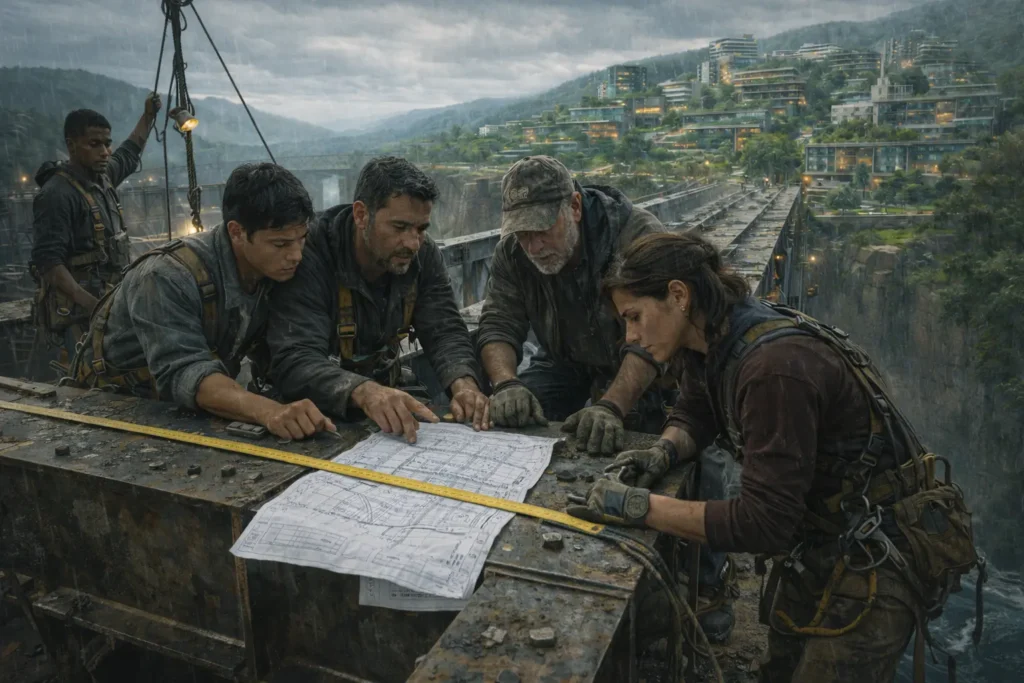
Our distinguishing advantage is the capacity to steward all our systems using higher-level cognition developed in social scaffolding. We can and need to scale this cognitive capacity deliberately, including the ability to form and revise models of how things relate (constraints, trade-offs, causal links) so we can hold complexity without collapse and act with relevance rather than with reactions driven by stress. The resources and clues for this coherent stewardship and development are provided to us in our biology: the need to channel, enjoy, and develop our own impulses and the reward they can provide when harmonized across our living; our capacity to manage and enhance these processes to our benefit and participation in community; and the need for a healthy society, built on mutual respect, collaboration, and shared goals of stability and growth. When we attend to our biology and capacity with clarity, navigating the complexity of our existence for our own wellbeing, that individual coherence propagates outward into the community’s stability as well. Our existences are interdependent and our individual wellbeing correlates to our society’s wellbeing. Our human advantage also means that we are not in this work of stable wellbeing and development alone.