A four part series on what human beings actually are, the social ecology we depend on, and what to do about the world we’ve built that works against both.
The Coordination Paradox: Cognitive Failure at Scale
For the first time, global-scale coordination is technically and materially feasible. The major barrier is not raw capacity, but the abdication of our cognitive capacity to solve problems well. The failure to coordinate and instead extract is the result of higher level cognition enslaved to impulse infrastructures of the nervous system. The stable operational hierarchy – higher cognition recruiting impulse infrastructures for sustained, considered action – inverts under stress. Reason goes to the service of threat response instead of the other way around. The philosophies that defend extraction and hoarding practices sound eloquent and well reasoned. But they are the flailing of a mind driven by stress and the fears it produces – of the other, of scarcity, of submission.
That every empire writes its history to validate the right of the conqueror to conquer is a delusion firmly founded in a cycle of anxiety. The uniforms, ceremonies, flags and oaths are necessary to cover the underlying distress with solemnity. After a group wakes from the fever dream of subjugating innocent others for its own benefit, the brain’s neurocognitive systems that seek reciprocity begin to demand that the scales be balanced. The choice is to right the wrongs or rationalize the bloodshed and theft after the fact. The pomp and circumstance of any regime or business built on extraction doesn’t celebrate the truth. It is required to distract from and justify it. Deep within the brain, there is a still small voice of authenticity that knows that despite outward signs, these actions of extraction and failed coordination are an inelegant abdication of our cognitive advantage.
Extraction, in this context, is a deliberately lopsided value exchange. It also is short sighted, dependent on somehow “getting away with it.” Ancient traditions so valued “fairness,” a response so fundamental it registers in the brain before conscious reasoning engages, that they considered it a domain of the gods. Most cosmologies contain figures dedicated to the balancing of scales of one sort or another. The throughline is plain, actions that take more from society than they give are imbalanced. This archetype exists because it has deep, essential meaning to the human brain. That is to say, this would not be so meaningful if the foundations of authentic and fair social coordination weren’t built into our biology. Our biology requires such synchrony, the dynamic alignment between an individual’s internal states and their social environment, not harmony in a soft sense, but functional coordination that makes cognition and meaning possible. It is precisely within society that our cognition and lives make sense. Our sense of meaning and our sense of purpose are derived from our dynamic place within society. Therefore strip-mining it is as ugly and self destructive as strip-mining nature.

Despite evidence to the contrary, it’s possible that very few actually do “get away with it.” Most likely we are failing to attribute the actual cause and effect dynamics of such actions, especially when sustained and deliberate. The cost to the extractor is not only social – the neurological account is its own argument, and a consequential one. The brain’s fairness response is fundamental and pre-conscious. Theft and thuggery require constant cognitive overhead to maintain, justify, and hide, making it structurally expensive to the practitioner.
While we appear to have the capacity and resources to solve many of our most substantial challenges, we are failing to do so. Just as fight-or-flight is maladaptive to most daily challenges, so is any knee-jerk reaction to deprivation. What is required is exactly what our cognitive advantage facilitates, to problem solve resource management and value exchange for mutual sustainability and growth. For example, many nations are turning to authoritarian leadership in an attempt to resolve lack of opportunity and resources. The authoritarian direction is contrary to the cooperative coordination the present situation actually demands. Authoritarianism reduces trust, pluralism, error correction, and distributed problem solving (all needed for coordination at scale). Therefore it’s the wrong instrument for scarcity/coordination problems. Deprivation occurs largely through misallocation, faulty segmentation, and resource capture (theft). It is insanity that we accept that a very small few benefit so disproportionately from the effort of so many. However, we compound that lunacy when, in realizing that we do not have enough opportunity to respectfully earn reciprocal value for ourselves, we seek solutions that have nothing to do with the problem. We run up a tree when we should be calmly sitting down to work out the problem.
To build systems of extraction is to operate as though the human being is something other than what it demonstrably is: a coherent organism whose higher cognition depends on, and in turn sustains, a functional social ecology. Abandoning proper stewardship of our essential wellbeing individually and socially is costly enough. But extraction goes further. It actively destabilizes how the system works. That is the precise nature of the abdication.
Optimization: The Mechanism of Extraction
The misdefinition of optimization across industries provides one of the clearest insights into an ongoing abdication of higher level cognition in common business practices. What looks like aggressive strategy is actually reason conscripted by fear: a stress-captured brain inventing an incoherent and costly practice and calling it optimization. The practice is to squeeze maximum value from every node in the pipeline – workers, suppliers, customers, communities, infrastructure – while returning minimum value to any of them. The word comes from the Latin word optimus meaning “the very best.” There is nothing very best about this practice in action. A form of extraction, like all others, it affects everyone, even those benefiting only in the short term. A coherent and intelligent business strategy is dedicated to building sustainable value for its stakeholders. That must include the employees, vendors, and customers as well as the investors. But this strategy, designed to squeeze as much value primarily for a select few at the expense of all the others, builds nothing lasting for anyone. Solutions that only serve the short term benefit of a few at the cost of almost all else are evidence of substantial cognitive collapse under distress.
Business, as a practice of social exchange, is a factor of the biological imperative of our cognition, its development and operation. To undermine it, is to undermine yourself and your own near future. The neuroscience of fairness and reciprocity is well documented: the fairness response, the reciprocity circuits, and human sensitivity to inequitable exchange. Authentic value exchange is part of the intelligence of the biological infrastructures of our brain concerned with and dependent on social cohesion. To invent business practices, policies, and systems that position society as a resource to be mined and not an ecosystem to tend, is to embrace a cognitive dark age. There is nothing optimal about extraction. It doesn’t reveal cleverness on the part of these businesspeople, but instead cognitive failure.
Higher-level cognition used to only solve one or two needs/objectives while deliberately ignoring others is at the very least counterproductive. It is weak problem solving and is exactly what happens when impulse infrastructures of the brain commandeer reason to their limited cause. In this case, one of the essential needs being ignored is the stability of the neurocognitive ecosystem of the very actors practicing optimization. Regardless of whether one wishes to abandon their own cognitive capacity, establishing a social dynamic that undermines their own and others’ essential neurocognitive wellbeing for a buck is the equivalent of designing a large building with one toilet. Higher level cognition, training, and experience allow practitioners to handle complexity. The power of the experienced mind, as Elliot Jaques argued, lies in the capacity to hold multiple stakeholder needs across extended time horizons – the longer the arc a leader can genuinely account for, the more sophisticated the stewardship. This is leadership and should be the goal of any entrepreneur and institution.
Optimization, on the other hand, works in the opposite direction. The effects of the practice not only create a culture of diminished neurocognitive wellbeing, normally experienced as a sense of a loss of meaning and purpose, but is resource intensive in the long run. Optimization is a form of extraction practiced in value exchange in business. Extraction, among many other things, is poor resource management. Simply put, it is theft rather than stewardship. “Crime doesn’t pay” not because someone invariably goes to jail, but because undermining authentic value exchange is structurally costly. It does not make sense to the human brain and therefore is expensive to strategically maintain. In practice it burns through resources faster than it builds anything substantial. Optimization and extraction are the opposite movements of business development. For example, a new tech (like blockchain or AI) that’s deployed by a company whose managers are only focused on quarterly earnings is going to burn a lot more resources and take a lot more time to get to a workable iteration than it would if run by managers who can handle the complexity of actual reality and build a product that deliberately contributes to a healthy society. The latter builds on and enhances a social contract that values effective collaboration and authentic value exchange, essential to any endeavor and society. Consider “social media.” At some points it had a few potentially admirable purposes, but through a series of substantial business-model pivots, devolved into a bane of healthy society rather than a valuable contributor to it. This “technology” has made a few people very wealthy at the cost of so much to everyone.
This is the actual condition of many large companies today, Google, Amazon, Meta, etc. They extract for a few and provide increasingly limited value to everyone else. In the case of the “distraction economy,” any business model built on the dopamine reward system, the collateral damage is the neurocognitive wellbeing for all involved. Clearly, this is not sustainable in any way and undermines individual and collective human survival, not to mention growth and development
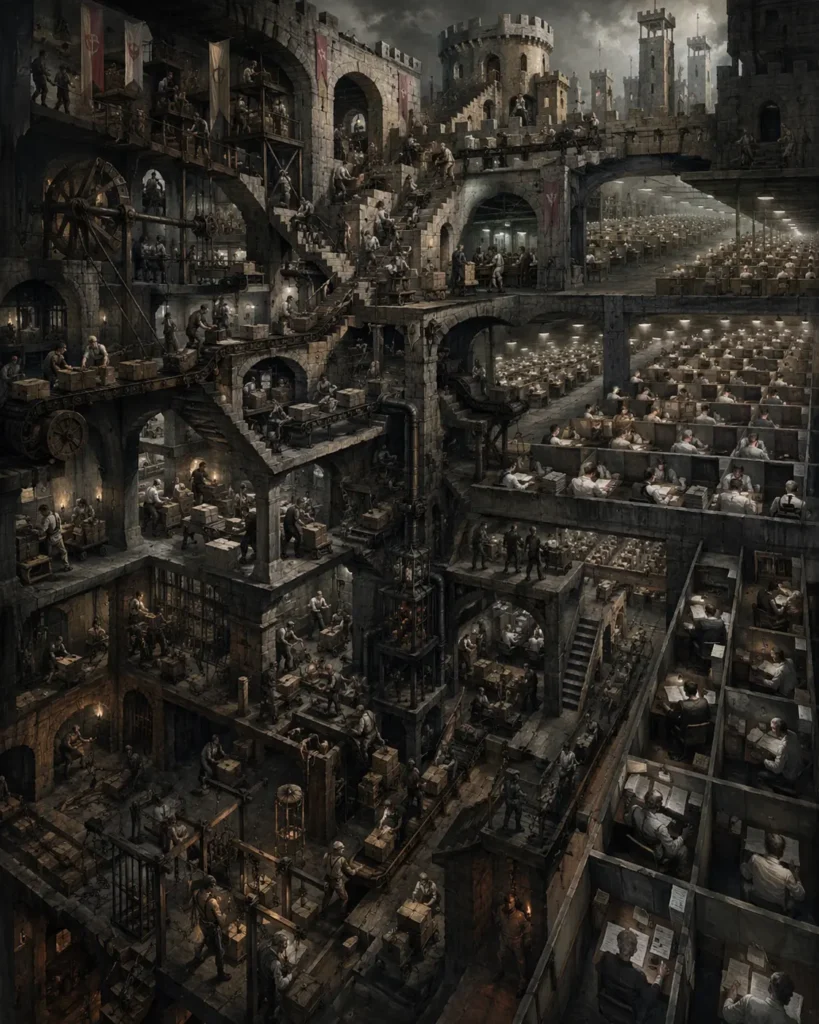
Amazon has devised and deployed systems of optimization that create what seem like medieval conditions for those caught in its tortuous supply chain, with torturous conditions for workers as a feature, not a byproduct. The decision makers in this organization have invented systems that would be at home in pre-enlightenment Europe. If we thought we had left this kind of abuse in our past, we are sorely deluded. Neo-feudalism* accurately describes the aspirations of some of today’s “captains of industry,” particularly from the tech sector (which tells us a great deal about the nature of our tech today). Regardless of the socially regressive nature of such governance systems, the most alarming effect is the cognitive degradation it facilitates across the board. Simply put, any system of thought or governance that undermines a healthy and dynamic society where each individual has dignity, respect, and opportunity to exchange authentic value, achieves two results regardless of the intentions. It undermines the baseline of neurocognitive wellbeing and the cognitive development of all. In reserving “the best” primarily for those at the top, such a social contract reduces what is “best” across the board for everyone. A society where an individual brain cannot discern that its effort will bring reciprocal reward diminishes its sense of meaning and wellbeing as well as development. In such a dynamic, “best” is typically mediocre. In large corporations dedicated to optimization, the evidence is in what they produce, which includes their solutions, the quality of life of their employees, and their cognitive capacity and contributions, as well as their merchandise. For example, work at most major corporations today is notably devoid of purpose and meaning. One does not go to Amazon to do their best work at any level of the corporation.
The fact that one can clearly draw a throughline from the practice of “optimization” to feudalism is telling enough in regards to social justice and human dignity. But it interestingly reveals that those operating from this scarcity worldview are suffering from a persistent threat calibration in their brain. They have abdicated their higher level cognition, enslaving it to impulse infrastructures that are poorly suited to leading coherent thought.
The Ideological Arc: How Extraction Got a Philosophy
By the mid 20th century, it would have been easy to believe that we had evolved far beyond medieval feudalism and defeated imperial colonialism through enormous cost. During and after World War II, the world saw examples of our cognitive advantage at work, real coordination at scale. Stopping the march of authoritarianism – itself an example of reason conscripted by fear infrastructures – required profound higher-level problem solving across disparate groups and identities. It also required massive sacrifice for the greater good. Little of that sacrifice, collaboration, or even problem solving is valued now. Shortly after benefiting from the rewards of such coordination at scale, certain thinkers allowed scarcity worldviews to again draft their reasoning. They invented grand design theories: myopic, top-down cosmologies of economy that only make sense if you ignore most of reality. It turned out that we had only paused the march towards regressive social systems built on extraction and control. It is not a coincidence that this thinking is best evangelized through fear. It is the real god it serves.
Global coordination at scale is not a fantasy and has never been. The coordination required to defeat forces far more prepared and driven to brutality in WW2 is a prime example of what human cognitive capacity can achieve. What followed demonstrated something equally important: that coordination at scale produces outsized and sustained benefit. The Marshall Plan, the formation of the UN, and the emergence of the European Union – none perfect, but all significant – were attempts at coordination infrastructure that worked well enough to demonstrate the principle. Within the United States, Keynesian economics and the retain-and-invest model of managerial capitalism built the American middle class and produced the most broadly distributed prosperity in the nation’s history. While not perfect, these models were tested and worked.
In 1970, Milton Friedman published his seminal argument for shareholder primacy as an essay in The New York Times Magazine titled “A Friedman Doctrine: The Social Responsibility of Business Is to Increase Its Profits”. The foundations of his thesis had come earlier in his book, Capitalism and Freedom (1962). The problem that he and others in his camp were concerned with was the centrality of power in the hands of experts. The managerial class were the experts that made decisions for everyone, including shareholders. Having lived through fascism, they viewed models utilizing versions of this pattern as totalitarian and anti-liberty, and especially anti-individual freedom. At the same time, by the 1970s the Keynesian economic model seemed to be floundering, conglomerates were behemoths, stagflation was rampant, and change was slow. These are valid points and concerns. The dissonance is in the response. A coherent response is to utilize theories and policies as nothing more than tools. They should never become fixed doctrine or dogma. They may affect change, but quickly calcify and reproduce the same intransigent condition and problems that they were trying to address. Through the lens of our cognitive capacity and advantage, dogmas are at the very least lazy if not an abdication of coherent thought.
Friedman had valid concerns but let stress drown reason. Instead of honoring the complexity of good business, society, and the actual problems he was diagnosing, he reduced the truly worthy work of an actual business leader to cartoonish simplicity. He claimed that the corporate executive is an agent of the owners (shareholders) and their only social responsibility is to maximize profit for them. In context, his argument was a direct response to the errors he was trying to address. This is well and good. But it does not constitute an absolute, or doctrine for enterprise. Real human liberty requires engaging and trusting our higher-order cognition. This means that there will never be a one-size-fits-all solution to any problem. Instead we need a wide range of tools and approaches that facilitate our cognitive flexibility, not grand design theories. Friedman, instigated by stress, overcorrected. The job Friedman describes is not executive, it is administrative, which is what it has become today. Instead of experts, which are required for any worthy work, executives were reduced to faces. In many corporations other employees have far more substantial job descriptions. If these executives have only one job and it’s administrative, why are they paid so much?
Friedman’s argument, followed to its natural but catastrophic end, has become the dogma of optimization. It was not grounds for a doctrine, but a potential solution for a moment that ignored a great deal of context and reality even at the time. It would not pass muster in any other worthy domain. We would reject that the physician is an agent of the hospital board; their sole social responsibility is to maximize the biological duration of the patient. This ignores the quality of life, the relief of suffering, medical ethics, or the patient’s autonomy. In this view, a doctor who keeps a brain-dead patient on a ventilator indefinitely is “more successful” than one who facilitates a peaceful, dignified passing. The same for anyone who would claim that the teacher is an agent of the taxpayer; their sole social responsibility is to maximize the aggregate score on standardized assessments. This reduces children to data entry points. It ignores critical thinking, actual learning, character development, emotional safety, or the spark of curiosity. If a student passes the test but leaves school hating to learn, the “Friedman Teacher” has succeeded. We would never accept that the musician is an agent of the venue owner; their sole social responsibility is to maximize the decibel output for the duration of the contract. Friedman’s thinking applied here reduces art to acoustics. It strips away the emotional resonance, the cultural commentary, the technical mastery, and the soul of the performance. A jackhammer and a Stradivarius are equal in this job description, provided they both make enough noise to fill the room.
Constrained by an oversimplified cause and effect, Friedman myopically focused on the maximization of profit and fatally misunderstood the larger human ecosystem that made profit possible in the first place. A business leader who sticks to this doctrine soon loses any business to lead. Yet it has been the foundational theory taught at business schools for decades. Instead of presenting would-be entrepreneurs with a worthy cognitive challenge, one that provides meaningful work and a sense of purpose, it steers them towards cognitive mediocrity. It’s no wonder that large corporations are the burial grounds of innovation and start-up culture has been reduced to the get-rich-quick scheme of investor rounds for hollow businesses. We have raised an entrepreneurial class that instead of seeing themselves as essential to healthy society, thinks that they can have their cake and eat it too: they can benefit from society while strip-mining it.
Shortly after Friedman published his dogma on the why of cognitive abdication, Lewis Powell wrote the Powell Memo (officially titled “Attack on American Free Enterprise System”). This was the how. The title and text of his memo reveals the fear impulse on which it is grounded. Not only does he repeat the claim that business is under “attack,” but his memo is not a reasoned argument. It’s a manifesto repeatedly calling for aggression. His perceived enemies were a list of people who thought things, such as activists, academics, and theologians, as well as the media, which was considered a reliable institution then. His memo on how to abdicate cognitive advantage became the marching orders for a new generation of those willing to conscript reason and the power of the human mind to the impulse of fear.

Neither of these two proposed empirical theories were refined by evidence and adjusted by consequences. Instead they preached dogmas, closed systems that succeeded by reducing reality to whatever didn’t challenge the thesis. This is a failure of the basic executive function of cognitive flexibility. Powell’s Memo goes farther. It advocates for a response to an invented conflict that deliberately uses the tools of reason against itself. He writes how to commandeer and shut down debate as well as deploy propaganda, all these tools used deftly by his disciples today. Consequently, from these false gospels of industry we get the legend of the “job creator,” all the more imaginary in the wake of layoffs in the face of new technology. Among other nonsensical beliefs, they rationalize the concentration of wealth as a social good. When the fear impulse is dominating reason, solutions and thinking do not adjust to reality. Instead fear tries to demand that reality adjust to it.
These men, operating with cognition conscripted by fear, stripped “American Free Enterprise” of its real value, power, and place, while desperately trying to achieve the opposite. We need enterprise. It has a legitimate and essential role in stabilizing and developing human cognition through authentic value exchange. Instead, enterprise, in their reductive vision, stands in opposition to what we would consider healthy society. It is its antagonist. They created a fight exactly where there shouldn’t be one. Treating profit as a sole objective of business, or social engagement as a battle, shreds the authentic human exchange we rely on for our baseline neurocognitive wellbeing and developmental opportunity. From here, there is nowhere to go but down. They were among the founding fathers of the abdication of our cognitive advantage right when we had begun to see the potential of what coordination at scale and human dignity looked like.
The Cognitive Diagnosis: Stress Placing Fear at the Helm
While optimization in this definition is clearly a strategic and moral failing, behind the scenes lies a series of cognitive failures of a specific and diagnosable kind. The scarcity worldview defines an eternal anxiety. It proposes a reality where there will never be enough. Instead of seeing the limit of resources as an opportunity to innovate, a brain committed to this perspective panics. It is a survival orientation even when survival is not threatened. The brain’s meaning-making processes run on an elaborate and refined prediction loop. The brain is constantly building its map of reality from experience and then checking that map against incoming data. Specifically it looks for data that it doesn’t expect so that it can keep the map up to date. That is except when the brain’s ecosystem is governed by stress. Stress biases the process, causing data to be misinterpreted and the predictions to go off course. Such a brain has positioned itself in a world of constant threat. It may be standing right next to you, but it is observing a parallel reality, and for certain reasons, cannot rationalize itself out of it. In this case, the threat infrastructures of the brain stay activated, commandeering the same higher level cognition that if allowed to, could properly resolve any actual threat to survival then return to a baseline of stable wellbeing. It is the neurocognitive equivalent between living in a home or a cement bunker.

This is precisely why it is not helpful to follow a leader whose worldview is grounded in stress rather than one who is pointing to human potential. Such a leader will never be able to manage resources well, as their world is grounded in the fear that there will never be enough. They aren’t seeking to manage resources; they want to hoard them. Then only those closest to them should enjoy the spoils. I am sure certain contemporary “leaders” come to mind. These minds are driven by the persistent belief that there is never enough, therefore hoarding is always rational, cooperation is naïve, and the social world is fundamentally zero-sum. This worldview is a chronic miscalibration, a threat program stuck “on” when reality no longer justifies it. It is also a failure to manage threat responses, like fight-or-flight. In our connected world today this cycle of stress does not protect or facilitate survival, it fundamentally undermines it.
Stress also undermines the brain’s executive functions. As of this writing there are nine: inhibition, self-monitoring, cognitive flexibility, emotional management, task-initiation, working memory, planning/prioritizing, organization, and goal-directed persistence. These are cognitive skills dependent on neurological infrastructures which develop through childhood. They form the basis of what we consider the baseline of healthy operation for an individual and an individual in society. Certain neurodevelopmental conditions are associated with persistent difficulties in the development and operation of some of these executive functions. In these conditions, the neurological development and functioning that support particular executive capacities may differ in ways that make those capacities less reliable under ordinary demands. Everyone experiences moments of stress when these capacities collapse. For people living with some neurodevelopmental conditions, difficulties in these capacities can be more pronounced and persistent.
This diagnosis identifies three overlapping but distinct conditions. The first is a typically developing brain under sustained stress. With the right restoration it can be responsive to a stable environment and in principle recover the cognition that the stress collapsed. The second is a brain whose developmental environment, or whose present one, has produced a systematically distorted model of reality. This brain is operating within a worldview so consistently reinforced that executive functions, like cognitive flexibility, fail. Such a brain can operate with common sense and coherent problem solving in most situations, except where its distorted model of reality is concerned. The third is an actual diagnosable neurodevelopmental condition, such as ADHC. In that case, executive function may be restored with the right strategies and treatment. Unchecked, each condition produces maladaptive stress responses. Friedman focused myopically on the maximization of profit because stress reduced his vision to one factor among a multitude essential to the larger human ecosystem in which stable commerce operates. Stress in its right place is a coherent adaptive capacity suited to immediate, short-term problems. It is not only poorly suited to complex long-term problem solving, it actively blocks it.
It is important to note that groups of people, societies, do not have executive function nor cognition in the same way an individual does. They can and do share knowledge, emotion, and awareness. The distinction is important to avoid false cause and effects. A group is a dynamic and fluid collaboration of individual minds all of which themselves are dynamic and fluid. While not one mind, humans seek coordination as a baseline, it is built into our biology. An example are the elaborate infrastructures that monitor and reward equity in social interaction and exchange. At an early stage humans demonstrate rather advanced social awareness in this respect. By age 9, most children develop an “equal/multicentric” perspective, where they will actually sacrifice their own gain to ensure an equal split between others. However, just like with executive function, stress can throw a wrench into normal operations of the brain. Stress is a condition that humans can easily share. This is where we are collectively.
We are experiencing the results of decades of a functional failure to update: an inability to revise an inaccurate worldview when conditions change; a tendency to treat outdated threat heuristics as if they remain accurate, despite evidence and consequences. Hoarding vast wealth in systems where coordinated provisioning is demonstrably essential to survival is not leadership. It is miscalibrated survival behavior amplified by power. It is not “advanced.” It is archaic. It elevates thuggery – dominance, extraction, consolidation – over actual baseline human behavior and problem solving.
The “solutions” invented by a brain at the mercy of a cycle of anxiety may look sophisticated – complex financial instruments, lobbying infrastructure, ideological think tanks – but as evidenced by their results, are still a maladaptive threat response. These “solutions” are even elaborate, but their short-sightedness reveals that they fail miserably at the real complexity management our situation demands. They may be clever, like a heist is clever, but they are not wise.
Even on their own stated terms – if the genuine concern was the centralization of power in expert hands, or the inefficiency of state management, or individual freedom – a more nuanced and surgical correction was available and demonstrably achievable. The choice to dismantle rather than refine, to burn rather than correct, is itself the diagnostic evidence. Stress-collapsed cognition narrows the solution space to binary options: total control or total dismantling, state capture or extraction free-for-all. The middle ground – calibrated correction, targeted reform, stewardship of what was working while addressing what wasn’t – requires exactly the cognitive flexibility that chronic stress collapses. The Powell Memo isn’t evidence of sophisticated strategic thinking. It’s evidence of a mind that has reduced a complex coordination problem to a war, because war is the only frame available to a brain locked in threat response.
It seems that survival is a daily commitment regardless of your situation. You need consistent nutrition, rest in reliable shelter, and security. However, in a functioning society that’s not survival, that’s maintenance. Maintenance is easy, an administrative action. Survival is more dramatic, it deserves a threat response. Stress has invented problems that we didn’t have, like placing enterprise society at war. It has redefined maintenance as survival. Then it conscripted reason to invent solutions that ignore reason, like the Powell Memo. Then in the wake of the unnecessary destruction, the stress to justify the mess completes the circle. Modern existence, as well as development, depends on coordinated systems that handle complexity well. The anxiety cycle of the scarcity worldview is no longer merely archaic. It is structurally self-destructive.
The Connected World: Why Extraction Is Self-Undermining
“Don’t get caught” is a poor and unsustainable business strategy. It’s the thinking of thugs. The real delusion is not in not getting caught, especially in this case, because they have been caught. The practices like tax evasion, unearned subsidies, poor value exchange, hoarding of wealth, and other heists are all out in the open now. The real delusion is about what is actually being stolen from whom and at what cost.
Today, the scope and immediacy of our global connection means that anyone’s backyard is everyone’s. The truth is that it’s always been that way, it is only harder to ignore now. The real delusion of the cost of abdicating cognitive advantage and failing to participate responsibly in the maintenance and development of healthy society is similar to the practices that caused the climate crisis. In the end, it really doesn’t matter if a factory spewing toxic fumes is next door or across the world; the effects will eventually affect everyone. The cause and effect relationship in these situations is always complex as these practices affect ecosystems. That means they undermine the wellbeing of complex interdependent infrastructures and processes that involve far more than air. It is delusional to ignore the fact that in reality cause and effect relationships are not simple, one step lines, but complex networks. Given that many business leaders have proven that they lack the capacity to understand or manage complexity, it is understandable that they would miss this.

Despite what anyone may say, the invasion threatening societies today are not of poor refugees, but global conglomerates with no intention other than to extract value for their shareholders. These conglomerates take any legal form necessary to cross borders and extract wealth. The decision makers driving them consistently fail to demonstrate the necessary higher-level cognition required for real stewardship. They seem incapable of realizing that global society is now interdependent so that extracting wealth without an authentic exchange of value to all stakeholders (not just shareholders), undermines not only the wealth they want to extract but any sustainability to them as individuals or as a conglomerate because it undermines society. Due to global realities, undermining society anywhere is now to undermine one’s own society. The invaders have been invading themselves for sometime.
The Political Failure: Doctrine Defended Against Evidence
If Friedman and Powell are among the architects of our present incoherent social contract, Thatcher and Reagan were among the most effective subcontractors. Thatcher’s statement in a 1987 magazine interview that there is “no such thing as society” has been taken out of context, but not far. The full quote is, “And, you know, there is no such thing as society. There are individual men and women, and there are families, and no government can do anything except through people, and people must look to themselves first.” It is marked cognitive failure to praise individual responsibility while dismantling the social substrate that produces capable individuals. It is either propaganda or insanity. She does not demonstrate tough-minded realism but an utterly incoherent understanding of basic human existence and operation. Like Friedman, she lost sight of the context of reality that provided the greater structure in which the problem she was trying to address lived and so failed to understand the interdependencies and consequences. In her memoirs she defended quotes like the one above trying to argue context back in self-defense. It would have demonstrated greater cognitive integrity if she had sought to retain a coherent context of how individuals look to themselves in the first place. Then this particular misunderstanding would never have occurred. Instead, she was right, because of her and others like her, there is no society, at least not the one we need.

That these thinkers and leaders continued to advocate for their theories and policies after evidence proved them wrong, reveals the same cycle of anxiety that produced the theory in the first place. The evidence they ignored was in living memory of what broad-based prosperity had looked like when coordination was actually practiced. A theory that cannot update when its consequences become visible is a doctrine. Sound theories that address complex and interdependent realities cannot be made as a knee-jerk reaction to problems. They need to be tested and refined, honed to ensure that the complexity is honored and holds. When rigid dogmas are applied to human governance, they do not facilitate agency or responsibility, as this one claimed to do. In the outward name of individual freedom while enslaved to a dogma, these leaders transformed essential and worthy institutions into extraction machines.
It is incoherent to undermine essential human functioning and then blame humans for not essentially functioning. Dismantling society and then blaming individuals for not looking to themselves is as illogical as dismantling democracy and then claiming it does not work. The trend has been to treat humans as less than they are then blame them for being ungovernable and unsophisticated. The cognitive failing is in the leaders, yet they blame the ones being led. It is the act of schoolyard bullies. The equivalent of tripping someone then blaming them for stumbling, on a national and global scale.
Society is a complex interdependent ecosystem, no element in it has just one function. Government is the formal structure of society’s organization, just like enterprise is the formal structure of society’s proper exchange of value. These institutions are the formal structures through which human cognitive capacity is collectively organized and expressed. Also, because individual cognition develops within social scaffolding, the health of those institutions and the health of individual brains are genuinely interdependent. Failing to see this basic reality reveals that the brains of those designing and defending dismantling institutions are in distress. These thinkers and leaders did not solve any problems, they invented new ones. The same applies for business leaders today. Led by stress and driven by fear they rationalized strip-mining an ecosystem we all rely on, making it unstable and depriving it of the very thing they were looking for. Instead of maximizing profits, they have made maximizing profits more difficult, unsustainable, and unreliable.
Stewardship at Scale
While the extraction world-view has produced many systemic moral failures it is the result of a series of cognitive ones. Invented by minds locked in a cycle of anxiety, it is an incoherent response to a problem of scarcity they imagined then made real and worse. The fact that today’s business and political leaders can’t respond to the evidence that extraction and hoarding are self-destructive reveals substantial cognitive inflexibility. Specifically, it demonstrates an inability to track the complex interplay of forces in which resources exist to manage them for stability. It is like playing jenga with systems everyone depends on. Proposing neo-feudalism as a solution to a developing dark age they are responsible for creating is cognitive failure, not problem-solving. They are not villains, but they also are not examples of the best of us; they are individuals running maladaptive threat responses from positions that amplify the consequences to scale. The diagnosis is not an exoneration; it is an indictment of the systems that select for and reward this mode of cognition. They cannot hold complexity, navigate context in real time, and prove and test workable solutions that create stable and reliable situations for all stakeholders. Unfit for stewardship, they lack the capacity for metacognitive leadership and problem solving.
We are at this moment precisely because the human capacity to develop something far better has been systematically underdeployed and undersupported. This is a developmental failure, not a species failure. The solution is already visible whenever coordination was actually tried and allowed to work. That means it is not utopian, but demonstrable and practical. Instead of abdicating our cognitive advantage to a cycle of anxiety that leads to self-destruction, we have the capacity for coordination and stewardship at scale for the benefit of all.

Read Parts 1 & 2
Coherence: Humankind’s Advantage and Developmental Imperative
Cultivating Our Cognitive Advantage Part 1
Interdependence: The Biological Imperative of Society
Cultivating Our Cognitive Advantage Part II
Notes & Sources
- Senate Health, Education, Labor and Pension (HELP) Committee: In late 2024, the committee released a sweeping 160-page report titled “The ‘Injury-Productivity Trade-off’,” documenting Amazon’s internal speed requirements and their link to worker injuries.
- Trades Union Congress (TUC): The UK-based TUC maintains the “Challenging Amazon” report, which details practices such as surveillance, gruelling physical conditions, and the refusal to recognize unions.
*A good read on the topic is Yanis Varoufakis’ book Technofeudalism: What Killed Capitalism.