
A four part series on what human beings actually are, the social ecology we depend on, and what to do about the world we’ve built that works against both.
Human development is an oddly expensive strategy: a large, plastic brain that takes years to become reliably functional, dependent throughout on sustained provisioning, protection, and structured learning. The question is what makes this viable, and what it requires. Bonobos and chimpanzees have childhoods lasting around fifteen years; male African elephants don’t leave the maternal group until a similar age, spending the following years in bachelor groups before reaching independence — and don’t reach breeding maturity until around forty. The reason in each case is the same: what’s being developed is complex cognition and social language, capacities that take years to master and that only mature inside sustained social environments. The long developmental arc exists because of what it’s building. Sociality is part of the development itself.
As expensive as this process is, in the right conditions and with the right constraints, it affords more advanced capacities for existence. It’s obvious that a long, resource intensive developmental arc interdependent with sociality is a luxurythat’s not for all species. Chief among those capacities is cognition. In the case of humans, the interdependence with society means that higher-levels of cognition provide, facilitate, and depend on societies of more nuanced complexity, creating an iterative, mutually developmental ecosystem. While humans are not alone in having a long road to adulthood facilitated by a society, they are unusual in the complexity of that development, its corresponding society, and the potential afforded by both.

While a luxury and potentially fragile, complexity is often a byproduct of existence. Stephen Jay Gould proposed a “Left Wall” that represents the minimum level of complexity for life to exist at all. Most life tends to stay near this wall. Since life involves growth and mutation some organisms have followed a random “walk” away from it into a “right” tail of higher complexity. The same general arc has been observed in other spheres. The “Mineral Evolution” theory proposed by Robert Hazen argues that the Earth began with only about 12 species of minerals. Today there are over 5,000. A large portion of this “geological complexity” was actually triggered by the rise of life (the Great Oxidation Event – to which we were all apparently invited), showing that these realms are deeply interconnected. It is important to not take this effect too far. If complexity were a “law” of nature for all species, we would be having deeper, two way conversations with our pets, and bacteria wouldn’t be the most prolific organism on the planet.
The Law of Increasing Functional Information seems to sum up this process well without imposing a deterministic plan, a teleological direction, or forgetting that complexity is still a “luxury” (not for every species). Essentially, this theory suggests that complexity isn’t “destined,” but is common in any system where different configurations are tested and the ones that “work” (for stability or reproduction) are kept. It’s a helpful refinement of the thought of complexity because it doesn’t define complexity as complexity for its own sake; existence is not a hoarder. But that complexity develops when it works, providing stability and being replicable. This is relevant to humans as it supports the point made in part 1: we evolved as a unified whole, a layered self-contained ecosystem with biological infrastructures that enable fast, impulse systems and higher-level cognition. The system is elegant and time tested, while still in long-term development. Our layered internal ecosystem is not a machine but a complex interdependent set of dynamic elements and states that require respectful stewardship to function well. In turn this internal ecosystem is interdependent with a social ecosystem requiring the same attention, care for sustainability as well as development into its full potential.
This existence evolved without intention or plan, but that doesn’t mean that there is no optimal state, a range of conditions under which the system functions well. It also means that there is no “mistake.” The long, rigorous feedback loop of evolution results in stress-tested, stable systems. Persistently unstable systems don’t persist. Complexity however, tends to introduce fragility. But it is important to use this term in context. Human existence, interdependent with society, may seem “fragile” compared to the existence of bacteria. But it is resilient, adaptive (facilitated by the cognition it enables), and has demonstrated a capacity for continued development. If we were to infer any absolute morality in such an existence, it would be between stewardship vs abuse. Abuse undermines stability as well as optimal functionality. Stewardship – acknowledging the reality of human capacity, potential, actual need, and the actual environment – seeks coherent harmony with all the factors to facilitate as optimal an existence as possible.

Higher-level cognition, including its capacity to recruit and shape impulses, matures through structured development. It requires sustained feedback, correction, modeling, and shared attention, the steady calibration a solitary environment cannot easily provide. Also, as it matures, it depends on society in which to operate and continue to develop. Cognitive stagnation is not conducive to human wellbeing. Cognition and society are mutually stabilizing while fostering mutual nuanced development. The point is not that individuals cannot think alone, but that the kind of cognition that can track complex reality, updates, and coordinates under constraint is trained and reinforced inside a social environment that can provide repeated, structured learning across time. In a fundamental sense, society in some form is a biological imperative for us.

This higher-level cognition, nor its capacity to recruit impulses, does not mature without structured development. It requires sustained feedback, correction, modeling, and shared attention, the steady calibration a solitary environment cannot easily provide. Also, as it matures, it depends on society in which to operate and continue to develop. Cognitive stagnation does not appear to be conducive to human wellbeing. Cognition and society are mutually stabilizing while fostering mutual nuanced development. The point is not that individuals cannot think alone, but that the kind of cognition that can track complex reality, updates, and coordinates under constraint is trained and reinforced inside a social environment that can provide repeated, structured learning across time. In a fundamental sense, society in some form is a biological imperative for us.
This is also why society is not the same thing as a crowd. A herd can be an aggregation, bodies near bodies for protection or convenience. A society, in the sense that matters here, is an ecosystem of complex coordination: people cooperating across time through shared norms, cumulative teaching, and the storage of knowledge outside any one mind. When that exists, cognition becomes more than private cleverness. It becomes collective problem solving, distributed competence, and the ability to manage shared constraints through coordinated action rather than through isolated improvisation. From a biological perspective, society forms the foundational “purpose” of each individual’s existence in a state of fluid interdependence. In an efficient framework, your unique way of making meaning, your skills, interests, and quirks will facilitate your contribution to your group, forming a large part of what makes life “meaningful” to the biology of your mind.
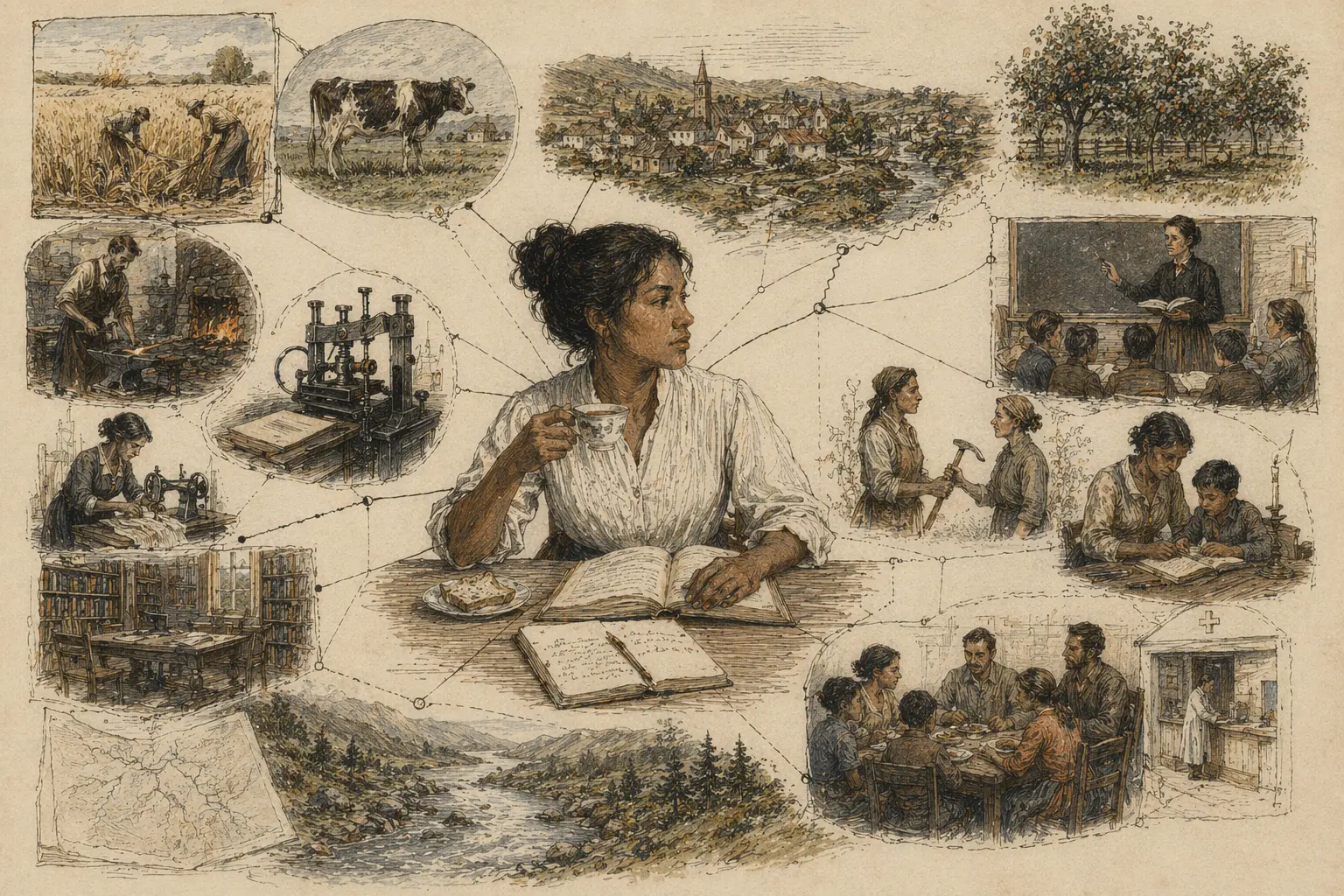
A community is a role-differentiated coordination system with reliable handoffs and shared norms. Role differentiation is necessary but not sufficient: it can exist in arrangements that are coercive or extractive, where the “handoffs” serve power rather than coordination. The distinction is whether roles are organized to support reciprocity, error-correction, and mutual dependence in a way that stabilizes learning and cooperation over time. In a functioning community, roles are not static identities carved into stone. They are adaptive and revisable as people grow, contexts change, responsibilities rotate, and new needs create new forms of contribution. Individuals do not merely “join” society; they develop a distinctive way of making meaning within it, a cognitive identity that shapes what roles they can inhabit well and how they strengthen the whole through their particular constraints, sensitivities, and skills.
Institutions are the durable scaffolds of this ecology. Institutions are not cognition, but they are externalized cognition: collective memory and coordination technology, such as laws, norms, infrastructure, accounting systems, public health systems, and education systems. At their best, they stabilize cooperation, reduce unnecessary conflict, and protect the long developmental runway that advanced cognition requires. When they fail, the correct diagnosis is not that society is irrelevant, but that the scaffolding is misdesigned, captured, or miscalibrated to reality. Part III will argue that the modern world has made coordination at scale materially feasible while also making failure at scale far more consequential, especially when institutions are shaped by chronic defensive postures or extraction incentives that degrade the very social substrate they depend on.
The human being is coherent: a stable, interdependent ecosystem shaped by evolution into reliable function. That coherence is the starting condition. It requires sustained effort to tend it: coordinating the many signals and needs of that ecosystem, across time, in genuine alignment with reality. This is what coherence demands of us as individuals. Society is where that demand scales. The social ecology isn’t the place we go after we’ve sorted ourselves out; it is the developmental environment inside which sorting ourselves out becomes possible at all. To ignore one is to misunderstand what both are.
Humans are a layered internal ecology whose higher cognition develops and functions best inside a social habitat. Society is the precise developmental environment that real life requires. Neither utopian nor sentimental, the implication is practical stewardship: designing our local communities and our institutions to protect the long runway of human development, to make roles adaptive rather than rigid, and to treat diversity as a coordination asset instead of a management problem. We already possess tools – measurement, communication, education, and systems design – that can scale this kind of coherence, but only if we stop treating people as crowds to be controlled and start treating society as an ecosystem to be kept healthy.
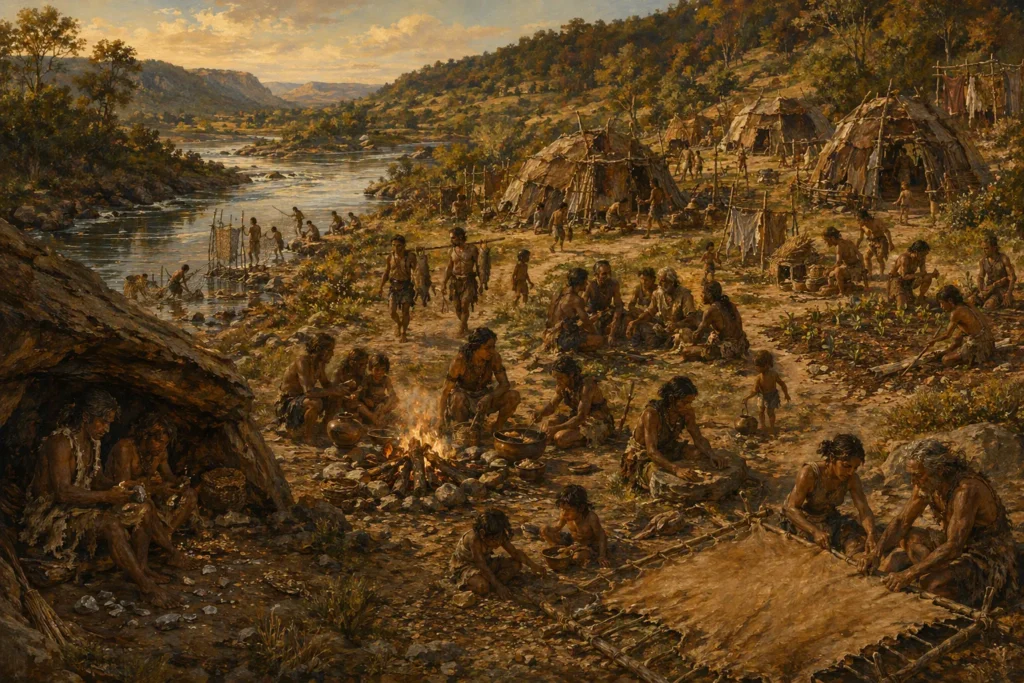
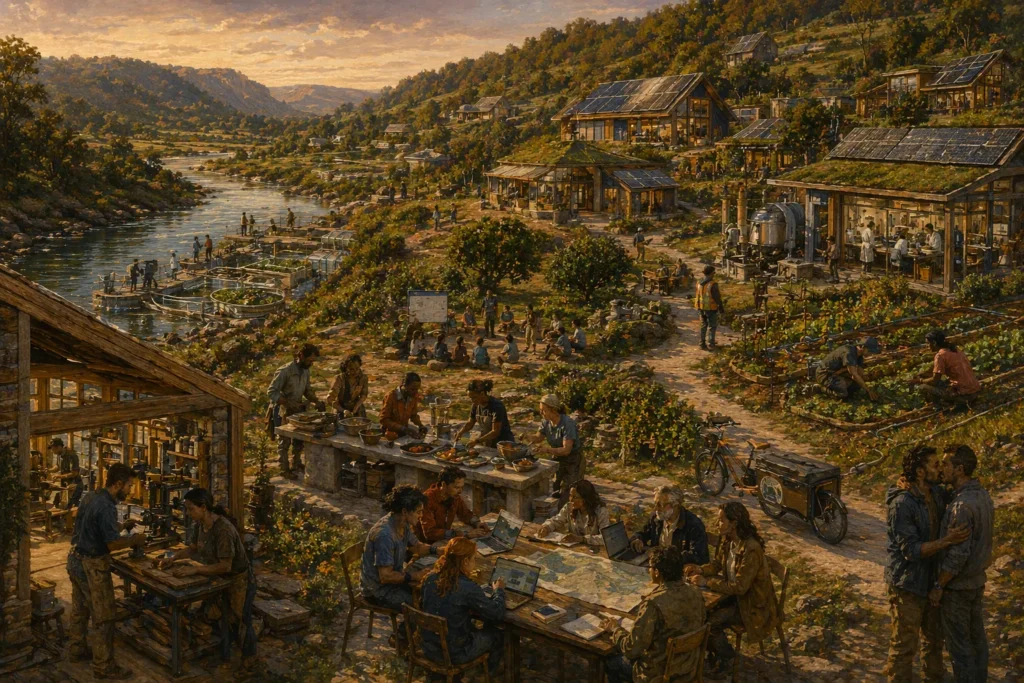
The aim is not nostalgia or perfection. It is coherence: communities that diversify roles, adjust dynamically to changing conditions, and support stable, long-term wellbeing