
Author: Milo de Prieto

  • The Process & Purpose of Purpose

    The Process & Purpose of Purpose

    How the brain composes meaning and why you should participate in the process

    Navigating Reality: The Illusion of Fixed Meaning

    It may seem like some things just are, their meaning fixed and obvious. Likewise, we tend to believe that we choose our beliefs with deliberation and steer our decisions with clarity. But the brain does not operate like a compass that can point to truth when you have a clear head. The brain doesn’t chart meaning, it generates it in real time.
    Each moment, our brains interpret vast input at incredible speed, long before conscious awareness catches up. We mistake this seamless interpretation for fact, for truth. But meaning is something we build, beginning deep within the nervous system that then works its way through our brain, being tagged and categorized along the way, filtered by as well as reaffirming our sense of self. This process is how we navigate the world, and it is always under way.

    We think we are reading the world, when it’s more accurate to say that we are defining it as we go.

    An illustration of a large sailing ship at sale at night to demonstrate how our minds are like ships always at sea, are we taking responsibility for the navigation when we need to?
    We are a ship always at sail.

    The Hidden Process: Before You Know You’re Navigating

    Long before you have a conscious thought about anything, your deep brain is hard at work processing your experience, looking for information that it finds relevant. Regions like the amygdala are scanning the raw data picked up by your senses for anything it may find relevant. Along with the insula and anterior cingulate, your deep brain flags what might matter: anything novel, threatening, familiar, or compelling as well as dismissing what is not. It is a fluid and rather complex categorization shaped by emotion, learning, and bodily state. The salience markers it develops are not objective data points. They are rankings, immediate, and embodied. They say, “this matters, this way,” and in doing so, impose meaning before you even have an opportunity to consciously question their valuation. This emotional tagging system is the first step in constructing relevance.

    Then these cataloged signals travel swiftly into the prefrontal cortex, where you assemble them into enough of a story to act on. So, emotion isn’t irrational. It’s the very efficient product of a highly complicated neurocognitive process. In an instant, it condenses complexity into something you can act on. However, in feeding you coordinates, your deep brain has already imposed bias by choosing what to prioritize and why.

    You’ve taken raw data and formed a detailed map and are moving through it before you’re even aware there’s a route on it to choose.

    Lantern, compass, and navigation instruments arranged on a map before a window overlooking the sea at night.
    The tools of our navigation system are extraordinary, a nervous system that spans the body, limbic systems that assign relevance, an amygdala that flags what matters, and a prefrontal cortex that assembles meaning into action. These tools are always in use. The question is how these instruments have been calibrated.

    Drawing the Map: Constructing Reality’s Terrain

    What the deep brain flags as meaningful becomes the material of your internal cartography, a map of what matters, what doesn’t, what threatens, what inspires. You’re not just mapping mountains and rivers, you’re deciding what counts as mountains or rivers. What populates your map does so because you decided it was worth putting on the map in the first place through your own process of cartography.

    The fixed points you’re navigating between, were fixed by you, or more specifically your deep brain. The meaning of reality you think is so factual and obvious, doesn’t just appear, it is constructed by your brain. While it seems universal, this terrain is personal. What one person avoids, another seeks out. A winding trail for one may be a well-lit boulevard for another. These differences aren’t moral or logical; they are interpretations. What feels real is actually just what feels familiar.

    Moment by moment, the map of fixed reality you’re reading, you just created.

    Hand drawing glowing routes across a large parchment map with a feather quill.
    We are actively participating in the creation of the map we take as fixed right before we read it.

    Creating the Compass: How We Decide What Matters

    Old world maps were often decorated with mythical animals on them to mark the unfamiliar as dangerous. The Lenox Globe of 1510 actually has the words on it, “Here be Dragons” (Latin: hic sunt dracones). We’ve done the exact same to the maps we’ve drawn to navigate reality. 

    The complex emotional tagging system of your deep brain is not only telling you what makes up the map, it’s telling you how and where the meaningful directions are. What is passable or not was decided by you. Your map shows meaningful space that can be navigated, your compass tells you how and which direction to go. These signals that say “go this way” or “don’t go there” are the result of reinforcement, not revelation.

    Your compass is built from repetition, social influence, and past outcomes. You learned what earned reward or sparked rejection. You absorbed values from those around you and internalized the directions they pointed toward.

    You are not just holding the compass; you tuned its needle and then you follow it. At the same time, your brain is inventing the map and then deciding where true north lies. 

    Ornate glowing compass with gold directional points and decorative circular engravings.
    We’ve constructed the landscape and the system to navigate it by.

    Setting the Patterns: How Meaning Becomes Instinctual

    Where did all this pre-meaning come from? Patterns begin forming as soon as your consciousness emerges. Repeated emotional experiences create highways in your neural circuitry, shortcuts that turn signals into instincts.

    The people around you reinforce these shortcuts. They model, mirror, and respond, embedding cultural norms into your internal map. Over time, these grooves deepen. They feel natural, even inevitable.

    But familiarity is not truth. The most traveled path isn’t necessarily the best one. It’s just the one you know.

    This is how you created your instinct. And you need it. It’s a very useful tool that gets you through most of the day. You do not have the time or energy to engage with your complex navigational process at every moment. But instinct is not ancient wisdom, just memory with authority. It’s formed from what has been working until now. That becomes the path you walk by default. Instinct works until it doesn’t. That’s when someone has to take the helm.

    Glowing winding path through a dark misty forest.
    What we take for truth and fact tends to be based on routine and familiarity rather than rigorous, mindful development.

    The Journey: Meaning in Motion

    Just as the fixed points on your personal map of reality are constructions, meaning that you made them fixed, so is the notion that it is all unmoving and immutable. Each moment we test, reinforce, and revise our internal systems by acting. Every step updates the map and compass we’ve constructed as no step is exactly like the one before. We are always on the move, evolving. The trail you take reshapes the terrain, which reshapes the trail, and so on.

    Meaning is not static. It is generated in motion. Our beliefs are clarified, challenged, or calcified through what we do. Looked at together over a period of time, single steps form trails. In turn, and in collaboration with our society, we form tradition by grouping those trails together. But tradition soon recedes into legend because humans never stop moving. We stretch out this meaning to the horizons behind and in front of us. But that’s not how we live. We live in the step we’re taking right now, in the present. That step feels reasonable because it aligns with the meaning we just created and imposed. Overall, we tend to take steps, then assign meaning later.

    We reinforce our interpretation of reality through living it. The maps we drew and the compasses we tuned aren’t just guides; they’re shaped by every step we take. This cycle is how instinct is reinforced but also shows us where conscious navigation becomes possible, if not necessary. We’re making it all up anyway.

    Person walking along a glowing path marked with question marks under a night sky.
    Our maps of purpose and direction are created through an immediate and iterative process, being formed and reformed as we walk them, presenting themselves as terra firma.

    Navigating with Intention: Acting Meaningfully

    For most of life, autopilot works well enough. It’s instinct, built from patterns that have served you. But it’s not exact or fully present. When something truly matters, when the stakes are high, or the work unfamiliar, autopilot will drift if not fail. It cannot measure and account for complexity it has not learned yet. It can’t keep in mind new factors it has to consider and demands it has to meet. Letting old coordinates steer a new voyage is like setting sail without establishing where you are going, how long you’ll be gone, what provisions you’ll need, or how you can resupply.

    Any meaningful project or relationship will demand that you take the helm, examine your goals, and chart your course deliberately. For meaningful work, you must pause. Ask: Where am I going? Why am I going there? And by what values am I navigating? While this work seems heavy and time consuming, it is not. You’re doing it anyway. Without this essential neurocognitive work, you will wander, waste time, effort, and resources.

    Exploration is noble when discovery is the goal. The resources expended in the experiment are well spent, as they were intended for that. But if you need to get anywhere, you’ll need to chart a course.

    An illustration of a woman (an every person) navigating a schooner by the stars to demonstrate the capacity to connect your cognitive identity and purpose to your work and living.
    When it matters, take the helm of your life with intention.

    Dead Reckoning: The Art of Purpose Making Without Absolutes

    Dead reckoning was the process sailors used to calculate where they ought to be before the invention of celestial navigation, or when the stars were not visible. Celestial navigation provided fixed absolutes in the sky from which sailors could figure their position. While we feel we are navigating by absolutes, like the sailors with their sextants, we in fact are not. We’re dead reckoning, making it up as we go along, all of it, the sea, the boat, the rocks, the stars, and constellations we navigate by – we’re the makers of meaning.

    Purpose isn’t an abstract concept. It is a process, a neurocognitive sequence of filtering, assigning relevance, encoding emotion, and taking action. It happens moment by moment, whether you recognize it or not.

    You are always underway. But how are you steering?

    When it matters, do you take responsibility for how you make meaning and consciously participate in structuring that process? When it matters, do you take the helm or let the currents decide?

    You are never anchored. The strength of your purpose floats like the needle of a compass between unconscious autopilot and mindful intention.


    Small ship at night following glowing lines across the sea beneath a star-filled sky.
    Navigating with purpose is not a matter of control—that’s impossible. It is a practice of understanding and working with inner currents and external constellations, the way a sailor moves a ship with wind, sea, and stars.
  • Beyond the Scorecard

    Beyond the Scorecard

    Shared Terrain: Rethinking Assessment as Development

    ON CURIOSITY

    In 1927, Heisenberg discovered that you cannot study a thing without affecting it. The character of the detached observer, aloof, clinical, untouched, is seductive, but a myth. Curiosity is a force and the act of studying is violent, sometimes soft, many times fatal. Ask the rats.

    Painterly close-up of a scientist in a white lab coat and blue gloves holding a white laboratory rat as they look directly at one another, both with deep blue eyes.
    Research is a Contact Sport

    The researcher never arrives empty-handed. They carry with them the universe of their experience and assumptions, the gravity of their purpose, and the slant of their approach, an angled intent, like rays of sunlight breaking through clouds. Every question posed limits the field of view. It is a kind of incantation, summoning only what the inquirer believes might appear. Anything else is unnecessary, invisible, or worse, unimportant. Even time conspires in the distortion, there’s always a lunch break, a deadline, a limit to attention span. The researcher is not liberated from reality, they are just as bound as the frog splayed out before them, belly open to the world, wondering “why?,” or “why me?”

    We would be better served by a different metaphor of research. Rather than the clinical, aloof, and detached entity poking around, we should remember we are like children giving into our sense of wonder and curiosity. Picture a child sitting on their haunches by a stream, mesmerized by the vast universe before them between a few stones. We are playing god, not god. The important and operative word is playing. The work of our research could use the joy, openness, and above all humility to know that no matter what we think we’ve figured out we are always just beginning. We are always children sitting on our haunches by a stream.

    THE TECHNOLOGY

    Having even a basic awareness of all that we are really doing when we pose a question is essential to the entire process of educational assessments. Our tests and probes aren’t painless nor sterilized, and the subjects are very much affected by anything we do.

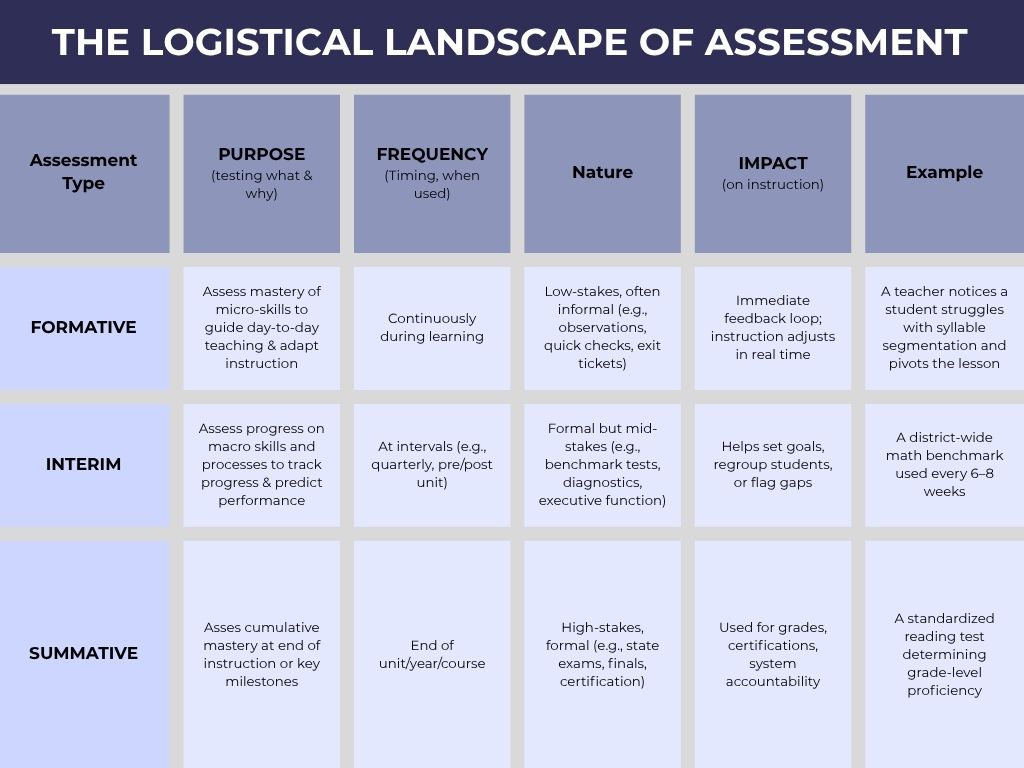
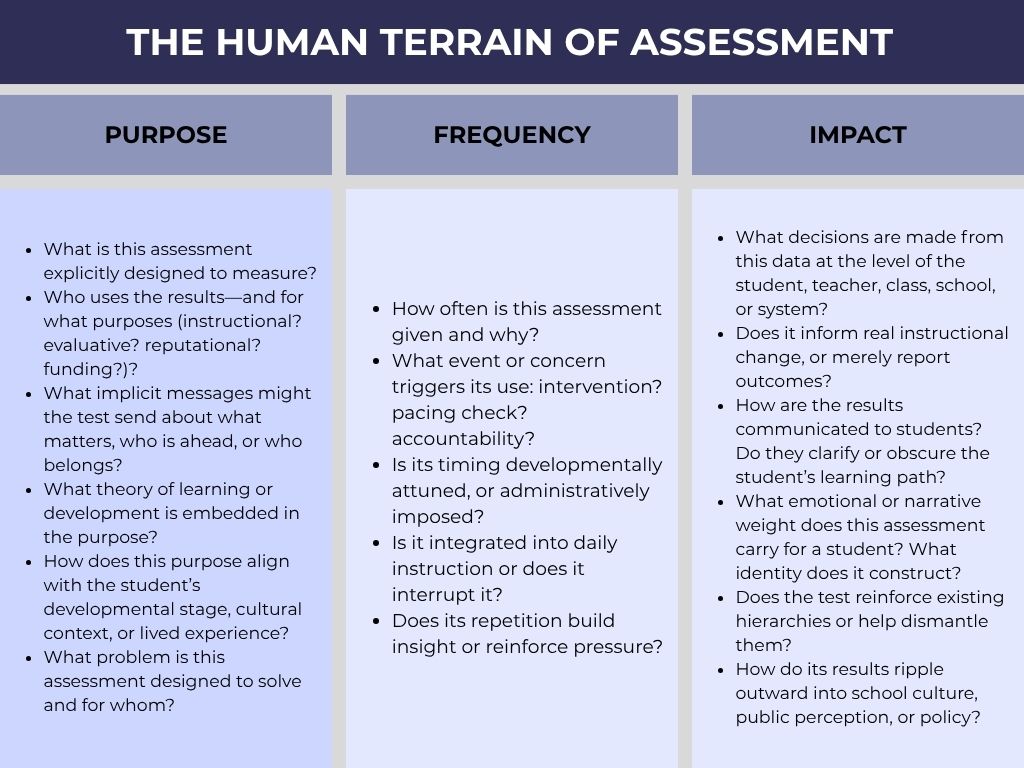
    One typical way of understanding and categorizing assessments is to use the spectrums offered by three parameters: purpose, frequency, and impact. Purpose is simply what the assessment is intended to study. Frequency can refer to almost daily, certain times of the year, or regularly, at say the 4th grade. Impact, which I find the most interesting, asks how do the results provide necessary information to guide how students are taught, if at all.

    Testing has long been used to punish, to filter, and above all, to rank (see summative below). If you’d like a firsthand experience of testing as barrier, try navigating a written driving exam, Spain’s version offers a particularly vivid case. But none of these purposes serves to advance education in general, instruction specifically, or learning at all. And yet we’ve organized much of education, and adult life, around this reductive scoreboard logic, despite how little it actually tells us. I, for one, am not comforted by the thought of sharing the road with someone who earned their license merely by surviving a bureaucratic gauntlet. What measurable skill did that really require? When, exactly, did they become a worthy driver? What parts of their own process and skill did they come to understand?

    Three-panel painterly illustration showing a young man driving, a judge seated behind scales and an open book, and a smiling doctor in a white coat with a stethoscope.
    We assess for clearance, not awareness.
    Not what you’ve learned, where you’re strong, or how to grow, just that you got through.

    Most people are aware of standardized tests used to rank students and educational systems, administered at certain grade levels. Their purpose tends to be to test how well a student, class, school, or educational system performs compared to others of a similar situation. These tests probe arrival at milestones, called benchmarks, what the student should be able to do or know at a certain age or after completing a course. If you encounter any kind of test, other than of your patience, you will have encountered these the most, such as the aforementioned driver’s exam, national educational benchmark tests, college entrance exams, or any test for certification. These assessments are typically known as summative, their frequency is the least (thank god), they try to get a global perspective of learning or mastery, and other than to shame or laud anyone, they don’t remotely impact how or what students are taught, they simply don’t elicit that kind of information. We keep summative assessments around out of habit and hierarchy, not because they give us what we actually need to support growth.

    Interim assessments are more frequent, used to predict a given student’s journey on the way to mastery. They are administered pre or mid- instruction, and sometimes at intervals such as early into a course and then towards the end. Rather than the on/off switch of standardized tests, these may assess foundational skill development, cognitive processes (like executive functioning) that affect learning, or working understanding of a topic. These assessments are intended to flag potential areas that could use reinforcement or provide students with necessary strategies and scaffolding for success.

    Advances in the neuro and cognitive sciences have allowed us to develop a more thorough understanding of how we learn. We understand that full mastery is made up of a complex ecosystem of acquired primary skills, each formed of multiple subskills, all working together. Armed with this knowledge, we can quickly and informally assess mastery of a sub-skill either right before and during instruction. This kind of assessment is called formative as it offers granular information immediately useful for adjusting a lesson in real-time to efficiently guide a student to mastery.

    Educational assessments are improving, focusing more on developmental insight (interim) and real-time instructional adjustment (formative). Yet summative tests, which offer little real value, still dominate into adulthood.

    THE PEOPLE

    But this framework, purpose, frequency, impact, is only the entry point. To understand assessment’s true force, we have to look not just at its design, but at the people it touches and how. Obviously, the purpose of any given assessment is grounded in assumptions formed by the methodology of the educators (researchers) and the immediate society that they are in. Assessment is not a neutral act, it enters the room with culture, intention, and consequence. It is almost always disruptive and somewhat “violent.” The entire procedure can provoke sincere questions of social justice (cultural bias embedded in questions favoring one group, or the understood definition of mastery of a subject) and most importantly, student development, directly affecting identity and sense of agency.

    In educational psychology specifically, and psychology in general, context, situation, and narrative are more powerful determiners of behavior and success than individual capacity and personality. For example, a well-meaning but inelegant administration of an interim assessment for first grade admission, could establish in a child’s mind their identity, as role, in the coming educational journey even before the school’s doors open. Not understanding what is being asked of them, the student could find the assessment process confusing and threatening, telling them that this place is not for them (from an actual case).

    Thankfully, education is evolving. By looking at development and learning as composed of both structured and situational processes, we’re recognizing how to set students up for success and really teach, rather than merely rank. For example, neurodivergence is no longer seen as a deficit to be corrected, but as a distinct pattern of perception, shaped by the brain’s unique chemistry and structure. This shift calls not for correction, but for calibration, adjusting methods and environments to fit how an individual child naturally learns.

    NOTE: structured — the ecosystem of interconnected subskills and primary skills working together; and situational — we each go about that development differently with different circumstances and realities affecting our journey.

    I know that as we develop a nuanced understanding of cognitive identity (the way our brains uniquely process, learn, and make meaning) allows us to design education that meaningfully and practically affirms individual journeys. We may be traveling toward similar developmental goals, but the route, pace, and terrain vary for each of us. That essential understanding will accelerate and enhance our learning and development lifelong.

    THE LAND

    Assessments have evolved with our understanding, functioning more as tools for insight than instruments of ranking. And yet, we still lean too heavily on ranking. Summative assessments continue to dominate, socially and institutionally, even though they offer the meagerest of insight. They rarely, if ever, serves us. What real value do we gain? Validation? Shame? That reflex alone unravels the myth of educators as clinical observers. None of us stand outside the learning process. Parents, teachers, people, we are all shaped by the same cognitive forces, elbow-deep in the same soil.

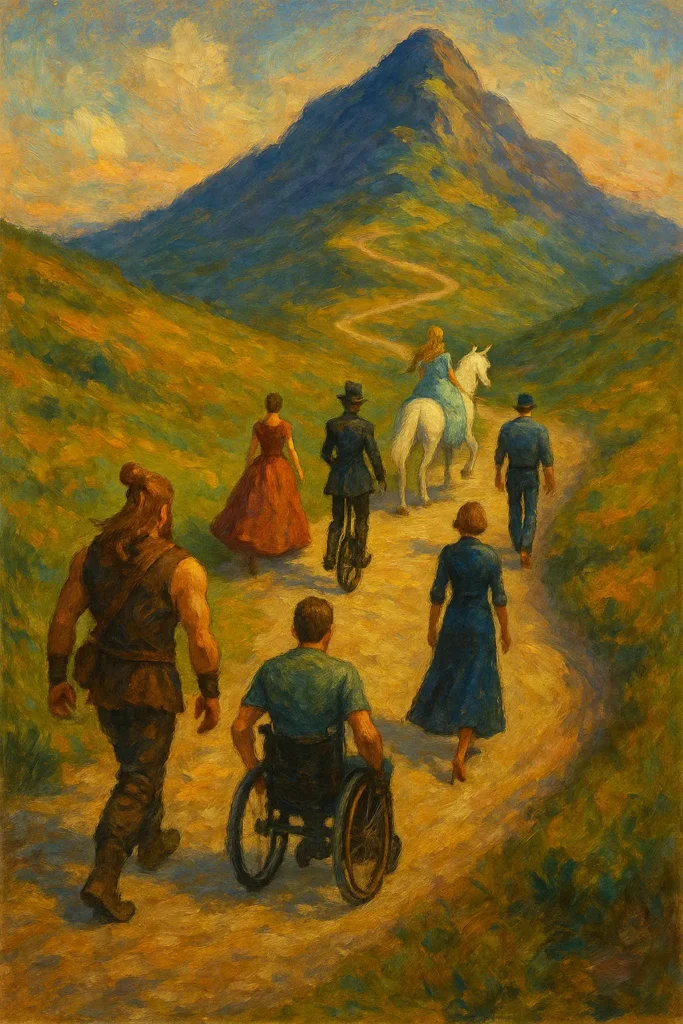
    When we understand the truth that learning is a shared terrain and lifelong, assessment becomes an activity we use to grow together, not a scorecard we impose. Neuro and cognitive science reminds us that while our developmental roadmap may be shared, the navigation of it is personal. By walking those paths visibly, with our students and each other, modeling curiosity, struggle, and delight, we don’t just access growth, we develop a society dedicated to it.

    Painterly illustration of a diverse group traveling up a winding mountain path, including a rider on a white horse, a person in a wheelchair, and others walking toward the peak.
    While there may be generally one path, there are no formulaic journeys: “Neuro and cognitive science reminds us that while our developmental roadmap may be shared, the navigation of it is personal.

    This shift has radical implications, not just for classrooms, but for culture. Imagine a society where the dominant “tests” of life aren’t summative but formative, where progress is measured not by accumulated status, but by evolving skill, perspective, and purpose. Instead of comparing résumés and bank accounts, we’d know to check in on our continual development of mastery, reflect on how we’re learning, and grow alongside one another and our students. That’s not just better education. That’s a better way to live.

    We are always children sitting on our haunches by a stream.

    Painterly illustration of a young boy crouching barefoot beside a shallow stream, looking at a glowing spiral galaxy reflected in the water.
    We never grow out of curiosity, we just teach and test it out of ourselves.
  • The Quantum Self: Developing Who We Are Through Situation

    The Quantum Self: Developing Who We Are Through Situation

    The Importance of Narrative, Situation, and Context in Development

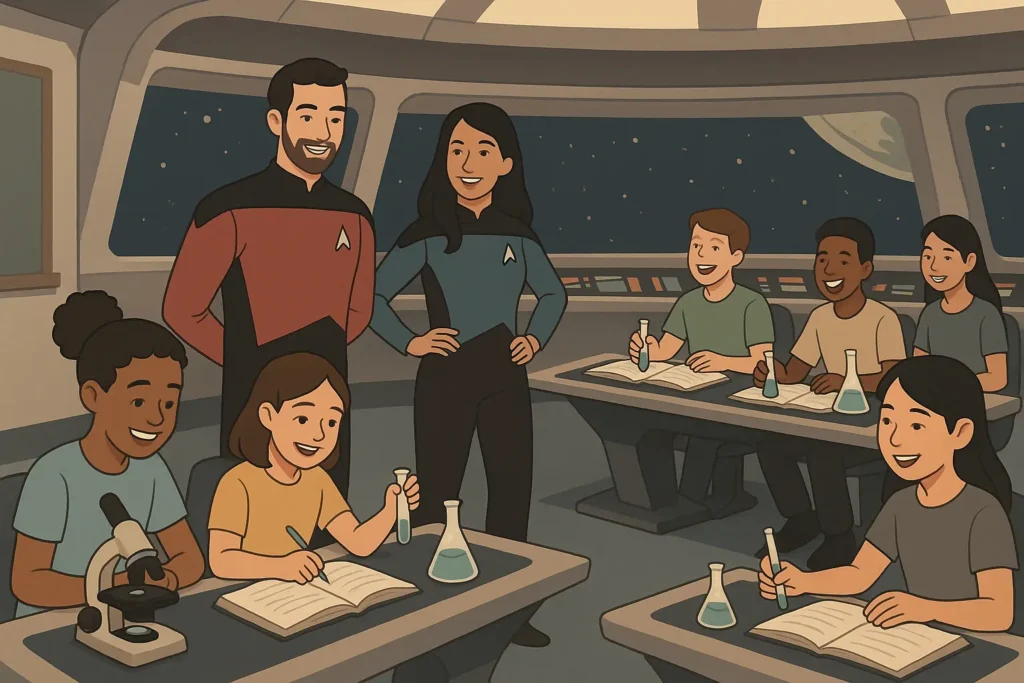
    In one secondary school I had worked with in the US, two chemistry teachers with adjacent classrooms spent their own money and free time to turn both into two different sets of the starship Enterprise from TNG. Each day they wore their uniforms and invited their students to join in their simulation. Activities, lessons, and benchmarks from the curriculum were restructured into scenarios within the Star Trek universe. It took a little while for them to work out all the kinks and get into a seamless flow, but their fandom and ingenuity delivered far greater rewards than the sum of their work and investment and far more than they could have anticipated. The students, barely born when TNG ran, responded to the set-up as passionately as the teachers, not making the classes very popular but instilling a passion for learning that was reflected in their grades.

    Children doing science activities in a Star Trek-style classroom with two instructors.
    The right context creates developmental propulsion.

    Recently, when talking with a colleague, who is also an accomplished actress, while discussing the power of context and narrative, we imagined a scenario: she had landed the role of Wonder Woman in an upcoming film and the shooting began in a month. She realized that while it would be hard work, she could easily achieve that ripped look to pull off a superhero through a proper regime of diet, exercise, and possibly working with a trainer. The thing is that she knows now exactly what to do regardless of the promise of the role. While she is fit above average normally, like any of us, she feels she could improve. Body image aside, the situation and narrative is not enough for her to make this a priority even to get to a goal less strict than that of the famous Amazon.

    In both examples, narrative plays an important role in driving action. In both cases the program or curriculum already exists. The roadmap is not missing. In the first example teachers used narrative to instill drive in their students and in the second it’s used to make a vague goal into an achievable target.

    In his must-read 2022 book, Laziness Does Not Exist, social psychologist Dr. Devon Price, delves into how the research has long understood the role of situation, context, and narrative in predicting behavior. Procrastination, he writes, is not a character flaw or problem to be solved with discipline, but a symptom of an individual’s situation and position within that. The context creates a narrative in our head that causes us to delay or fail to perform completely. Thinking that this can be solved by trying harder is as delusional as thinking you can move the moon off course by concentrating hard enough.

    In an earlier article I pointed out how we use methodology grounded solidly in neuro and cognitive sciences to teach language acquisition, literacy, to children. Yet we then turn around and teach adults a second language with no real strategy or processes long debunked. The body of research in this field is generally called the Science of Reading. It has been proven to apply to all languages with an alphabet and so tends to have a different name in other languages if at all. The point is the thesis of how we learn and use language based on the way the brain works, literacy is achieved through the mastery of a set of primary skills, each made of sub skills, that all work together in a rich ecosystem in the brain. As the brain achieves mastery in these distinct skills, language quite literally flows out without consciously clambering through grammar rules. Through research, we are successfully applying this thesis to other disciplines as applicable and to human development as a whole. However, this comprehensive curriculum to achieve language mastery is not enough.

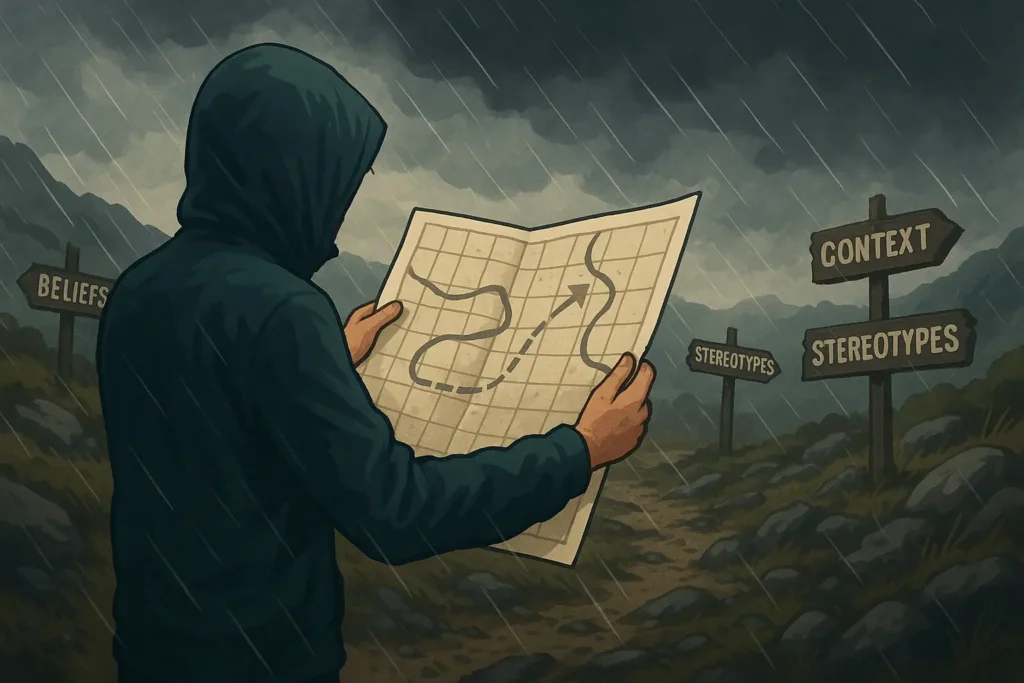
    Imagine the entire set of skills detailed out as a map in front of you showing you the path from beginner to fully literate in a particular language. This map alone lacks terrain and live reports on the weather. I’m straining the metaphor to show how the map is not enough. It is absolutely groundbreaking and necessary. But without the proper context and narrative, you or any student won’t get very far down its path.

    Hooded person holding a map on a rainy path surrounded by signs reading Beliefs, Context, and Stereotypes.
    Even the best roadmap is useless in unhelpful conditions.

    For children, this context obviously extends outside the classroom. Conditions at home will enhance or delay certain developmental skills and determine educational success. For example, an unstable home, filled with conflict, causes young children to develop peripheral vision rather than perpendicular or binocular vision, required for reading. Even a stable home without books or parents who read fails to extend the relevance and power of reading in the greater world in the mind of the student. It’s well researched that students whose parents read fare far better than those that don’t, a challenge exacerbated by our increasingly digital lives (and Tik-Tok rot).

    It’s important to note that while parents seem to be at fault, blaming anyone is unhelpful. In fact blame is a situational structure that blocks development. If we want to grow individually and collectively we need to look at blocks in development not for the purposes of performatively “taking” or placing responsibility but to understand the mechanisms causing a situation so that we can efficiently disentangle ourselves from them.

    Within the classroom, skill with situational navigation can empower or obstruct even the best curriculum. This is why we have a continuously improving set of skills for the teacher simply called best practices, as in any industry. When I was regularly consulting in the classroom, we explained that these practices would streamline the teacher’s work even when they were having a “bad hair day.” It was a colloquial way of developing metacognition of how one was good at what they did, consciously competent, so that their personal mood or situation could be subsumed into their professional situation. For teachers, this is absolutely imperative given the vast responsibilities they have to perform in demanding circumstances.

    In the case of adults, the challenge for development is not the lack of will, but the narrative context they find themselves in, which includes what they believe they are inherently capable of. For example, your brain wants to learn language, it loves to communicate. But you might have decided that you are not good at speaking other languages or learning in general. You might think it’s too late or not “your thing.” These feel true only because you believe them to be. Although, also telling yourself otherwise is not going to substantially change the narrative. Referring back to the scenario of getting fit for a film role, the essential pieces that changed the motivation were the sense of purpose aligned with a realistic and easy to articulate and follow plan of action. These two effects changed the situation in this imaginary case through narration.

    This mental exercise of imagining a situation with purpose and plan that could change one’s situation so as to address blockage, shows that if we are more intentional with our sense of self, using simple narrative structures innovatively in unison with well defined strategies and plans, all designed to work with our personal contextual present, we could develop in helpful ways, rather than struggle in wishful limbo. Obviously, this is not simple “manifestation,” it requires a holistic shift of certain elemental ways we have of thinking about our value, capacity, and past. Simply demanding that we “fix” our wrong thinking of, say, our value, isn’t going to get us anywhere. We must investigate how we live the “value” of ourselves as a process, the situation in action we reinforce through multiple microactions and almost unseen habits. We investigate without shame, without performative responsibility, instead with curiosity and gratitude (for the lessons — it sounds new agey, but works).

    I particularly like this statement from Dr. Price:

    “It’s really helpful to respond to a person’s ineffective behavior with curiosity rather than judgment.”

    He attributes this awareness to the work of Kimberly Longhofer (writing as Mik Everett), who leveraged their own journey through disability and homelessness to show that situations do not define people at all. We ignore the value of anyone in difficult situations to our own detriment. What follows is that just as we acknowledge our cognitive identity (or at least personality), we should also understand our approach to our narrative patterns that form our situations. These approaches to situation are not whats but hows, not fixed truths but learned processes, which we can use to bring us towards peace rather than stress.

    This further demonstrates my notion of seeing identity not as a monolith but a quantum field or wave, defined not by fixed traits but by how our cognitive patterns express themselves across possible situations. Observation collapses potential into choice, and the self takes form in relation to context. Who we are isn’t just who we are, it’s who we become when the moment calls us forth. Cognitive identity is a wave of potential that becomes observable only when refracted through the lens of real-world situations.

    Consider an adult learner who’s always struggled with math. She avoids numbers in daily life, believing she’s “not a math person.” But then, she’s offered a promotion — one that involves budget oversight. The job comes with training, mentorship, and a specific goal. Framed within this new story, her relationship to math changes. It’s no longer a judgment of her intelligence; it’s a skill to serve her growth. Within months, she’s not only managing budgets but helping others demystify the same tasks that once froze her. The math didn’t change. The story did.

    The thing here is that the situation is formed of the set of circumstances you have at the moment. Many of these may not be readily mutable. However, they aren’t the most important part of the situation that determines your value and capacity, they are just there. The way you configure them and your relationship to them does. Many times we are simply accepting society’s interpretation of these circumstances, rich means you’re valuable, your job or partner status defines you, etc. These are by default reductive and if laziness does exist, it’s in this process of stereotyping. The truth is that different narrative practices can radically reconfigure the meaning of the same set of circumstances, your role could be victim or agent, villain or antihero, loser or learner, and so on. The same person who finds themself “homeless” can be forming a powerful story of transformation, step by humble step. They are not a fixed point but a waveform: capable of collapsing into despair or rising, when met with a reframed context, into self-definition.

    Split image of a hooded person slumped on a bench and the same person writing in a notebook.
    “rock bottom” or “building anew”
    The same situation can tell completely different stories going in dramatically different directions. Results of decisions are real, but they do not define who you are and what you are capable of, you do that.

    The story you believe you’re in determines the action you’re willing to take, no matter your strengths. To develop you must see yourself not only with agency but within a narrative that makes action meaningful. Our story isn’t a limited statue we chisel out from stone. It’s a field, always forming, shaped by what we see, and how we choose to see it.

    Silhouetted person walking along a glowing river-like path in a star-filled dark blue space.
    As difficult as it is to remember our story is always forming in our mind, not something carved in stone.

    NOTE: I use the term “taking responsibility” in quotes to refer to the performative action reserved for apologies. In the right context, it is cathartic and liberating. However, “taking responsibility” in that manner in the context of investigating why you are blocked, or don’t develop, can also be a cop-out, emphasizing the shame and blocking any ability to actually do anything about anything.

  • You Learned a Language Fluently Once, You Can Do It Again

    You Learned a Language Fluently Once, You Can Do It Again

    We teach children fluency with research. We teach adults with empty rituals.

    Cartoon of five people seated around a candlelit table like a séance, while a woman declares, ‘We call upon the Spanish subjunctive tense to reveal itself to us!’
    We teach language fluency with science, except to adults.

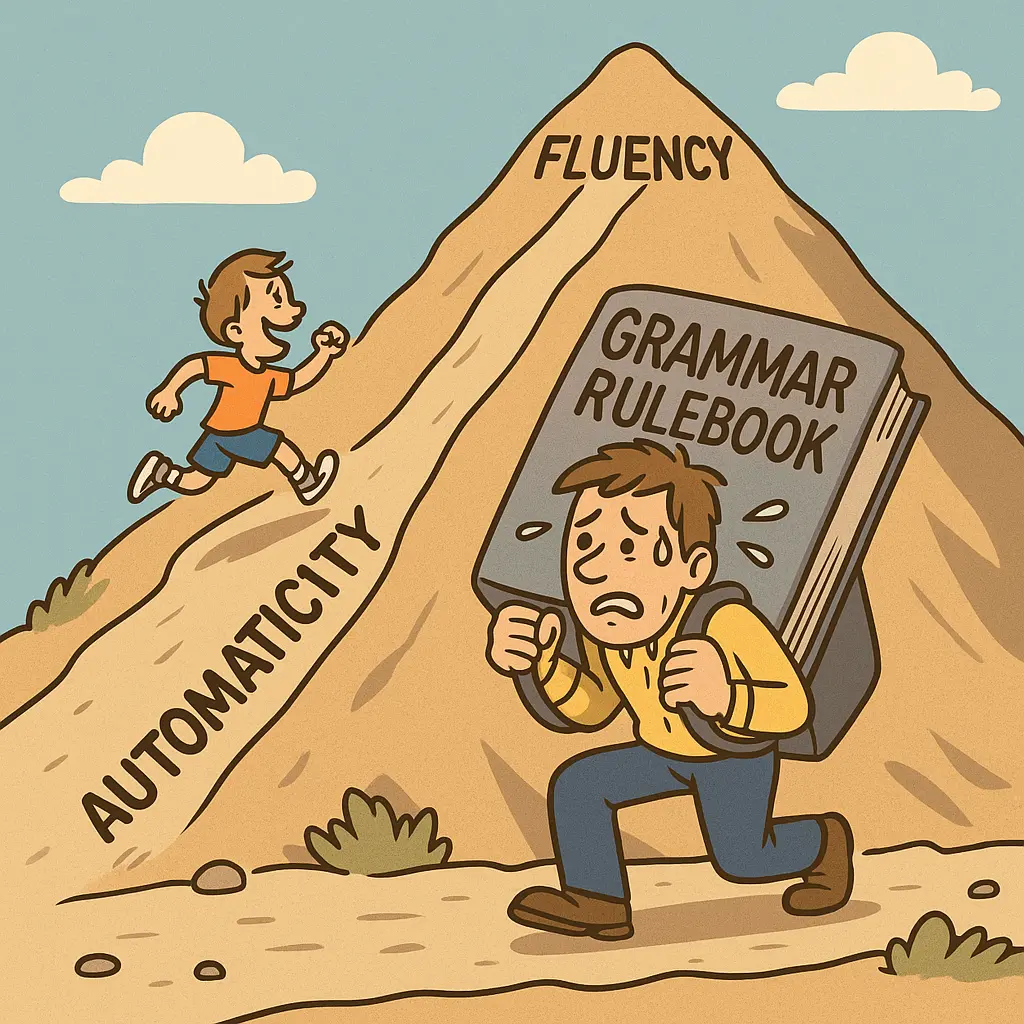
    If your brain has already mastered fluency once, it stands to reason that the most efficient path to doing it again likely lies in retracing those original steps. Yet most adult language instruction veers wildly from this principle, defaulting instead to rule memorization and grammar before mastery of basic syllables.

    Cartoon of two paths up a mountain labeled ‘Automaticity’ and ‘Fluency.’ One child runs upward easily while another struggles under a giant backpack labeled ‘Grammar Rulebook.’
    We already know how the brain learns language. So why do we ignore it when teaching adults a second one?

    First language acquisition has been studied for decades. We’ve moved past the era of phrenology-for-the-classroom and into more rigorous understandings of language development. And yet, until quite recently, many schools across the U.S. used the now-debunked Three-Cueing system, which claimed children learn to read through 3 cues, semantic, syntactic, and graphic (context, sentence structure, and visual cues; Larry, Moe, and Curly). This is linked to the While Language theory, which believed students developed language mastery through immersion or maybe it is osmosis. In reality, that’s about as effective as learning to swim by watching synchronized diving.

    It always amazes me that people who would carefully plan and take strategic steps toward goals like financial independence believe that something as complex and crucial as literacy or fluency should just happen through immersion. It’s like expecting to grow your savings account by hanging with the well-to-do. Most likely, you’ll end up as staff.

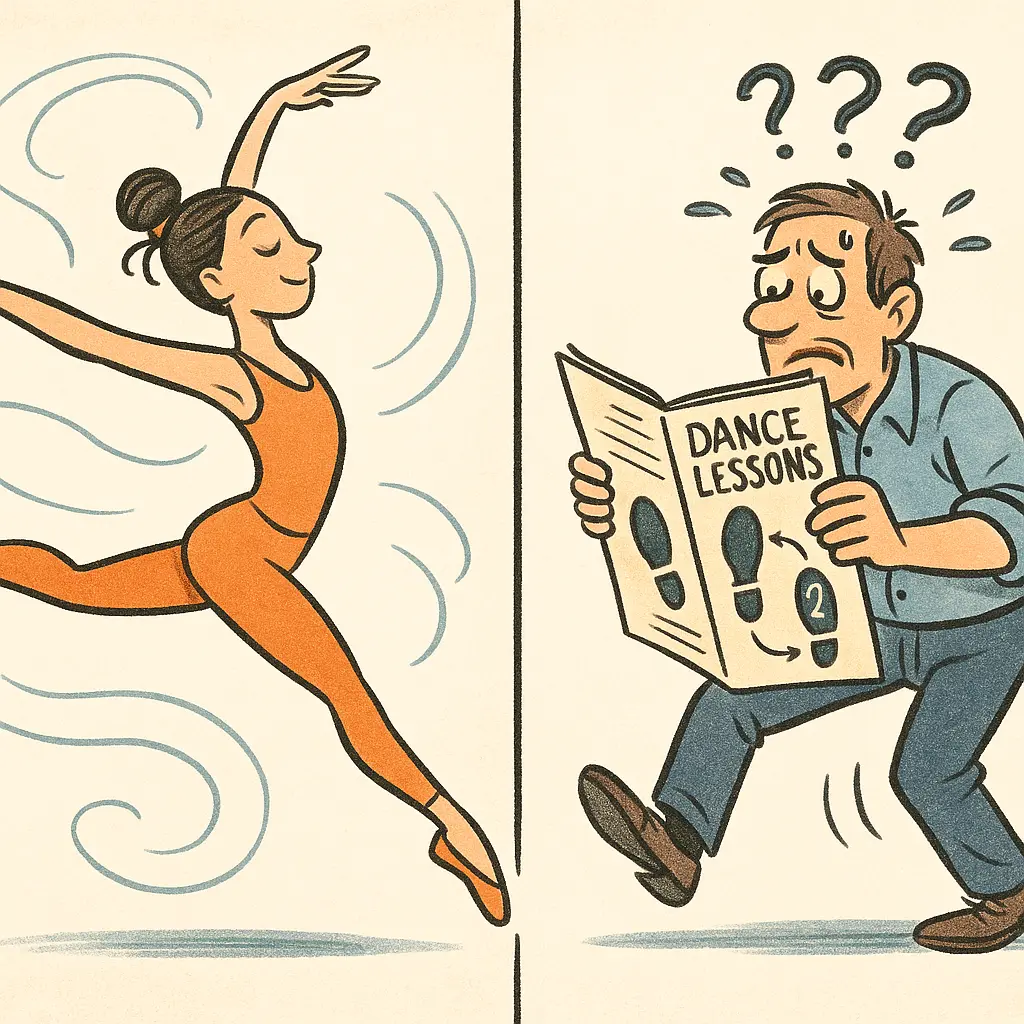
    The reasons we are studying language acquisition are to build effective systems for teaching and, perhaps more importantly, to better understand the brain itself. With advances in neuroscience, we’ve come to see that fluency is not through magical exposure. It’s the result of layered mastery: a cascade of cognitive sub-skills working in concert to achieve something fluid and whole. Like a gymnast in flight, the grace of the outcome is made possible by dozens of synchronized sub skills on micro-movements, body awareness, timing, strength, and more, all practiced to the point of automaticity. The accomplished gymnast enters a state of flow with all these collaborative skills.

    Split cartoon showing a dancer moving gracefully on the left and, on the right, a confused man trying to learn from a booklet labeled ‘Dance Lessons.’
    Mastery is a state of flow, you get there through building on skills not memorizing puzzles.

    Similarly, you are not consciously aware of all that’s happening when you speak. You don’t painstakingly construct your sentences, you just open your mouth and have at it. Your phonemes, syntax, vocabulary, and rhythm flow together in effortless sequence while your focus rests, if anywhere, on meaning (well, one hopes). The complexity is truly astounding, but you navigate it unconsciously.

    We now know that language is acquired through a structured sequence of neurological and cognitive processes realized as developments. A child begins with phonological awareness, the ability to hear and differentiate sounds, then builds on that phonics, decoding, fluency, and beyond. Each of these primary skill areas is made up of many sub-skills, which are themselves developmental. With the right input and guidance, even struggling learners can repair gaps, a missing sub skill or two, and move forward very quickly, within days of systematic and explicit instruction. This is the backbone of the Science of Reading, which is used in most classrooms now in many languages (the name is not important as it’s not an official program from any one source. It’s a synthesis of decades of research on how language is actually learned).

    Whether or not your teachers followed this approach, your brain did. And that’s the key. The Science of Reading reflects how the brain builds fluency through interdependent sub-skills, developed in logical sequence. It’s not just pedagogy, it’s neurology.

    If this is how the brain achieves fluency in a first language, why don’t we use the same map when teaching adults a second one?

    It’s safe, and being proven accurate, to extend this developmental compass to other complex domains of knowledge. Many follow similar layered acquisition patterns. With a bit of research we are discovering the primary and sub skills for other disciplines and overall human development. At least this is my thesis.

    In the case of language, these layers are not arbitrary. They mirror how the brain transforms sound into symbol, symbol into pattern, and pattern into meaning. However, this isn’t to suggest rigid instruction. Brains aren’t computers. You cannot simply plug in a curriculum like the science of reading and expect mastery. Real learning and effective instruction are dynamic and adaptive. We also know that circumstance and context matter as much as skill sequence. The process is also iterative, the brain is not learning each skill in isolation before going on to the next. The brain wants to learn and is leaping backwards and forwards sometimes at a fantastic pace. Instilling this understanding of learning and development creates lifelong learners.

    So, we know how fluency develops. We know how to recover or accelerate it when it snags. There is no reason adult learners can’t benefit from the same insight. If anything, with proper context and the right dynamic structure, they might progress faster.

    So again, the question: if your brain has already achieved fluency and works in this stepwise neurological process, why should learning a second language be approached any other way regardless of age? Why are we reinventing the wheel starting with a block? Why are adults learning the subjective tense before they can properly discern the syllables of a new language? We have the map of how to get where we want to go, just no one is using it.

  • Do You Take Responsibility for Your Own Cognitive Identity and Development?

    Do You Take Responsibility for Your Own Cognitive Identity and Development?

    Your uniqueness is vital to your and your local community’s wellbeing.

    We now accept what artists and researchers have known for a long time: identity is a performance. We choose which facets of ourselves to show in which context. We curate impressions. Some parts of the self feel immutable, but many are constructed, refined, or shed as we evolve.

    When people talk about identity, they usually mean character traits, sexuality, ethnicity, gender, social roles, or aesthetic preferences. We still treat identity as something to discover, as if we’re a monument to be unearthed. In truth, identity behaves less like a fixed object and more like a quantum field: full of permutation, contextual, fluid. But even as our language about what we mean by identity grows more nuanced, we almost never talk about it from the perspective of what’s doing the actual making of meaning, our brain. We have little notion of our cognitive identity.

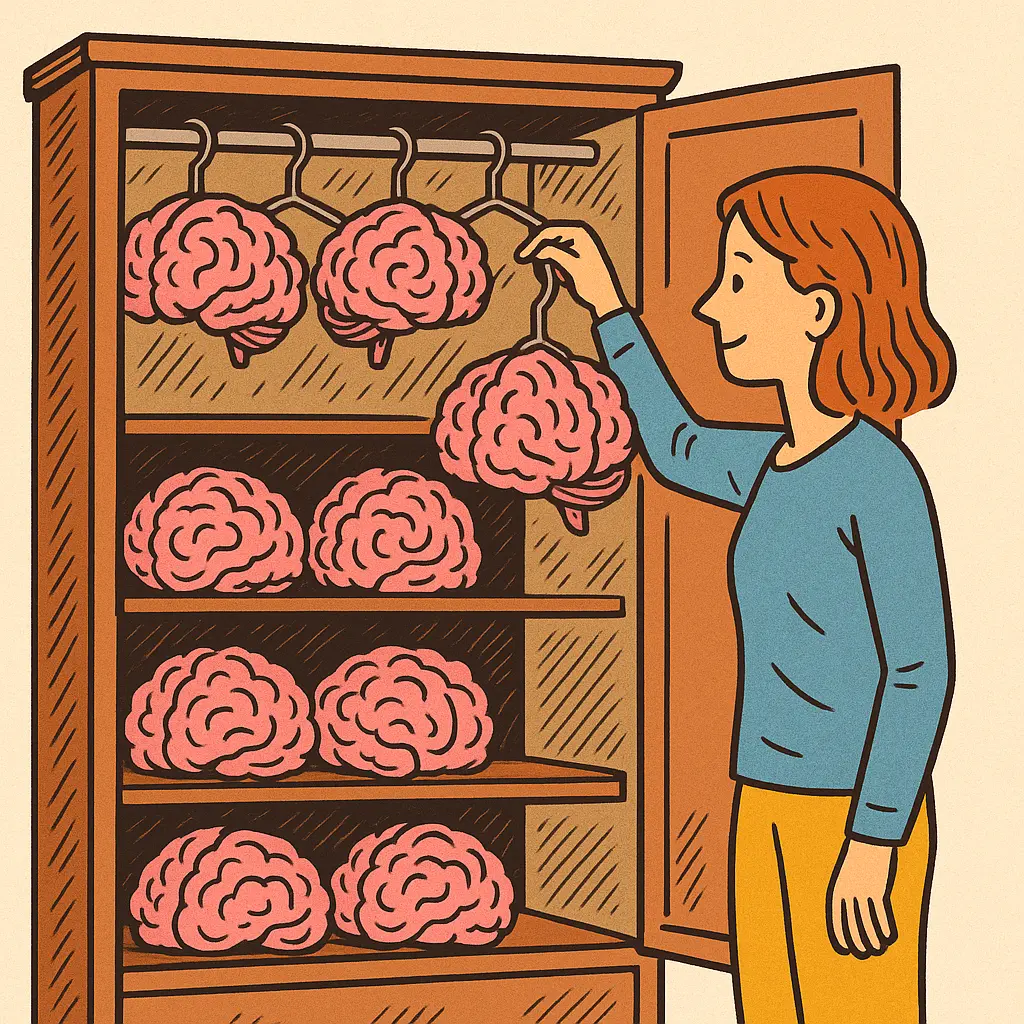
    Maybe you’ve taken one of the popular modern variations of the Myers-Briggs Personality Type Indicator and been told you’re an ENFP or an ISTJ. Perhaps you’re familiar with the DISC, Enneagram, or Big Five. They place you in a predefined category from within a specific range of outcomes, similar to a horoscope. At the very least they can help you feel seen. However, while very useful, these cannot be confused with a real understanding of your identity. You share the exact same results with millions and millions of others. So how is it that your wardrobe is more original than your brain?

    Woman opening a wardrobe filled with brains on hangers and shelves.
    How is it that we accept our wardrobe is more unique than our brain?

    There are thousands of other assessments too of varying relevance, some give you metrics across spectrums in emotional stability or innovative thinking, others can tell you which Spice Girl you are. But once you’ve been seen, what’s next?

    In education, we’ve long understood the power of diagnostic assessments. A good diagnostic doesn’t just say whether a student knows something. It explains why they struggle, or why they soar. It breaks down skills into subcomponents and identifies the gaps. That clarity turns frustration into strategic momentum. It gives students agency over their learning and development. These assessments are used effectively (if too rarely) in language acquisition, reading comprehension, and much more.

    The same is true for adults. Or it can be. But we still cling to outdated assumptions about learning and age. We treat childhood as the only arena of development. But your brain doesn’t stop developing just because you’re paying taxes (how it grows changes, though). The capacity for growth never expires, nor does the responsibility for it either.

    Your brain is the most powerful tool you own, rich or poor, thriving or flailing, Scary Spice or Posh. It’s also your greatest resource for shaping a meaningful life. Yet we rarely take responsibility for our cognitive development, let alone our cognitive identity. There’s no shared script for it. No rite of passage. No map. We’re socialized to believe that adults are cognitively “finished” and that any further development is about recovery and therapy, not expansive growth.

    That’s not true. I’ll have none of it.

    “I won’t have it. The world is wilder than that in all directions, more
    dangerous and bitter, more extravagant and bright. We are
    making hay when we should be making whoopee; we are raising
    tomatoes when we should be raising Cain, or Lazarus.”
    Annie Dillard, Pilgrim at Tinker Creek (1974)

    To develop, you first need to understand what you’re working with. Your brain isn’t a computer or a personality type. It’s a vast, living ecosystem of neurological and cognitive structures, functions, and processes. You could spend a lifetime mapping its terrain. In fact, you should.

    So when it comes to cognitive identity, the better question isn’t “Who are you?” but “Who are you when you’re… (insert physical or mental adventure here)?”

    …solving a problem, launching a project, improvising in chaos, learning a new language, city, or artform, seeing a pattern no one else sees?

    We now know, such as for those of us with neurodivergent brains, even your so-called cognitive weaknesses may be superpowers in disguise (granted sometimes very well disguised).

    So to know what you are working with, you need a framework, a way to talk about your cognitive patterns with precision and without judgment. I’ve built one.

    It starts with what I call your brain’s primordial message, an inner orientation that reflects your role in the world and how you engage with it. It’s something your brain works on from childhood and will keep doing, job title or not. It is a concept that would make sense to your seven-year-old self (assuming you’re not seven while reading this) and to your eighty-year-old self, too.

    From there, the framework maps your high-end cognitive processes: how you handle complexity, solve problems, and perceive and navigate the world. It also tracks how those processes are evolving. Finally, it aligns these insights with the core competencies and applied skills you’ve already demonstrated through experience. The result is a dynamic portrait of your cognitive identity and a practical roadmap for using it.

    When you align these elements, your purpose, your deep cognitive functions, and your real-world skills, you have a much better idea of what you should be doing as well as how. You can understand what kind of work will really engage and energize you, how you naturally solve problems, and what kind of challenges will help you grow. Rather than guess you can strategically plan your next move. This opens up developmental opportunities. I believe this is the key to real quality of life.

    See: Rethinking Maslow: Breaking with a hierarchy of scarcity to cultivate neuroecological abundance.

    See: Rethinking Maslow: Breaking with a hierarchy of scarcity to cultivate neuroecological abundance.

    But just like physical fitness, cognitive development doesn’t “just happen.” It’s a deliberate process.

    Know where you’re starting. Pick a target. Determine the milestones. Use the right tools. Go, adjusting to reality along the way.

    My approach is informed by my formal and informal study and research in neuro and cognitive science, which I enrich with divergent disciplines such as theology, quantum theory, esoteric traditions, fine art, and my years of educational practice and system design. But honestly, you don’t need my system. You just need a system, one that helps you understand and steer the most valuable resource you have: your mind.

  • Rethinking Maslow

    Rethinking Maslow

    Breaking with a hierarchy of scarcity to cultivate neuroecological abundance.

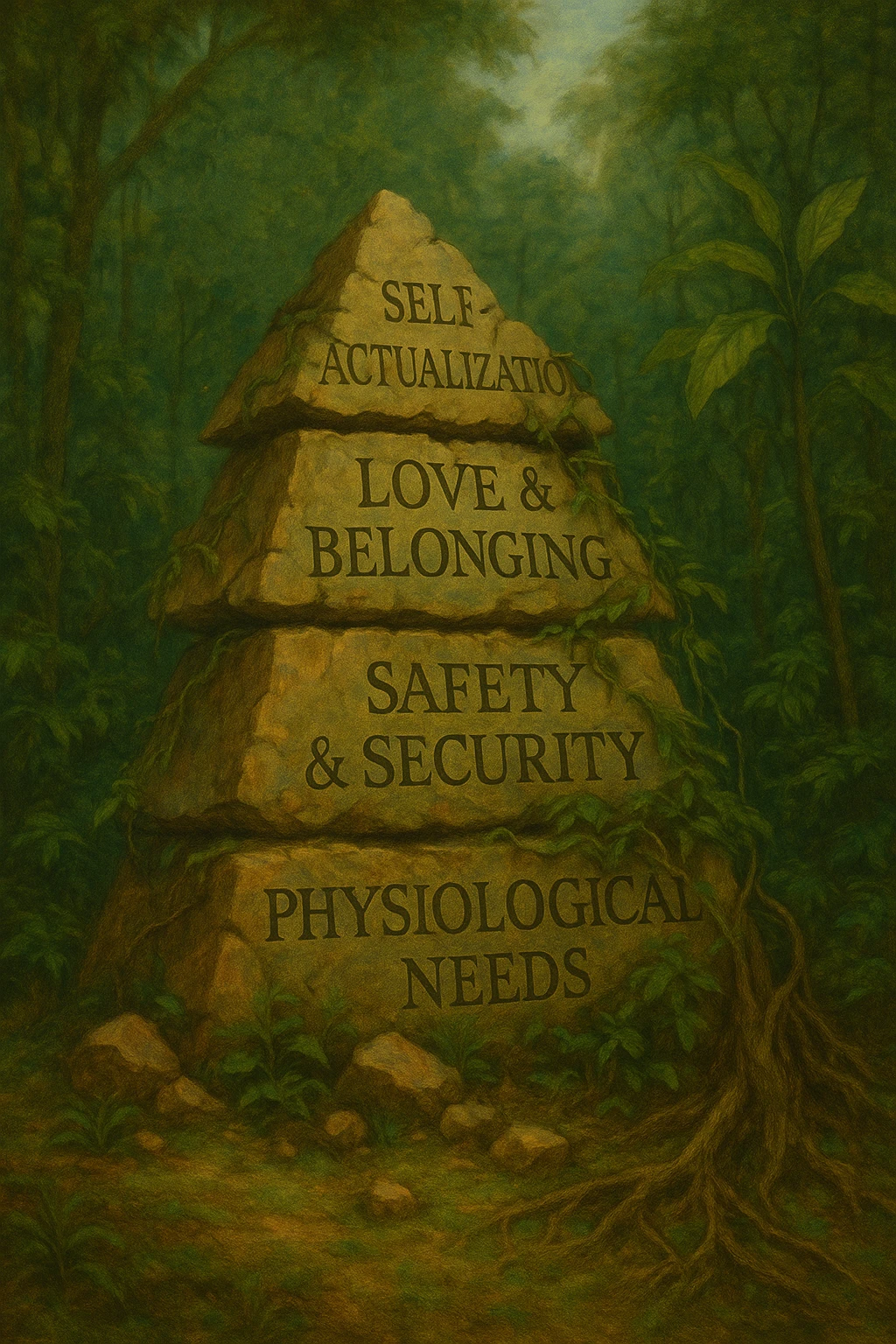
    In 1943, Abraham Maslow proposed that human needs exist in a hierarchy, a model later famously codified into a pyramid. This visual suggested a rigid, stacked system: if basic needs for food and shelter were unmet, higher cognitive functions were not possible. He placed self-actualization at the peak, treating meaning and purpose as a kind of cognitive luxury only accessible once all lower tiers were fulfilled.


    It’s a compelling framework, but its rigid, stacked architecture fundamentally misrepresents the interdependent, co-regulatory nature of the human brain. Modern neuroscience shows us that needs like meaning, connection, and flow aren’t indulgences; they are structural requirements for a well-functioning brain and nervous system, actively sought out even in the absence of safety.

    A crumbling version of Maslow's pyramid with "physiological needs" on the bottom, "safety & security" above that, "love & belonging" above that, and "self actualization" on the top.
    A scarcity model of needs in a system that only grows when the lower sections are sufficiently strong is a narrative that can limit basic wellbeing. The brain’s actual processing is dynamic and co-regulatory.

    The true problem with the pyramid is the subtle but devastating narrative it creates: if you’re struggling to meet basic physiological needs, higher functions—creativity, reflection, purpose—must be postponed or dismissed as luxuries. To internalize that view is to inhibit your own development.

    A Note on Intent: This essay is not a critique of Maslow himself, who framed his model as an observation of typical motivational prepotency, not a fixed prescription. Rather, this is a critique of any framework that reductively interprets human existence through a capitalist lens of scarcity, which is precisely how the prescriptive pyramid has been used. Capitalism is a constructed economic framework with narrow aims, not a human or biological reality, and such frameworks can only manage the vastness of human experience by compressing it into abstractions that strip away its substance. It is the equivalent of expecting a rainforest to behave like a filing cabinet.

    The Neuroecological Model: Tending the Systems for Sustainable Thriving

    Rather than stacking needs by social convention or survival logic, a neurobiological model should reflect what the brain and nervous system require, daily or cyclically, to regulate, grow, and function. This shift treats the brain not as a machine with linear outputs, but as a dynamic ecosystem to be tended as we would a garden, coastal reef, or forest. This is the grounding for our new understanding.

    This updated framework organizes our essential needs not by rigid hierarchy but by frequency of use, systemic impact, and cognitive cost. It identifies four neurological system groups that operate collaboratively in a dynamic, interdependent environment.
    This reorganization liberates possibility by achieving a profound conceptual shift: it reframes the human experience from a deficit to be solved (drudgery) to an opportunity to be enjoyed (tending).

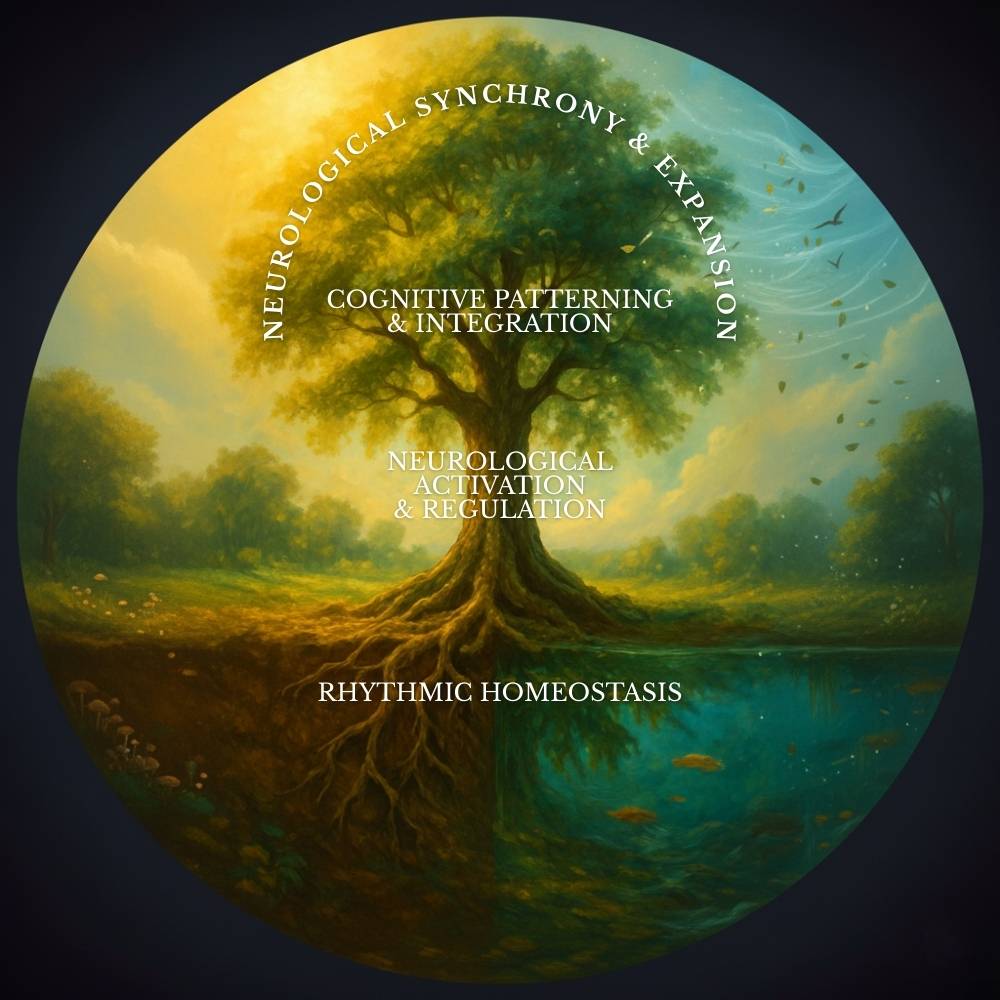
    The core of my thesis is this: when we prioritize the brain’s essential systems, treating the brain as an ecosystem to be tended such as a tree, we don’t simply survive, we optimize. The work of integration—of tending your own “internal tree”—is not a hard-won, exhausting chore requiring radical sacrifice and intensive discipline. Built on dynamic systems theory, this work is meant to be as practical, natural, and obvious as knowing when to water a plant or seek the sun.

    An illustration of a tree showing its roots below the ground and leaves above. The 4 neuroecological systems are described on them: The roots are "Rhythmic Homeostasis," The trunk is "Neurological Activation & Regulation System," the branches are "Cognitive Patterning & Integration System," and the leaves are, "Neurological Synchrony & Expansion System."
    The neuroecology model replaces the pyramid with a living system: a tree of interwoven functions. Each domain supports the others in continuous, generative feedback—no one part is optional. Your PURPOSE, like the canopy, is not a reward at the top—it is the natural unfolding of a well-nourished system.

    The Four Neuroecological Systems

    Rhythmic Homeostasis System (Foundational Neuroregulation)

    • Core Components: Sleep, Nutrition, Movement & Breath regulation, Light/Dark exposure (circadian entrainment).
    • Impact: Without these, the brain’s capacity for all other functions collapses. These are hardwired biological cycles—non-negotiables.

    Neurological Activation & Regulation System (Neurochemical Flexibility)

    • Core Components: Sexual expression, Touch and safety (co-regulation), Novelty and stimulation, Emotional expression (limbic processing).
    • Impact: These needs maintain neurochemical flexibility. Without them, chronic stress, anxiety, or hypoarousal can dominate.

    Cognitive Patterning & Integration System (Meaning-Making)

    • Core Components: Deep Focus & Flow, Meaning-making & narrative coherence (default mode network), Self-reflection and internal modeling.
    • Impact: This is where purpose fits—not as an aspirational extra, but as a daily integrator of experience and action.

    Neurological Synchrony & Expansion System (Social Intelligence)

    • Core Components: Belonging & recognition, Creativity and symbolic abstraction, Altruism and transcendence.
    • Impact: These support a brain’s need to extend, to relate beyond the self and to tap into emergent or collective intelligence.

    Conclusion: Your Purpose & Individuality is Core to the System, Not a Final Reward

    The prescriptive interpretation of the pyramid has an insidious corollary: Those who believe they’ve earned the luxury of self-actualization often pursue it without the systemic grounding necessary for true integration. Their efforts become hollow, performative, or even self-destructive.

    Interestingly, Maslow’s model has been interpreted as both a critique and a byproduct of capitalism, where needs are commodified, and scarcity becomes its own form of reward. A dystopian, yet revealing frame.
    Rather than being the final step, actualization, or purpose, can be redefined as an organizing mechanism: a way to align attention, effort, and emotional meaning. Purpose is not a final reward but a vital system, rising through every branch of life, essential to survival and quality of life.

    An illustration of a pyramid with roots tearing the stones apart. Inside grows a tree glowing with life.
    Maslow’s pyramid inadvertently commodified wellbeing — turning our inherent capacities into milestones we must earn through compliance with economic structures. But true quality of life doesn’t follow a hierarchy. The brain does not wait for permission. It seeks meaning, love, and coherence even in the absence of safety, and sometimes because of it. Wellbeing isn’t something to climb toward — it’s something to root, reclaim, and grow.