
Neurodivergence is not an excuse.
It is not an identity.
It is not a diagnosis.
In fact, it is not even a particularly useful description of a person or of any condition.
The experiences people have gathered under the term are real. Autism Spectrum Condition, Attention-Deficit/Hyperactivity Condition, dyslexia, and other neurodevelopmental conditions are real. Persistent difficulty with attention, sensory input, planning, learning, emotional management, communication, or getting yourself to do what you have already decided to do can have serious effects on daily life.
The problem is the actual meaning of the term versus what it intends to achieve.
The Terms
Neurodiversity describes variation in neurological development, organization, and functioning across human beings. Everyone’s experience of neurodevelopment is unique to them. The specific structure and operation of each person’s neurology is also unique. Additionally, each person is developing and operating in real time under real conditions that influence both. We only see some of the results of that development and structure in observable behavior. The truth is that neurodiversity accurately describes the variation of all human beings.
The later terms neurodivergent and neurodivergence were coined to identify people whose neurological functioning differed from what society treated as typical. They emerged from advocacy and helped many people explain experiences that had previously been dismissed, moralized, or treated simply as a defect. The intention was for social justice, and while the terms have become overused and misused as diagnoses, identities, and the like, that misuse provides us an opportunity to step back and adjust for everyone’s benefit and understanding.
Divergence describes a relation. Something diverges from something else along some particular measure. For example, you and a friend are walking down a path and at a crossroads you take different paths. That moment, the separation, the act of taking different directions can be described as a divergence. Past that moment, the term is a bit of an overkill. To describe one path as divergent is to immediately describe the other as normal, common, expected, etc. It is just like claiming you are an outsider. What you may really be describing is that in some things you act or behave “outside” the expected or common norm. It only makes sense in relation to being inside. If you are always outside, never inside, then you don’t belong in the group description at all. It would be like defining yourself as not Chinese when no one ever thought that you were.
In regard to neurodevelopment and neurological function, the term divergence isn’t as helpful as diversity, as explained above. There is no proper path of neurodevelopment, just as there is no proper human body. The word normal is unhelpful in describing neurodevelopment as it is in any other meaningful aspect of human existence as it suggests something that actually doesn’t exist. There is so much variation that any person can be “normal” in some things and not in others so that normal becomes meaningless. Also, we cannot point to someone’s neurodevelopment in any meaningful way like we can point to their development in learning a language or how tall they grow. Neurodevelopment is a lengthy process lasting well into the 3rd decade or beyond of a person’s life. All the while their neurology is functioning. That functioning influences the development, the two are in a kind of iterative conversation. All this is happening in real time under real conditions. Those conditions also influence development and functioning in various ways. There is so much variation in all of this as no one is exactly the same nor living the exact same experience.
What the term was trying to do was come up with a label that would help bridge understanding and give people who have the conditions described by it the space and freedom to be themselves and build worthy lives. To do this, it was trying to connect the important fact of diversity in human neurodevelopment with a set of clinically defined conditions, at the time mostly ASC, that result from variation in development and are themselves identified largely through what can be observed in behavior and functioning. Then it tried to connect all of that to the whole human being experiencing it and make the result useful as a label. That is a great deal of work for one word. The label was attempting to create a shortcut across several different kinds of information, none of which completely describes the person in the first place.
The real problem is not the term itself, and definitely not the intention. The problem is with the nature of labels. There is no label that will do this work effectively, especially not in daily life. The only label that can provide any meaningful description of who you are is your name.
The Problem with Labels
A whole person cannot usefully be described by a label.
Once neurodivergent becomes a category of person, it stops telling us what differs, how it differs, from what reference, or what any of that means for the particular individual. Two people described by the same umbrella term may have profoundly different development, functioning, needs, difficulties, capacities, and lives.
If you have found the term useful for recognizing something about yourself, that recognition does not suddenly become meaningless. Quite the opposite. It may be the beginning of a much more useful inquiry. The important question is what you were trying to describe.
Labels are useful when they invite welcome and helpful responses. For most reading this these are useful almost exclusively in the clinic, where insurance, medication, and other treatments are used accordingly. A label of a diagnosis is a tool. As a tool it fails miserably when used to describe a person or even one person’s experience of a condition. ASC, ADHC, dyslexia, etc. describe broad kinds of neurodevelopmental conditions. Each individual will experience them very differently, especially because they are observed in real life, under actual conditions and in real time. Even within those terms there may be general degrees of severity across experience and time. The spectrum described is really more like a nebula of existence and experience. This is all to simply demonstrate that the tools of labels need to be used carefully and strategically outside of clinical or research contexts where they were invented.
The term neurodivergence is a particularly unhelpful label. It seems to explain something real. But the more you dig into it, it does three things that are not so helpful at the same time.
First, it divides those who are divergent from those who are not and adds a valuation to each. It creates categories of people which is not only not accurate, it is not helpful to the term’s goal. Labels that create categories of people, come pre-embedded with evaluations on those categories. It is particularly problematic to describe yourself as “divergent,” as it means some form of not-normal. Yet the intention of the word was to normalize neurodevelopmental diversity. Since the label refers to the way you are constructed, that error is not something you can address. It makes sense then to think consciously or not that you are inherently broken and worthy of judgement. When I think of myself as a handful, I tend to make it true by acting and reacting in that unhelpful mindset. In those moments I don’t need to discipline myself. I definitely can’t address the situation with a different label. I need to observe myself from a different perspective, one that doesn’t separate me from others. Using labels like this subtly reinforces the evaluation they were trying to avoid. If the term neurodivergent is meant to remove judgement and evaluation from a person’s sense of self, it is particularly bad at it as the entire point of categories is to do exactly this.
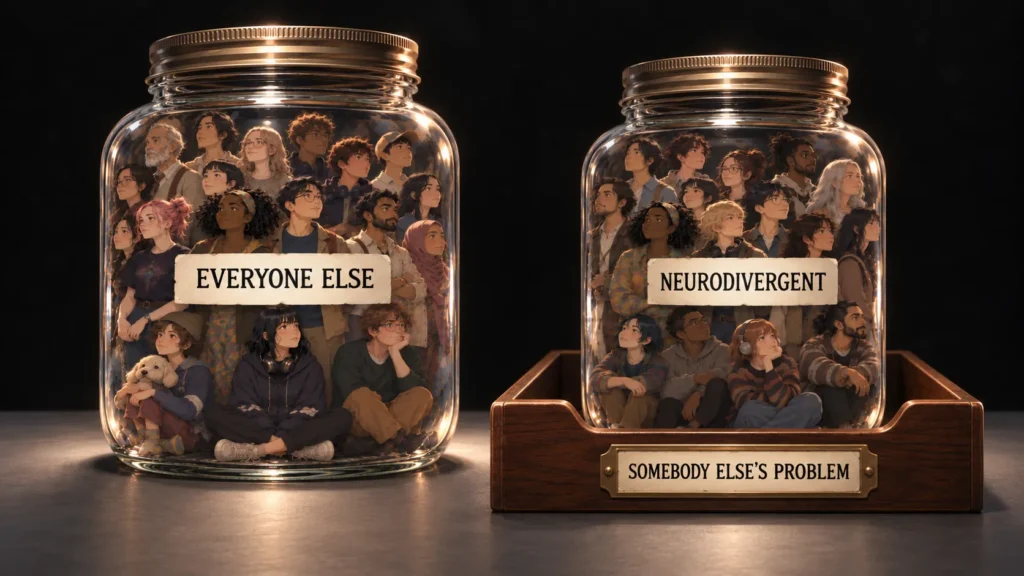
The second problem of the term neurodivergent is that the category removes one group from the concern entirely and fixes it squarely in the beings of the others. Regardless of what it originally intended, it claims that there are those who are normal and do not need special consideration who are distinct from those who do. At best maybe that invites pity. It makes the topic of neurodevelopment and its role in neurological wellbeing “someone else’s problem,” instead of a concern for everyone, which it most definitely is. If you use it to describe yourself, the default imposes that something is wrong with you. The concern is centered within you, not the environment, a process, or other important factor that may also relate to others (see the Opportunity and Social Conditions below). Fixing the situation inside you not only absolves them of “responsibility” but denies everyone else the possibility of seeing how they are affected by conditions when it would be most helpful. A good example is technology that relies on distraction, like social media. For those with certain conditions, it is a nightmare that makes sustaining wellbeing more difficult while offering a temptation hard to avoid. The truth is it is detrimental for everyone period. It is not a degree of detriment. It is just more noticeable for some more than others. But no one is immune.
The third problem of the term neurodivergence is also true of using any label as an identity: it is not up to the task and really doesn’t say much of anything that’s useful for describing an actual person. Inside the clinic, the specific diagnoses of ASC and the others start an investigation and treatment process, typically interventions are tried until the right combination is discovered that stabilizes the patient. The process hopefully continues through regular checkups and as new treatments and knowledge emerges. Outside of the clinic the terms are useful to help others understand your stabilization treatment process. They do not tell them who you are nor give a coherent reason as to why you may do certain things or have certain needs. They definitely don’t explain anything enough to excuse most behavior. When these terms are used as an identity they don’t even help answer the question, “then what?” Using any of them as an identity in this manner makes them a fixed thing to be navigated around. Instead of describing a dynamic process that you are working with, they are like a monolith that represents you. The very act of investigating and exploring necessary to building awareness is stopped as it is like questioning your youness.
Additionally, neurodivergence is a particularly unhelpful term for building shared understanding as it doesn’t mean anything concretely. It tends to be more of a performance of identity than a bridge to awareness (although, my particular experience of ADHC means that I rather enjoy performances). Divergence actually pushes others away, it says I’m different without describing in any way how. The term would be most helpful if it were able to describe the important and rich experience of neurodevelopment and neurological functioning that are realized in real time under real conditions for everyone. Neurodivergent also cannot be used to describe a person as a person does not exist in a state of divergence. They may have a condition that originated in their unique path of neurodevelopment, but that only describes part of how they are specifically neurodiverse, a quality shared by all humans. If the term is meant to build bridges of understanding, then again it is better to be more specific as well as use a kind of term in a way that doesn’t suggest an identity, something core to a person’s existence. It is more logical and helpful to say, “I have ASC,” or ADHC, rather than, “I am ADHC.” Even in the clinic this would be nonsensical. You can say, “I am autistic,” as the adjective form helps set up the next useful question which is “how?” The same applies to the adjective hyperactive. Either way, from there you start building bridges of understanding. The problem with the term neurodivergent (and the wrong use of neurodiverse), is not only that it immediately describes a category of person and is commonly used as a fixed label of identity, “I am neurodivergent,” which evokes the category and evaluation process it was trying to avoid.
Neurodivergence claims perpetual abnormal status for a person rather than describing how everyone is neurodevelopmentally diverse and in the end it describes nothing accurately or helpfully enough to serve as an identity, diagnosis, or even a social justice term.
We do not need more labels. We need to use a few in the right way in the right context. What is really needed is a shift in shared knowledge about neurodevelopment and neurological functioning for all. That is not achieved by a shortcut (label). The labels are getting in the way of that. What will work is an ongoing discussion, at times educational, always a conversation (a real exchange) to build practical and basic shared awareness that then can benefit everyone.
The Facts
Some of what people recognize when they encounter descriptions of ASC, ADHC, dyslexia, and related conditions occurs throughout the human population. Everyone becomes distracted. Everyone can become overloaded. Most people occasionally have difficulty beginning something they intend to do, organizing several demands at once, managing emotional intensity, or shifting their attention when circumstances change.
Under stress, these experiences can become considerably more pronounced.
That is one reason symptom lists are so seductive. A person reads one and thinks, “I do all of these things.” Probably. The clinical question is distinctly different.
Clinical diagnosis is concerned with the pattern: how intense an experience is, how persistently it occurs, how long it has been present, how broadly it affects functioning, and whether the effects are substantial enough to require treatment, accommodation, or other support. A familiar experience is not automatically a clinical condition merely because it appears on a list.
ASC and ADHC are highly heritable neurodevelopmental conditions. They do not suddenly develop in adulthood, even when their effects only become obvious or difficult enough to require diagnosis later in life. A change in environment, responsibilities, stress, or available support may expose patterns that were previously less visible or easier to manage. That is not adult onset. It is a neurodevelopmental condition becoming more consequential under different conditions.
Self-recognition can still be extremely useful. It can prompt investigation. It can give language to something that has been difficult to explain. It may even be what eventually leads someone to seek a professional assessment. It is not the assessment itself.
When a neurodevelopmental condition is seriously interfering with ordinary functioning or baseline wellbeing, the clinical response can operate as triage. Its immediate concern is to identify what is happening accurately enough to mobilize appropriate support and stabilize the person’s situation.
In that context, diagnosis matters enormously. But it also has important limits.
A diagnosis identifies a clinically meaningful pattern. It does not describe the whole person, their complete neurological development, or what that development may make possible across a lifetime.

The Responsibility
A neurodevelopmental condition that substantially affects your daily life creates a practical responsibility to understand and manage it as well as you reasonably can.
Responsibility must be considered outside of judgement or blame, just as a thing to do.
It does not mean you caused the condition or chose its effects. And it most definitely does not mean you can simply reason your way out of them. It does not mean performing “normality” (whatever that is) more successfully. This will never work. It means taking seriously the reality of the condition and its consequences.
If ADHC repeatedly interferes with beginning tasks, keeping track of commitments, directing attention, estimating time, or sustaining effort, knowing that you have ADHC is useful information. The work then is simply learning what those difficulties look like in your actual life and which conditions, strategies, tools, treatments, routines, environmental changes, and forms of support make your functioning more stable.
The same principle applies to ASC or another neurodevelopmental condition, although the actual work may be completely different.
Excuses are not helpful. Explanations are, and when necessary, apologies are. If an apology is in order, explaining why something unfortunate occurred matters less than explaining what you are going to do to help prevent it happening again. Otherwise excuses tend to become weapons, used offensively or defensively, that help no one and build no bridges of understanding.
Responsibility starts with the individual but must be shared by the community. The benefits and risks affect everyone.
A person cannot personally manufacture accessible healthcare, change a workplace policy they do not control, shorten a diagnostic waitlist, create family support that does not exist, or simply decide to have more financial resources. Some people are genuinely blocked from assessment and care by cost, geography, institutional failure, prejudice, or circumstance.
Responsibility correlates to actual agency.
The individual has responsibility for the parts of the situation they can meaningfully tend. Families, workplaces, clinicians, communities, and social institutions have responsibility for the conditions and resources that belong to them.
That exchange matters because none of us functions independently of the environments and people around us.
Important Aside
I love the fact that my brain works the way it does, most times.
When it seems it isn’t working, it’s hell.
The fragility of emotional stability is particularity frustrating. It seems that I live with a baseline of anxiety that sometimes is background noise and sometimes threatens to drown me.
Although I’ve developed how to set up environments and lifestyles that leverage my particular brain infrastructures for my wellbeing, it’s not easy. I exhaust myself. Shame seems to be more if a constant than anything else. But it doesn’t have to be this way.
That’s why I wrote this article.
The term neurodivergence signals a grave opportunity, both terrible and fantastic in it’s potential. If we build social structures around a respect for neurodivergence (just respect in general would be a great start), we can recruit it to our benefit. It can support communities of mindfully wellbeing, treating the brain as a garden to tend, not a machine to fix.
The Opportunity
Stabilization is a lifelong process and also the grounding of even more opportunities for development.
Once a condition is understood well enough that someone can begin building a sustainable baseline of wellbeing, another question becomes possible: what capacities may be developed from this particular configuration?
That question needs to be explored with great care.
A neurodevelopmental condition is not secretly a superpower. Severe impairment does not become an advantage because we give it more flattering language. Some people require extensive support throughout their lives, and some effects of a condition may remain difficult regardless of how thoughtfully they are managed.
But a trait that creates substantial difficulty under one set of conditions can operate very differently under another. A person may learn to understand it, support it, refine it, and eventually recruit some aspect of it deliberately.
For a deliberately non-scientific example, consider almost any X-Men film.
The mutation that eventually becomes spectacularly useful normally begins by destroying a kitchen, terrifying a school, or otherwise causing the kind of problem nobody would initially describe as a gift. The character needs support, practice, a community that understands what is happening, usually some specialized technology and, apparently, an excellent outfit.
The analogy only goes so far.
The useful takeaway is the supported and structured development, as well as its use. A capacity does not become reliable merely because it exists. Something initially experienced primarily through its costs may become more usable through sustained understanding and practice.
That possibility varies enormously among people and conditions. It should be explored and investigated rather than promised.
The Collective Opportunity
There is another opportunity here, and it is larger.
People living with certain neurodevelopmental conditions often have to make explicit work that other people can leave largely implicit.
Attention may need deliberate structure. Working memory may need to be extended into lists, visible cues, calendars, staging areas, reminders, or physical objects. Tasks may need to be broken into visible sequences. Recovery may have to be scheduled rather than left to chance. Environments may need to be changed so that unnecessary sensory, cognitive, or emotional demands are reduced. Supportive relationships may become part of the practical system rather than something separate from it.
I sometimes refer to this as externalizing the brain.
Nothing about a checklist implies that the person using it is defective. Pilots use them. Surgical teams use them. Kitchens run on mise en place. Humans routinely move cognitive work into environments, tools, procedures, and other people because complex functioning has always been distributed that way.
For someone whose functioning makes the dependency more obvious, these strategies may be necessary for stable daily life.
That necessity makes something visible.
This is why the neurodevelopmental conditions examined in the Neurodiversity Protocol provide such a useful test environment for understanding human functioning more generally. When compensation is substantial, dependencies between attention, cognition, emotion, effort, environment, and community become harder to overlook. Strategies that genuinely improve functioning under that degree of variability may reveal principles useful far beyond the diagnosed population.
The work is more obvious there. It is not exclusive to there.
This is one of the genuinely important opportunities within neurodiversity. Human neurological variation gives us many different configurations through which to observe how human beings function, develop, compensate, specialize, and contribute.
The value is not in sorting those people into a second type of human being.
It is in learning from the variation.

The Opportunities for Society
A neurodevelopmental condition belongs to the person, but its functional effects occur under actual conditions. Those conditions are really the key, even more than the name of any one person’s or even a group of people’s neurodevelopmental conditions. They provide clues to what everyone can find helpful for mental wellbeing.
A person who has difficulty sustaining attention across diffuse, low-relevance demands may function very differently in an environment with clear structure, immediate relevance, meaningful feedback, and visible progress. Someone highly sensitive to sensory input may experience substantially different functional costs in a chaotic environment than in one where noise, ambiguity, and interruption are reduced.
Obviously, environment is an important factor, among many, for helpful neurological functioning. This example demonstrates for anyone how neurological functioning (including our thinking and feeling that spark our behavior) happens through interaction between the person and the conditions in which they are functioning.
Modern life is unusually good at producing difficult conditions. Many people now work inside communication systems built around interruption, compete for attention inside environments deliberately engineered to capture it, navigate inconsistent social expectations, and are asked to maintain levels of individual self-management that communities once distributed among many people.
Those conditions can make existing difficulties much more costly. They can also create similar temporary difficulties in people who do not have the underlying neurodevelopmental condition.
This is a very important distinction. It is the same as reading a list of symptoms. Everyone being distracted does not mean everyone has ADHC. It may mean we have constructed environments in which sustained attention has become harder for almost everyone.
The individual still has work to do as does the society. This is the work that making categories of people obscures.
A coherent response cannot simply demand that every person become better at tolerating whatever conditions happen to be imposed on them. Neither can it assume that changing the environment removes every difficulty experienced by the individual.
Every person should develop awareness of their unique neurological functioning, their processing, in a way that is relevant to them. Then they can establish and adjust routines and tools that are helpful for their overall wellbeing. The same happens collectively, as regardless of diagnosis, neurological functioning is a part of everyone’s life and while each person is different there are important truths relevant to all.
The Bottom Line
Neurodivergence is not the term we need.
But it does point to the thing that needs explaining, neurodiversity and how everyone needs to understand their own.
If you use the word because it helps you recognize that your experience of attention, learning, sensory input, emotion, communication, motivation, or some other part of functioning differs substantially from what people around you seem to expect, keep the core idea. Then get more specific. Find language that helpfully builds your own awareness, supports your development, and is also useful to those around you.
You may be dealing with a neurodevelopmental condition that deserves clinical evaluation. You may already have a diagnosis and need better strategies for living with it. You may discover that an environment is repeatedly making a real difficulty more costly than it needs to be. You may find capacities worth deliberately developing. Most likely, several of these things will be true at once.
The responsibility is to understand what is actually happening and, within the agency and resources available to you, participate in building the conditions for a stable life.
The responsibility is shared by the people and communities whose actions affect those conditions.
The opportunity begins there too.
Human neurodiversity is vastly more interesting than a division between people who are neurodivergent and people who supposedly are not. Particular neurodevelopmental conditions can create serious impairment. They can require clinical treatment, accommodations, sustained management, and substantial support. They can also reveal capacities, strategies, and ways of functioning that would otherwise remain less visible.
The point is not to turn pathology into identity or impairment into mythology.
It is to understand a human being accurately enough to support their wellbeing and discover what development may still make possible.
That is a much more serious responsibility.
It is also a much more interesting opportunity.
The Caveats
Access to Assessment and Support
None of this assumes equal access to diagnosis, treatment, accommodation, or support.
In countries where healthcare is expensive, unevenly distributed, or difficult to reach, professional assessment may involve substantial cost and long waiting periods. Geography, language, family circumstances, employment, and other conditions can also limit what someone can realistically do.
That matters when discussing responsibility.
A person cannot be responsible for using resources they do not have. They can only work with the agency, information, support, and conditions actually available to them.
Self-recognition may sometimes be the beginning of that process rather than a substitute for it.
Pharmacology & Strategies
Medication can be an important part of managing some neurodevelopmental conditions and particular symptoms associated with them. It is one tool among several and should be considered with an appropriately qualified clinician who can evaluate benefits, limitations, side effects, and the individual circumstances involved.
Medication does not replace the longer work of understanding how someone functions.
Routines, environmental changes, sleep, movement, nutrition, tools, relationships, work structures, and other strategies may all participate in creating a sustainable baseline, depending on the person and the condition.
There is no magic pill. There is also no magic routine.
The work is observation over time: learning what actually helps, what does not, what changes under different conditions, and what continues to require support.
Severity and Support
The experiences grouped under diagnosed neurodevelopmental conditions vary enormously in severity.
For some people, a diagnosed condition may be manageable with relatively modest changes and strategies. For others, impairment may be substantial, persistent, and combined with other conditions. Some people require extensive assistance simply to participate in ordinary daily life.
Nothing in the argument about development turns severe impairment into opportunity by rhetorical force.
Those individuals deserve serious care, resources, dignity, and support.
The possibility of development begins from an accurate account of the person who actually exists, including their constraints.
Anything else is just another way of refusing to see them.
ARTESIAN is dedicated to human development and wellbeing. Specifically for those navigating a diagnosis within the neurodivergent umbrella we have developed various tools and processes. You can check them out here: The Neurodiversity Protocol.