
In 1943, Abraham Maslow proposed that human needs exist in a hierarchy, a model later famously codified into a pyramid. This visual suggested a rigid, stacked system: if basic needs for food and shelter were unmet, higher cognitive functions were not possible. He placed self-actualization at the peak, treating meaning and purpose as a kind of cognitive luxury only accessible once all lower tiers were fulfilled.
It’s a compelling framework, but its rigid, stacked architecture fundamentally misrepresents the interdependent, co-regulatory nature of the human brain. Modern neuroscience shows us that needs like affirmation, connection, and mastery aren’t indulgences; they are requirements for a well-functioning brain and nervous system, baseline homeostasis, actively sought out even in the absence of safety.
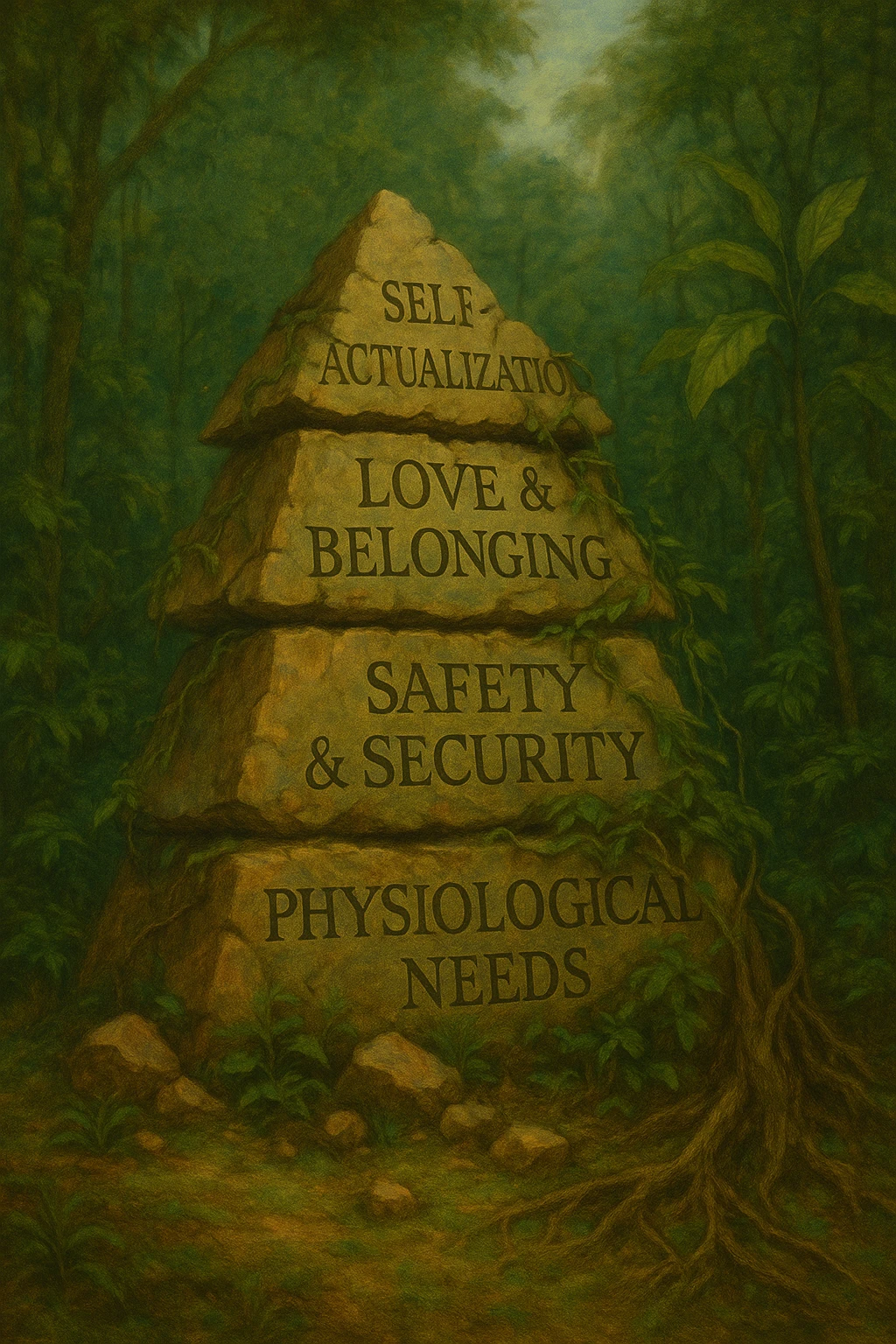
The true problem with the pyramid is the seemingly subtle but devastating narrative it creates: if you’re struggling to meet basic physiological needs, higher functions (belonging, learning, purpose) must be postponed or dismissed as luxuries. To internalize that view is to inhibit your own development as well as your ability to achieve the basic needs to begin with.
A Note on Intent: This essay is not a critique of Maslow himself, who framed his model as an observation of typical motivational prepotency, not a fixed prescription. Rather, this is a critique of any framework that reductively interprets human existence through a lens of scarcity (capitalist or otherwise), which is precisely how the prescriptive pyramid has been used. Capitalism is a constructed economic framework with narrow aims, not a human or biological reality, and such frameworks can only manage the vastness of human experience by compressing it into abstractions that strip away its substance. It is the equivalent of expecting a rainforest to behave like a filing cabinet.
The Neural Ecological Model: Tending the Systems for Sustainable Wellbeing
Rather than stacking needs by social convention or survival logic, a model grounded in human neurobiology should reflect what the brain and nervous system require, daily and cyclically, to modulate, grow, and function. This shift treats the brain not as a machine with linear outputs, but as a dynamic ecosystem to be tended as we would a garden, coral reef, or forest. This is the grounding for our new understanding.
This updated framework organizes our essential needs not by rigid hierarchy but by frequency of use, systemic impact, and cognitive cost. It identifies four neurological infrastructures that operate collaboratively in dynamic interdependence. This reorganization liberates possibility by achieving a profound conceptual shift: it reframes human existence from a deficit to be solved to an opportunity.
The core of my thesis is this:when we prioritize the brain’s essential systems, treating the brain as an ecosystem to be tended such as a tree, we don’t simply survive, we thrive. The work of integration, of tending your own “internal tree,” is not a struggle against itself (Descartes), a hard-won capitalist race (with few winners), or a to , exhausting chore requiring radical sacrifice and intensive discipline. Built on dynamic systems theory, this work is meant to be as practical, natural, and obvious as knowing when to water a plant or seek the sun.
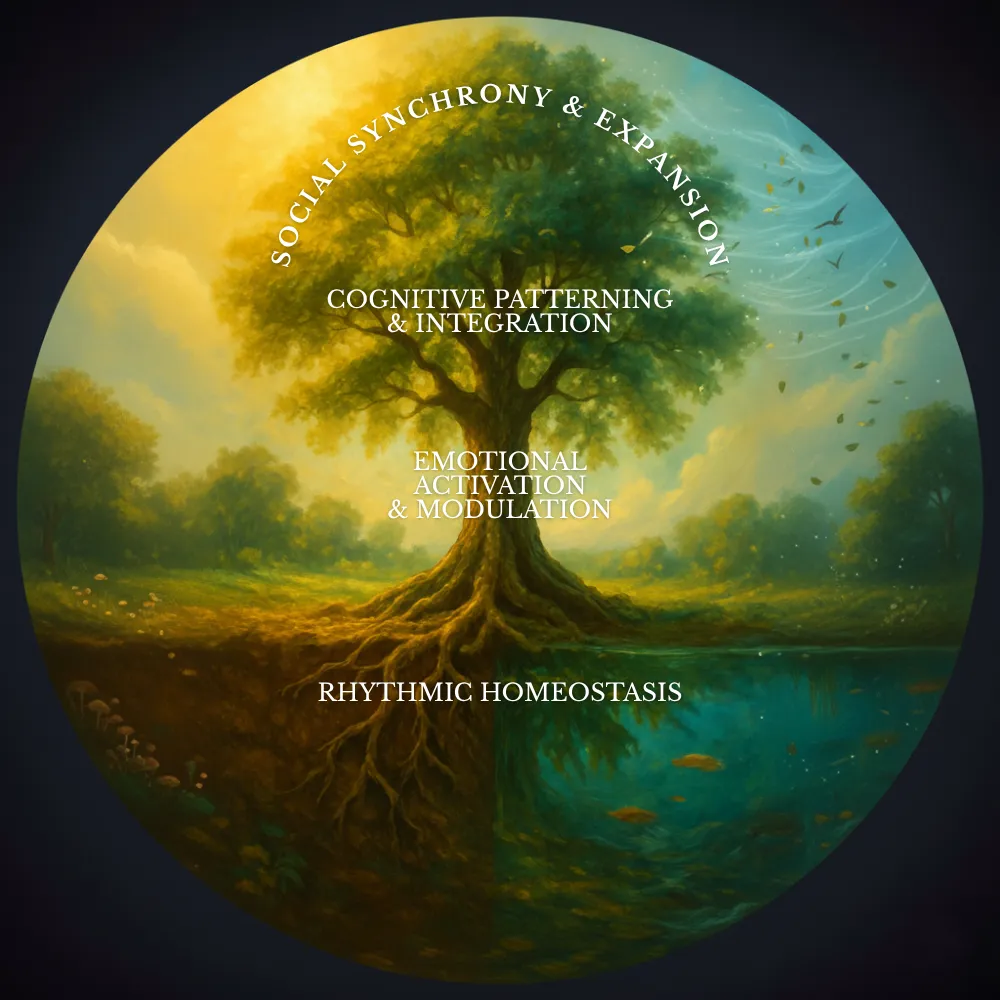
The Four Neuroecological Systems
Rhythmic Homeostasis Infrastructure
- Core Components: Sleep, Nutrition, Movement & Breath regulation, Light/Dark exposure (circadian entrainment).
- Impact: Without these, the brain’s essential wellbeing and capacity for all other functions collapses.
Emotional Activation & Regulation Infrastructure
- Core Components: Touch and safety, Novelty and stimulation, Sexual expression, Emotional expression.
- Impact: These needs maintain neurochemical flexibility. Without them, chronic stress, anxiety, or hypoarousal can dominate.
Cognitive Patterning & Integration Infrastructure
- Core Components: Deep Focus & Flow, Meaning-making & narrative coherence (default mode network), Self-reflection and internal modeling.
- Impact: This is where purpose fits, not as an aspirational extra, but as a daily integrator of experience and action.
Social Synchrony & Expansion Infrastructure
- Core Components: Belonging & recognition, Creativity and symbolic abstraction, Altruism and transcendence.
- Impact: These support a brain’s need to extend, to relate beyond the self and to tap into emergent or collective intelligence.
Conclusion: Your Purpose & Individuality is Core to the System, Not a Final Reward
The prescriptive interpretation of the pyramid has an insidious corollary: Those who believe they’ve earned the luxury of self-actualization often pursue it without the systemic grounding necessary for true integration. Their efforts become hollow, performative, or even self-destructive.
Interestingly, Maslow’s model has been interpreted as both a critique and a byproduct of capitalism, where needs are commodified, and scarcity becomes its own form of reward. A dystopian, yet revealing frame.
Rather than being the final step, actualization, or purpose, can be redefined as an organizing mechanism: a way to align attention, effort, and emotional meaning. Purpose is not a final reward but a vital system, rising through every branch of life, essential to survival and quality of life.