
Category: Neural Coherence Ecology
Neural Coherence Ecology treats a person as a living ecosystem rather than a set of parts to repair. It describes four interdependent Infrastructures, Rhythm, Activation, Patterning, and Synchrony. Like most ecosystems, its coherence is stabilized when treated with responsible respect, which involves the ongoing alignment of the four infrastructures under real conditions. It is the work of stewardship rather than a state you arrive at, and it sustains your wellbeing: a practical baseline of stable operation across the whole person. Because a human being matures and functions only among other people, society is an external ecosystem that is interdependent with each person’s internal one. These essays set out the thinking the rest of the work rests on.
-

Abdicating Our Advantage
Cultivating Our Cognitive Advantage Part III
For the first time, global-scale coordination is technically and materially feasible. The major barrier is not raw capacity but the abdication of our cognitive capacity to solve problems well. The philosophy defending extraction sounds eloquent and well-reasoned. It is the flailing of a mind driven by stress and the fears it produces — of the other, of scarcity, of submission.
-

What We Talk About When We Talk About Intelligence
The Context Problem at the Heart of LLMs
The problem with AI isn’t technical. It’s that we handed the wrong thing the wrong job and called it intelligence. Intelligence is far more than what those claiming they’ve invented the artificial version actually is. LLMs, for all their sophistication, are still in a pre-neuroscience era of their own development. Context isn’t a feature. It’s the whole game.
-

Interdependence: The Biological Imperative of Society
Cultivating Our Cognitive Advantage Part II
Humans evolved a costly advantage: higher-level cognition. But it does not develop, or function well, in isolation. Society is the developmental habitat of the human mind: a coordination ecology of shared norms, cumulative teaching, and institutions that store knowledge beyond any one person. The practical implication is stewardship—of selves, communities, and the scaffolds that make a coherent life possible.
-

Coherence: Humankind’s Advantage and Developmental Imperative
Cultivating Our Cognitive Advantage: Part I
Humans are not unique in intelligence or cooperation, what is distinctive is how these evolved in our biology: language, metacognition, and the capacity to model reality, revise beliefs, and coordinate at scale. Our challenge is integrating our impulses. Coherence is the trainable coordination of many signals across time, shaped through executive function and social scaffolding into stable, adaptive capability.
-

The Ecology of the Brain
Cultivating Mental Health & Revealing Human Potential
Tending your unique mind as a living ecosystem is the primary act of well-being, the one discipline from which human potential and a truly thriving society emerge.
-
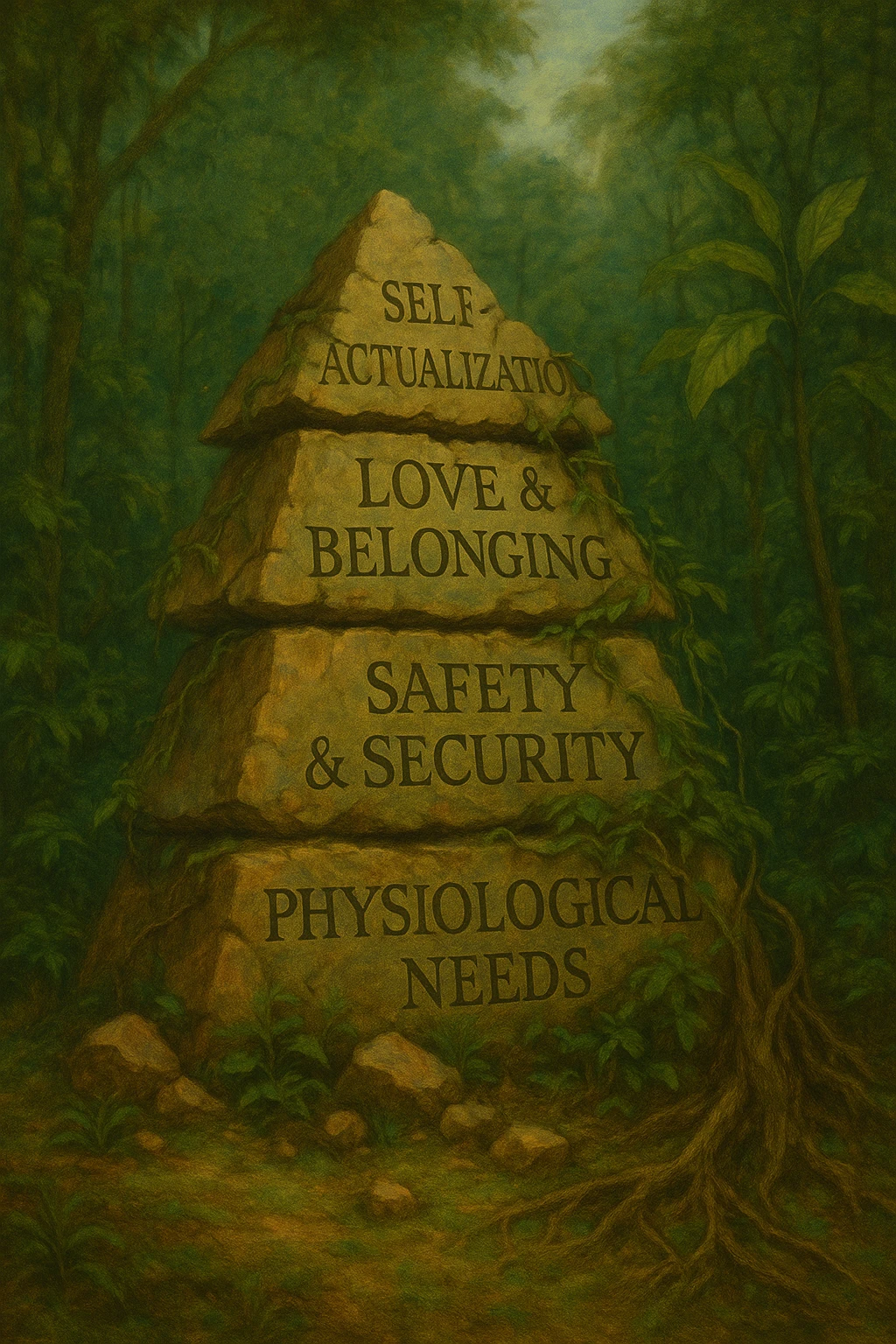
Rethinking Maslow
Breaking with a hierarchy of scarcity to cultivate neuroecological abundance.
Maslow’s famous pyramid positions personal meaning as the last stage of a hierarchy of priorities. Neuroscience shows something very different. The brain is a living ecosystem where purpose, connection, and creativity are daily requirements, not luxuries. When we stop climbing a hierarchy of scarcity and start tending our internal ecology, wellbeing becomes generative rather than conditional.